FROG-TRAP
A purse-string frog net that wandered into the game-call archives
Pole-mounted netted trap for catching frogs
➶ How it works
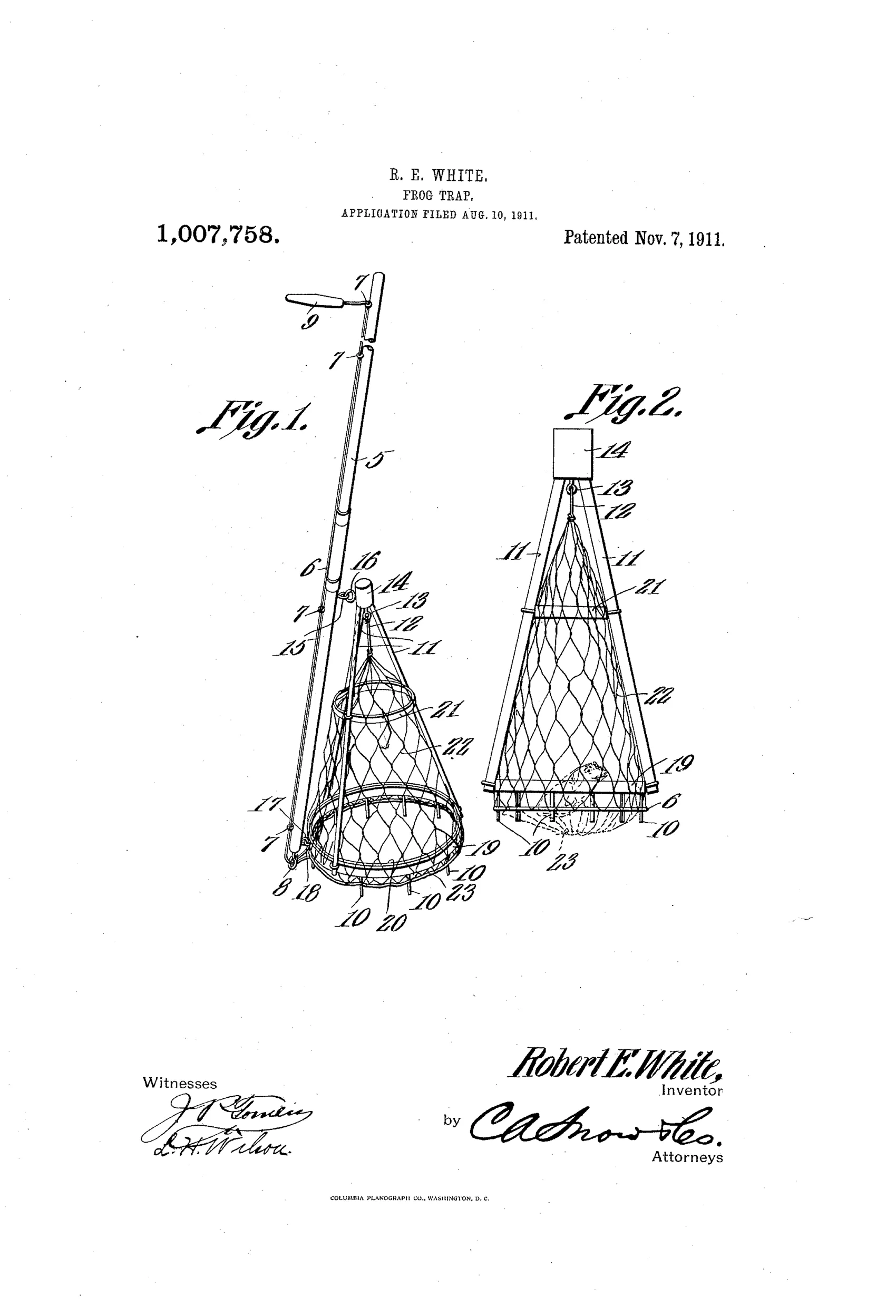
A conical meshed bag is mounted on a frame of braces, rings, and flexible fingers attached to the lower end of a jointed pole. The mouth of the bag is normally held open over the outer faces of the flexible fingers, which project from a ring at the base of the frame. A cord threaded through eyelets along the pole is woven as a noose around the mouth of the bag; pulling the cord slips the noose off the fingers, pursing and closing the bag's open end to trap the animal inside.
➶ What was claimed
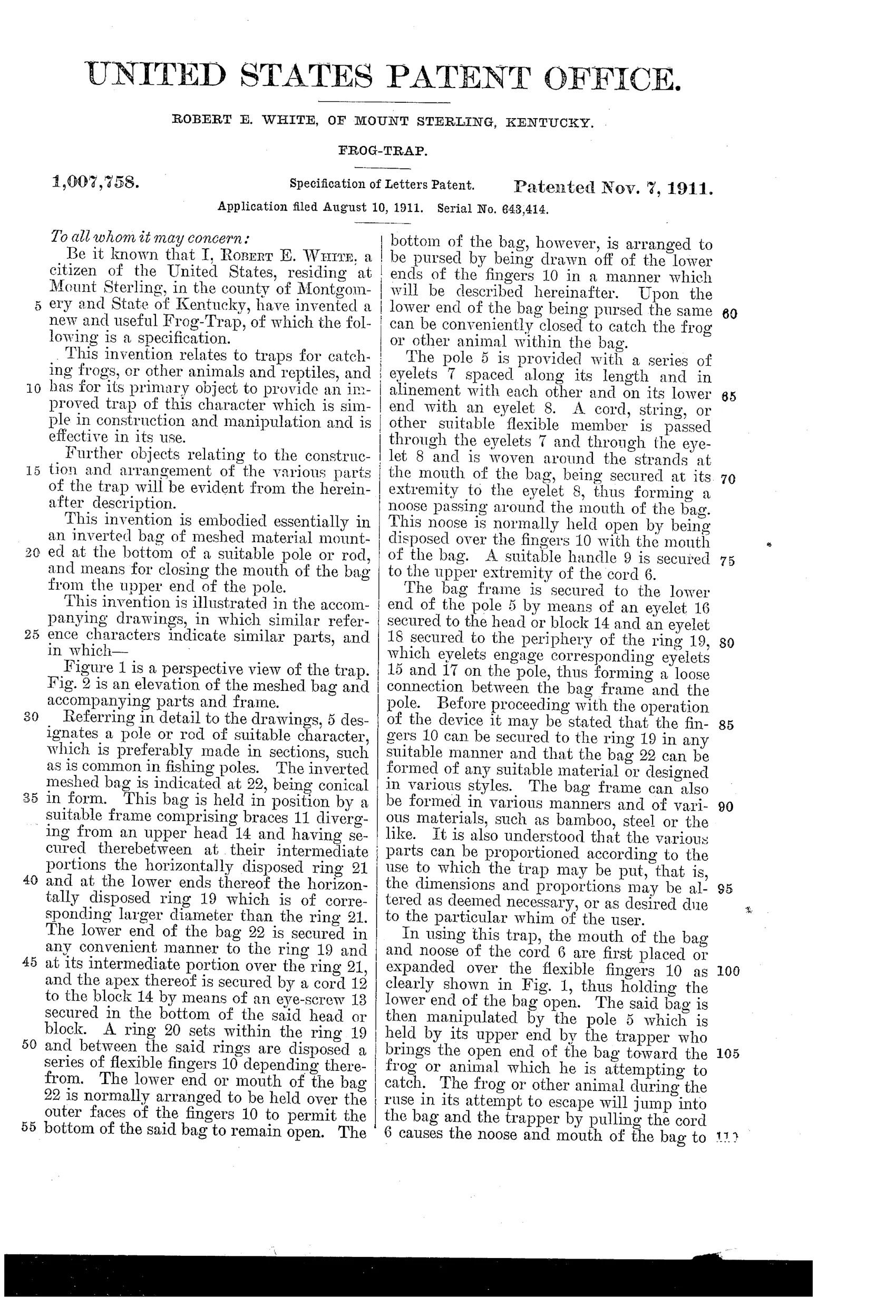
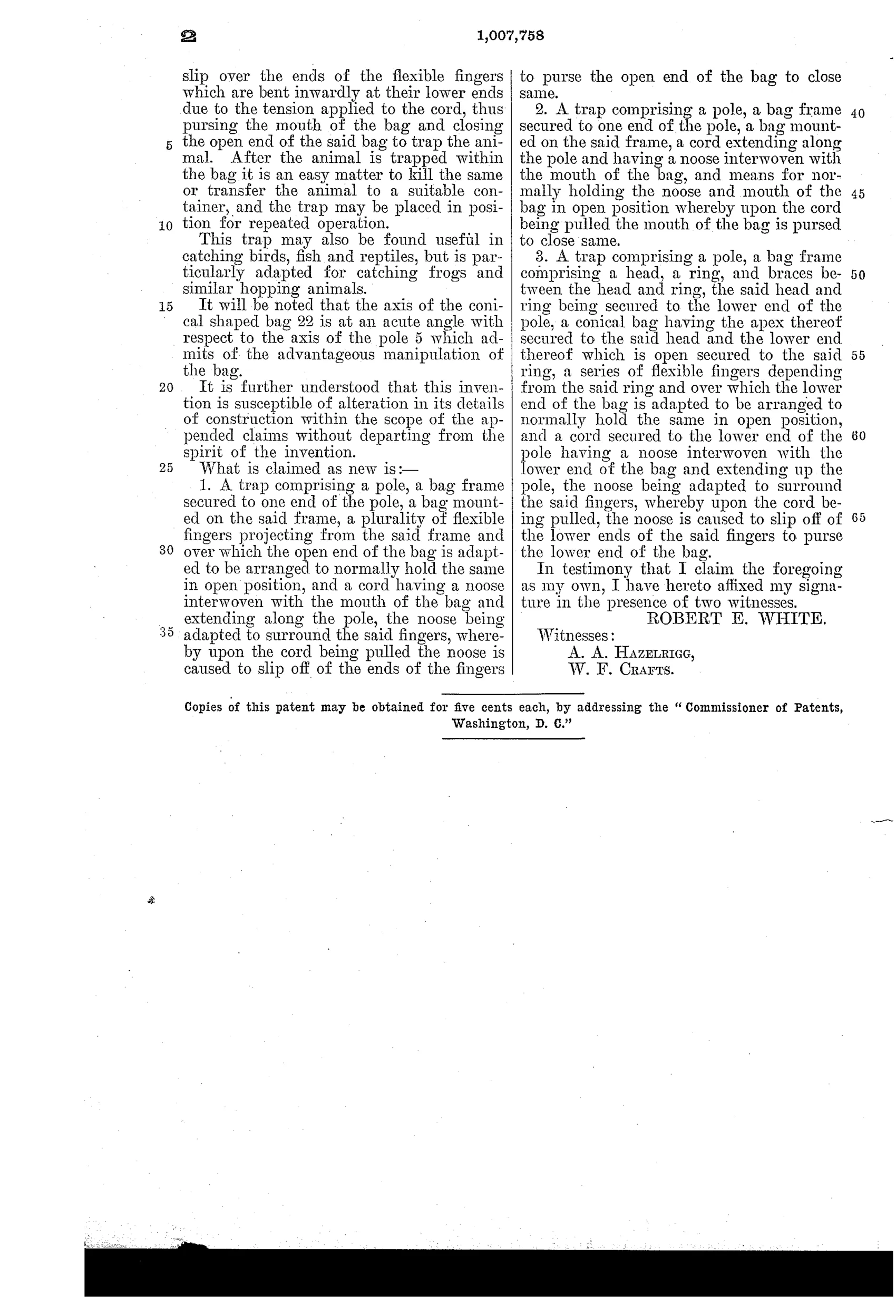
“A trap comprising a pole, a bag frame secured to one end of the pole, a bag mounted on the said frame, a plurality of flexible fingers projecting from the said frame and over which the open end of the bag is adapted to be arranged to normally hold the same in open position, and a cord having a noose interwoven with the mouth of the bag and extending along the pole, the noose being adapted to surround the said fingers, whereby upon the cord being pulled the noose is caused to slip off of the ends of the flexible fingers... thus pursing the mouth of the bag and closing the open end of the said bag to trap the animal.”
In plain English: The trap has a mesh bag held open on flexible fingers at the end of a pole, and pulling a cord slips a noose off the fingers to close the bag around the caught animal.
➶ In the inventor’s words
“The frog or other animal during the ruse in its attempt to escape will jump into the bag and the trapper by pulling the cord 6 causes the noose and mouth of the bag to slip over the ends of the flexible fingers which are bent inwardly at their lower ends due to the tension applied to the cord, thus pursing the mouth of the bag and closing the open end of the said bag to trap the animal.”— Robert E. White, from the specification
Paper patent — likely never produced
No manufactured example or maker is documented, and the simpler gig-and-lantern method made commercial production unlikely; a marked specimen would overturn this.
➶ Commentary
Let's be honest up front: this is not a call. Robert E. White of Mount Sterling, Kentucky, patented a frog trap — a piece of harvest gear that gets swept in alongside calls because the Patent Office filed hunting devices broadly. There is no reed, no tone board, no sound at all. What there is, though, is a tidy little mechanism worth thirty seconds of your time.
The drawing shows a conical mesh bag hung inside a triangular frame at the end of a long jointed pole. The clever bit is at the bag's mouth: flexible fingers project from the base ring, and the open hem of the bag is stretched over their outer faces, held taut like a drum. A cord runs up the pole through eyelets, woven as a noose around that mouth. When a frog jumps in, you yank the cord, the noose slips off the finger tips, the fingers bend inward, and the bag purses shut like a drawstring purse. It is essentially a remote-triggered purse seine in miniature.
Would it work? Probably, on a cooperative frog. The weak point is the 'ruse' the specification breezes past — you still have to maneuver a pole-mounted net over a wary animal before anything mechanical matters. As froggers have known forever, a gig or a bare hand at night with a lantern is faster. This is a workmanlike solution to a problem most people solved more simply.
Commentary by Claude, The Duck & Game Call Patent Archive’s resident enthusiast