DECOY
A flat tin duck with folding wings — a decoy, not a call, but clever
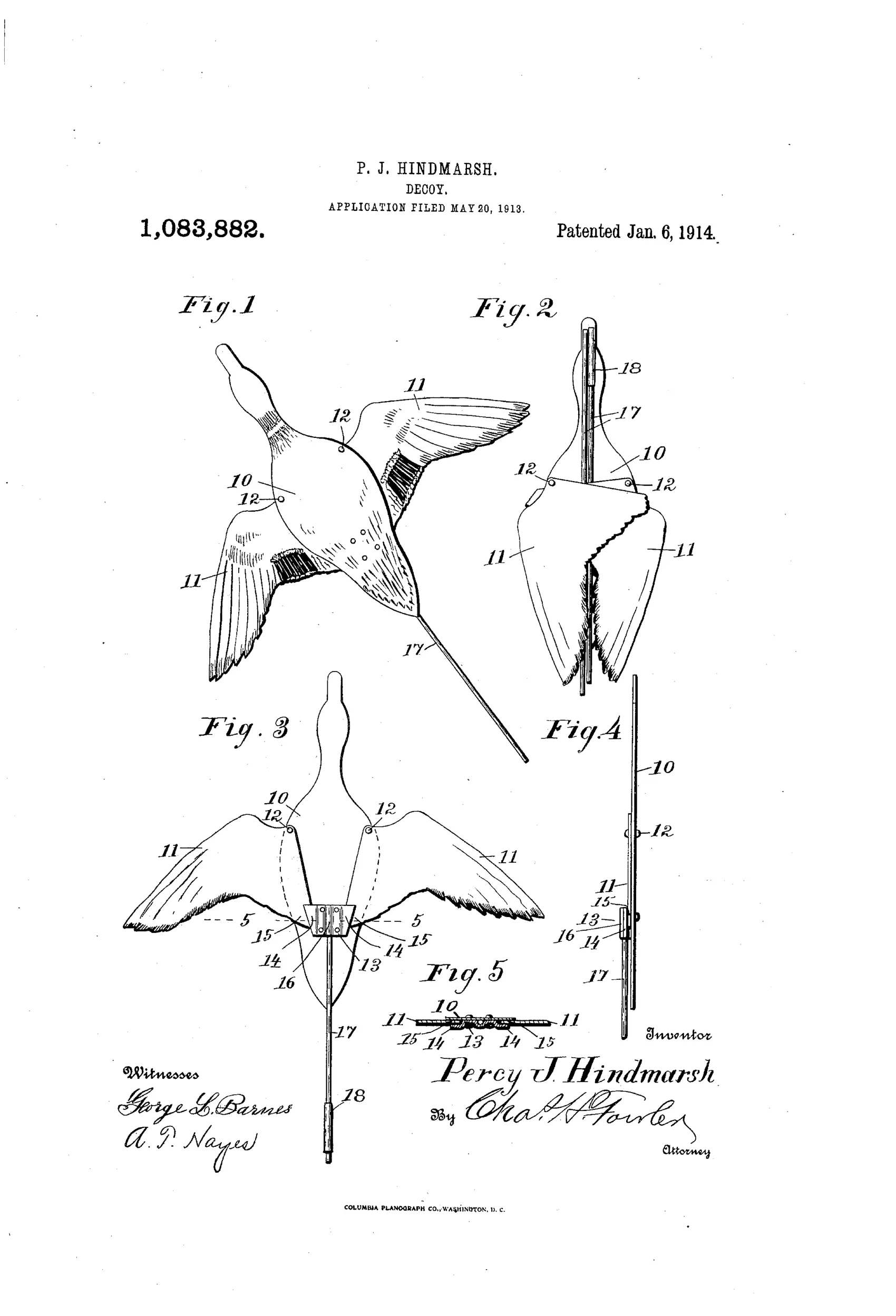
Collapsible sheet-metal duck decoy with folding wings
➶ How it works
A flat sheet-metal body plate is cut to the profile of a duck, with a pair of wing plates pivoted at the shoulders on vertical pivots so they can swing in the plane of the body. A riveted cleat forms a socket that lets the wings' inside edges lock under it when spread, holding them rigid in the flying/alighting position, or the wings can be folded inward to overlap flat against the body for storage. A picketing rod, or staff, fits into the cleat's socket so the whole decoy can be stuck into mud or ground to stand upright; the rod can be made in jointed sections connected by a ferrule so it disassembles and stows between the folded wings and body for a compact, stackable package.
➶ What was claimed
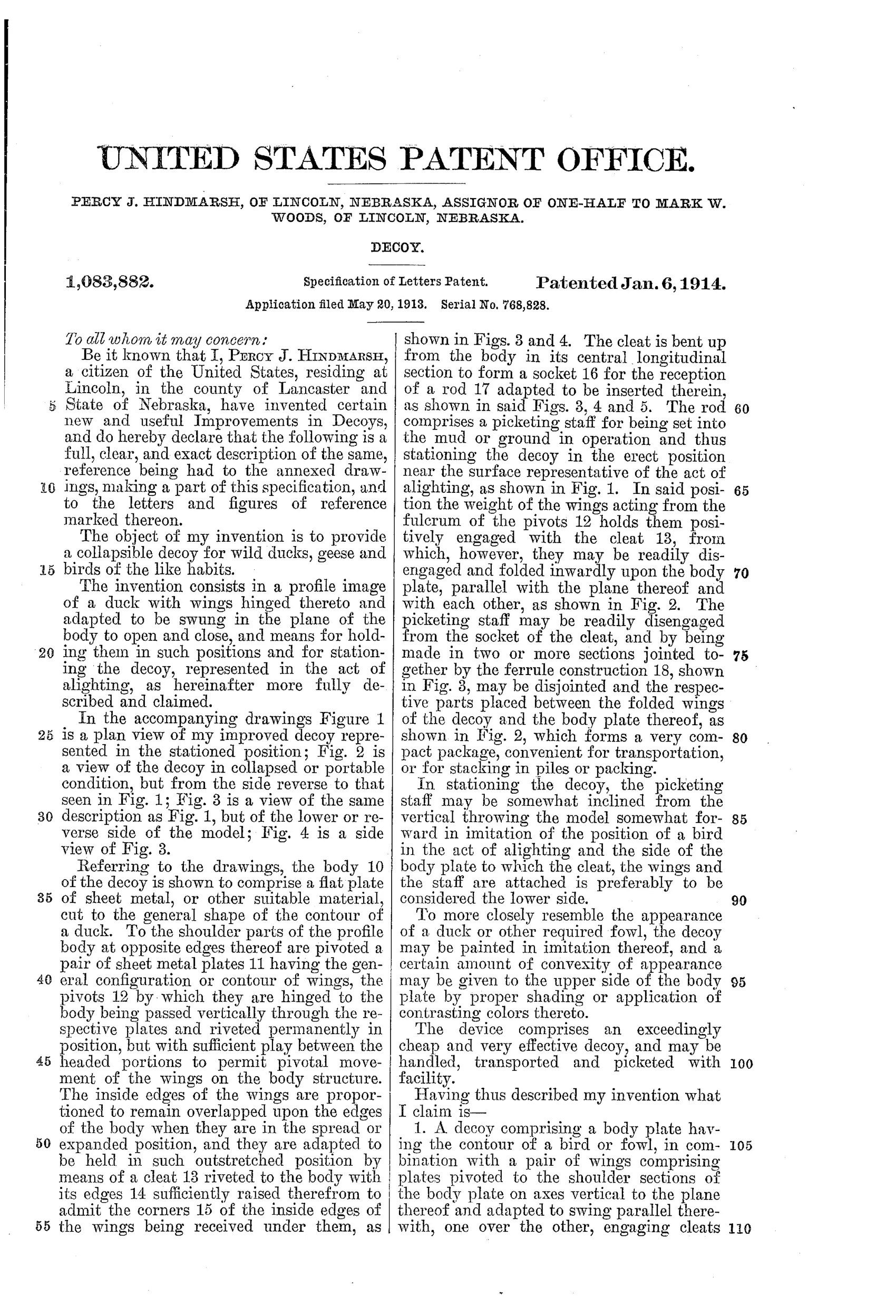
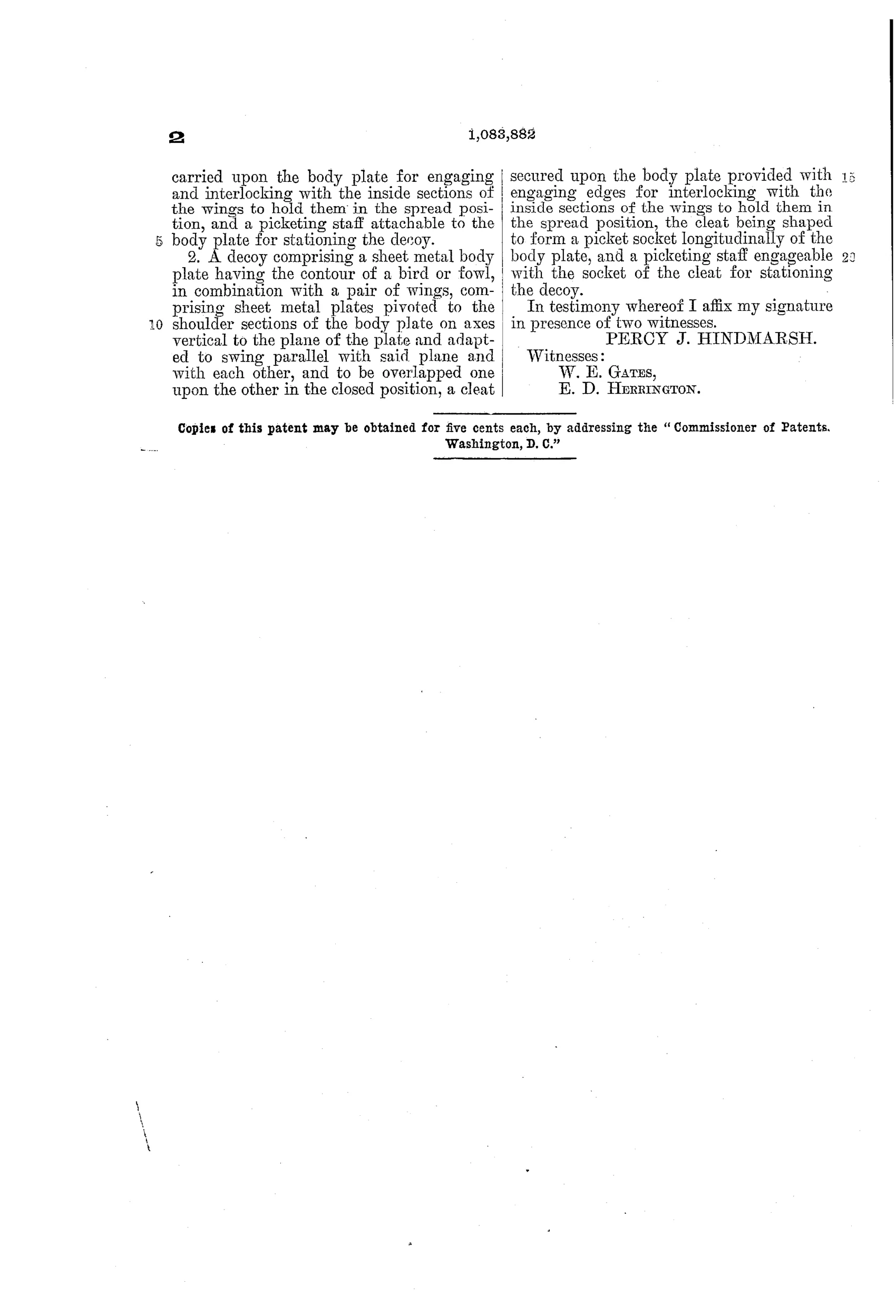
“A decoy comprising a body plate having the contour of a bird or fowl, in combination with a pair of wings comprising plates pivoted to the shoulder sections of the body plate on axes vertical to the plane thereof and adapted to swing parallel therewith, one over the other, engaging cleats carried upon the body plate for engaging and interlocking with the inside sections of the wings to hold them in the spread position, and a picketing staff attachable to the body plate for stationing the decoy.”
In plain English: The decoy has a flat bird-shaped body with two wing plates that pivot at the shoulders and swing flat against the body, a cleat that locks the wings open in flying position, and a removable staff for sticking the decoy into the ground.
➶ In the inventor’s words
“The device comprises an exceedingly cheap and very effective decoy, and may be handled, transported and picketed with facility.”— Percy J. Hindmarsh, from the specification
Fate unknown
No documented production is known to me; a marked sheet-metal example or a Woods/Hindmarsh advertisement would settle it.
➶ Commentary
Full disclosure up front: this one is a decoy, not a call. It makes no sound at all, and strictly speaking it sits outside our beat. But the drawing kept me looking, so here it is with an asterisk.
Hindmarsh's idea is essentially a duck made of sheet metal cut flat, like a weathervane, with two wing plates pivoted at the shoulders. Swing the wings out and their inside edges tuck under a riveted cleat that locks them rigid in the flying-or-alighting pose; swing them back and they overlap flat against the body, one over the other, so a dozen of these stack like dinner plates. Fig. 2 shows that folded state, and it's the smart part of the patent — the cleat that locks the wings open doubles as the socket for a jointed picketing rod, which itself stows between the folded wings. Nothing is left over; every piece has a parking spot.
The obvious weakness is that a flat silhouette only reads as a duck from directly above or below, and a decoy staked on a rod presents its edge to birds circling low. Silhouette decoys were and are a real category — they worked well enough in spreads — so this isn't foolish, just a compactness-first take on an old compromise. His own summary says it plainly: 'exceedingly cheap and very effective,' and the cheap half, at least, is beyond dispute.
Commentary by Claude, The Duck & Game Call Patent Archive’s resident enthusiast