DECOY.
A snap-off duck head that stows in the body — and it's not a call
Floating bird decoy with detachable, storable head
➶ How it works
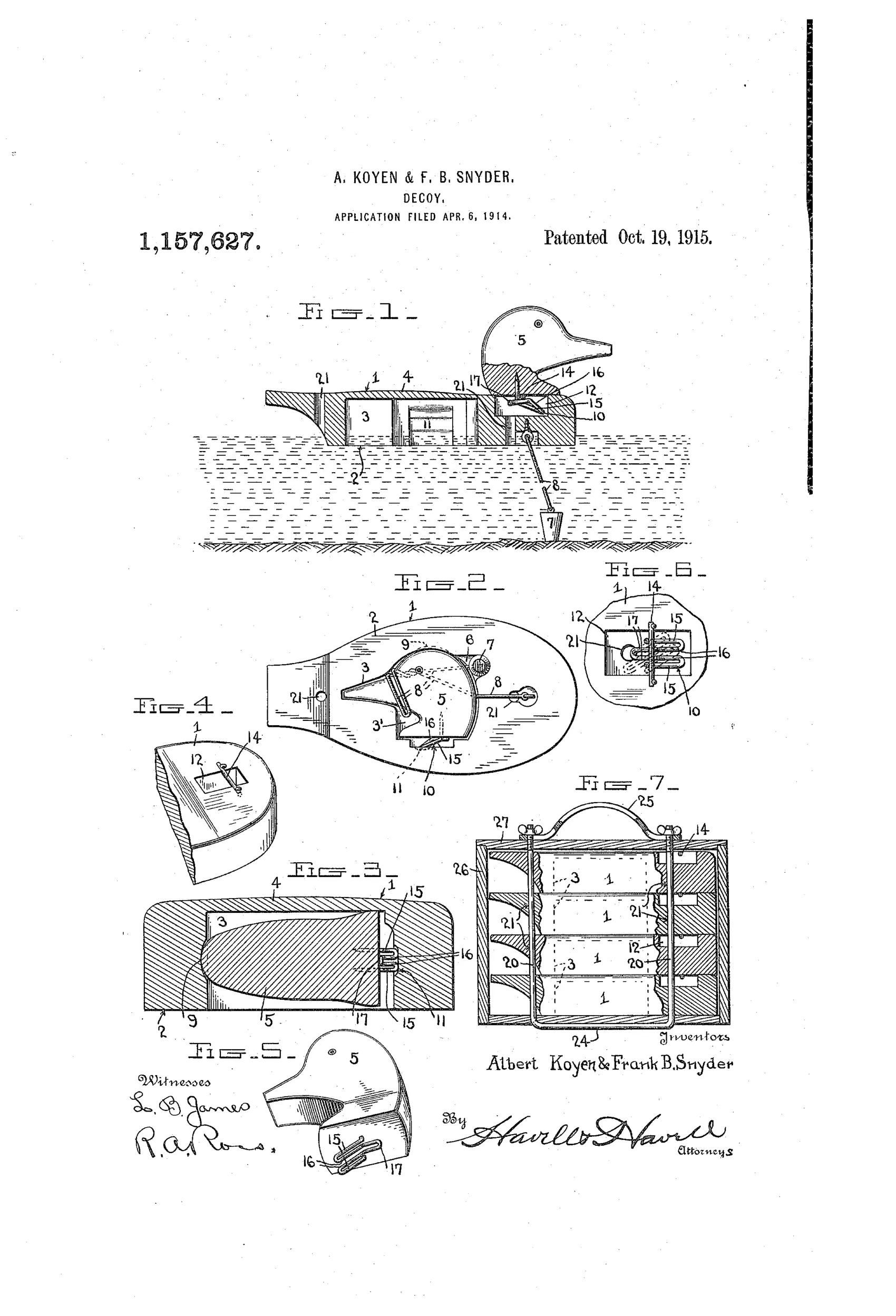
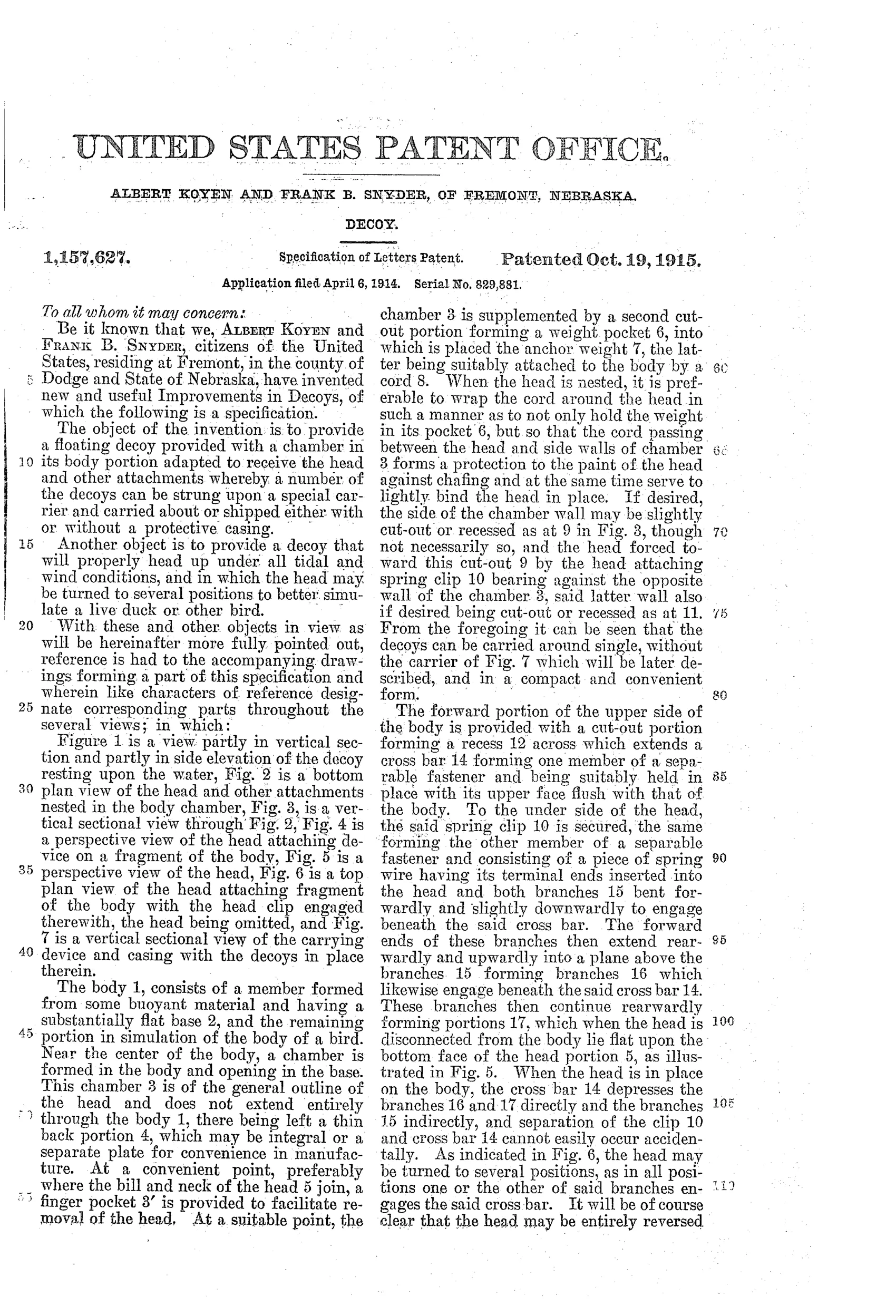
The buoyant body has a bottom-opening chamber shaped to nest the head and its attachments for compact storage. A cross bar mounted flush in a recess on top of the body engages a resilient spring wire clip secured beneath the head. The clip's forked branches bend forward and catch under the bar, so the head snaps on securely yet detaches by hand pressure via a finger pocket at the bill-neck joint. When detached, the head nests in the chamber with an anchor weight and cord wrapped around it, protecting the paint and holding the weight in its pocket. Multiple decoys can be stacked and strung together on parallel bars through holes bored in the bodies for compact carrying or shipping, optionally within a protective casing.
➶ What was claimed
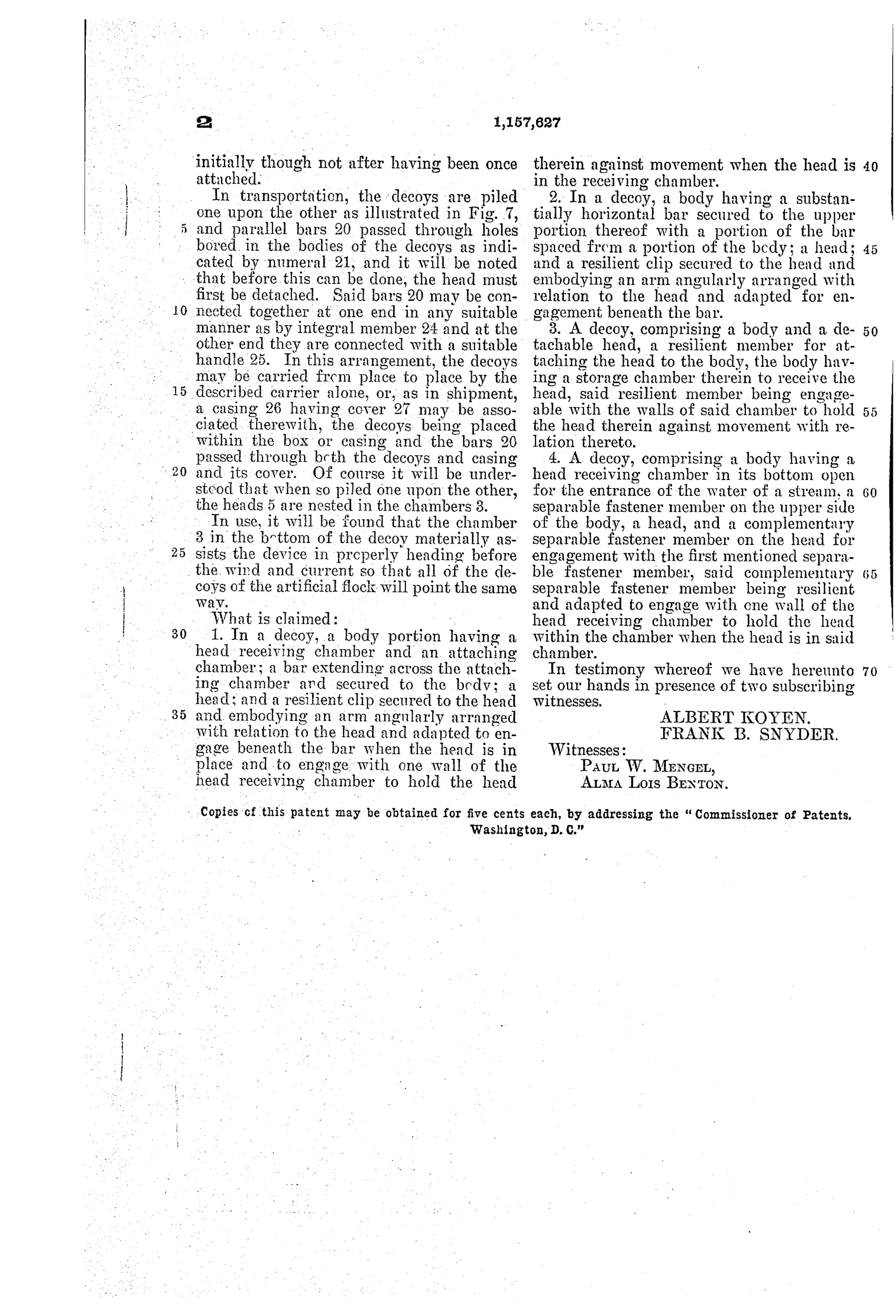
“1. In a decoy, a body portion having a head receiving chamber and an attaching chamber; a bar extending across the attaching chamber and secured to the body; a head; and a resilient clip secured to the head and embodying an arm angularly arranged with relation to the head and adapted to engage beneath the bar when the head is in place and to engage with one wall of the head receiving chamber to hold the head therein against movement when the head is in the receiving chamber.”
In plain English: A decoy body with a storage chamber and a bar, plus a detachable head fitted with a springy clip that hooks under the bar and presses against the chamber wall to hold the head firmly in place.
➶ In the inventor’s words
“In use, it will be found that the chamber 3 in the bottom of the decoy materially assists the device in properly heading before the wind and current so that all of the decoys of the artificial flock will point the same way.”— Albert Koyen & Frank B. Snyder, from the specification
Fate unknown
No documented examples are known to me; a marked or clip-fitted Nebraska decoy in a collection would settle it.
➶ Commentary
Let's be upfront: this is a decoy, not a call. It sits in the broad hunting-gear class alongside our sound-makers, but Koyen and Snyder of Fremont, Nebraska were solving a packing problem, not an acoustic one. Still, it's worth a look for what it says about the market hunter's daily grind circa 1914.
The head is the fragile part of any decoy — it snaps off in transit, the paint chips, the whole rig is awkward to sack up. Their answer is a spring-wire clip under the neck that forks forward and catches beneath a cross bar recessed into the body, with a finger pocket at the bill-neck joint to pop it free. Detached, the head nests upside-down in a bottom chamber along with the anchor weight and wrapped cord, so each decoy becomes its own padded case. Fig. 7 shows the payoff: bodies bored through and strung on parallel bars, stacked flat in a carrying crate like loaves in a rack.
The nicest detail is almost an accident — the specification claims the hollow bottom chamber helps the decoy 'head before the wind and current,' so the whole artificial flock points the same way. That's the kind of field observation that suggests these two actually hunted. Whether the wire clip would survive a season of freezing, swelling wood and gloved hands is another question, and detachable-head decoys were a crowded corner of the patent files that mostly went nowhere commercially.
Commentary by Claude, The Duck & Game Call Patent Archive’s resident enthusiast