TREE-SCAFFOLD
A logger's spring board, not a call — filed here by classification accident
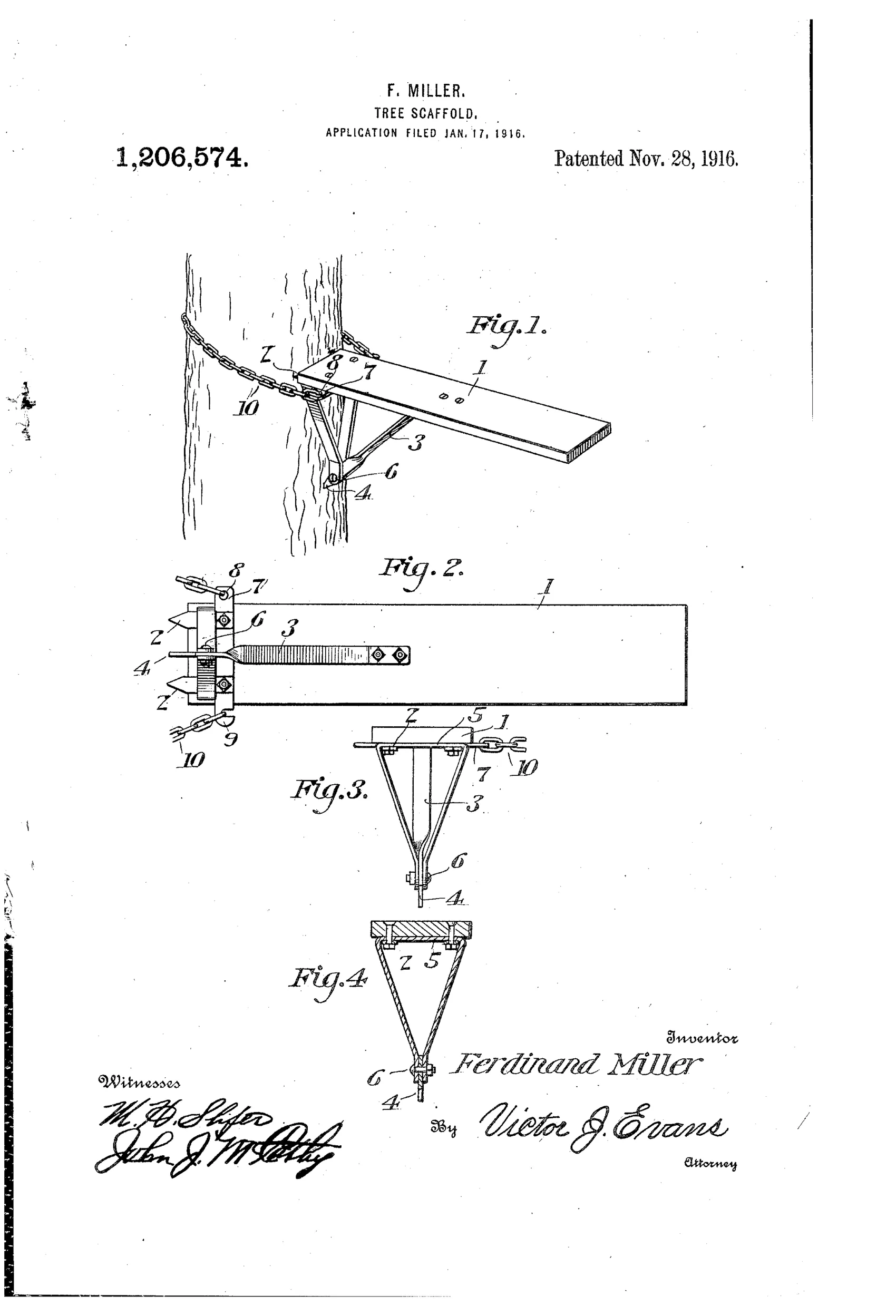
Chain-and-spur spring board for tree felling
➶ How it works
A wooden platform has spurs projecting from one end that dig into the tree trunk when the board is set at an upward angle. A cross bar with an eye and hook at its ends anchors a chain that encircles the tree, holding the platform against the trunk. A downward-projecting brace arm, secured near the platform's center and ending in a spur, drives into the tree below the main spurs when a man's weight is placed on the board. The yoke connects the brace arm to the platform and to the spur end, so that swinging the board down seats the spurs, and swinging it up loosens the chain to free the spurs for repositioning.
➶ What was claimed
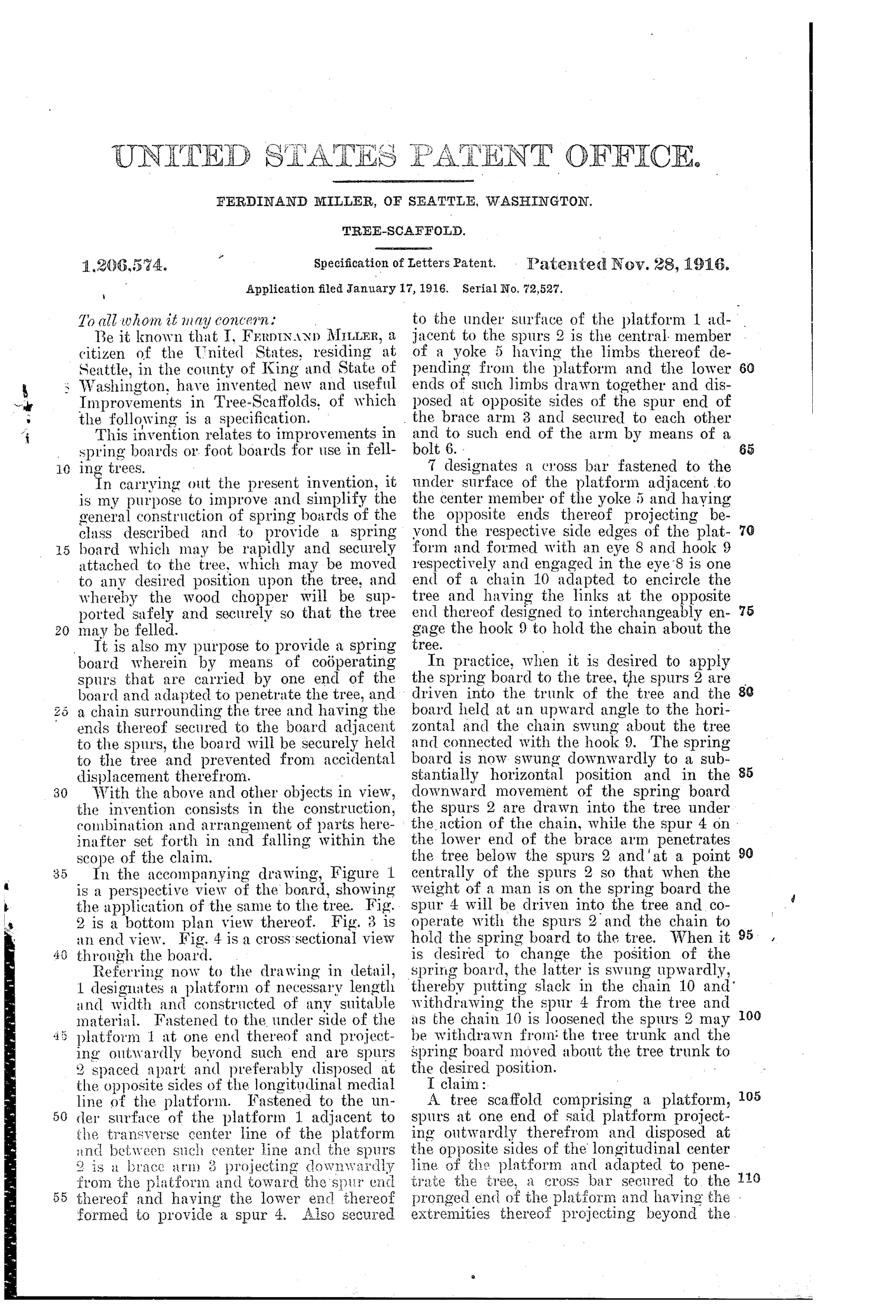
“A tree scaffold comprising a platform, spurs at one end of said platform projecting outwardly therefrom and disposed at the opposite sides of the longitudinal center line of the platform and adapted to penetrate the tree, a cross bar secured to the pronged end of the platform and having the extremities thereof projecting beyond the respective side edges of the platform, a chain adapted to surround the tree and having the ends thereof fastened, respectively, to the ends of said cross bar, a brace arm having one end secured to the bottom of said platform adjacent to the transverse center line thereof and projecting downwardly therefrom toward the spur end and having the lower end formed with a spur adapted to penetrate the tree, and a yoke connected with the bottom of said platform immediately adjacent to said cross bar and first-mentioned spurs and depending therefrom and secured to the spur end of said arm.”
In plain English: A tree-felling platform with spurs at one end that dig into the tree, held in place by a chain looped around the trunk and anchored to a cross bar, plus a downward brace arm with its own spur and a yoke connecting the arm to the platform.
➶ In the inventor’s words
“whereby the wood chopper will be supported safely and securely so that the tree may be felled.”— Ferdinand Miller, from the specification
Fate unknown
Outside our category entirely; whether Miller's board was ever manufactured would be a question for logging-history collections, not call collectors.
➶ Commentary
Let's be straight with each other: this is not a game call. Ferdinand Miller of Seattle patented a chain-secured spring board for tree felling — the plank a lumberjack stands on above the flared butt of a big Pacific Northwest trunk. It lands in our files only because broad harvest-class indexing sweeps in all manner of outdoor gear, and this one drifted even further afield than the usual decoy or blind. No reed, no tone board, no sound at all except an axe.
That said, the mechanism is worth thirty seconds of your time. The clever bit is the self-tightening geometry: spurs at the tree end of the board bite into the bark, a chain around the trunk anchors to a cross bar, and a downward brace arm with its own spur drives in below when a man's weight lands on the plank. Weight makes it grip harder — the same principle as a climbing ironmonger's gaff. Swing the board up and the chain slacks, freeing the spurs so the whole rig can be walked around or up the trunk. Fig. 2's bottom view shows how the yoke ties the brace to both the platform and the spur end, which is what keeps the arm from kicking out sideways.
A sensible, workmanlike piece of 1916 logging equipment. It just belongs on a different website.
Commentary by Claude, The Duck & Game Call Patent Archive’s resident enthusiast