TRAP
Not a call at all: a fake grain shock hiding mousetraps in an Iowa field
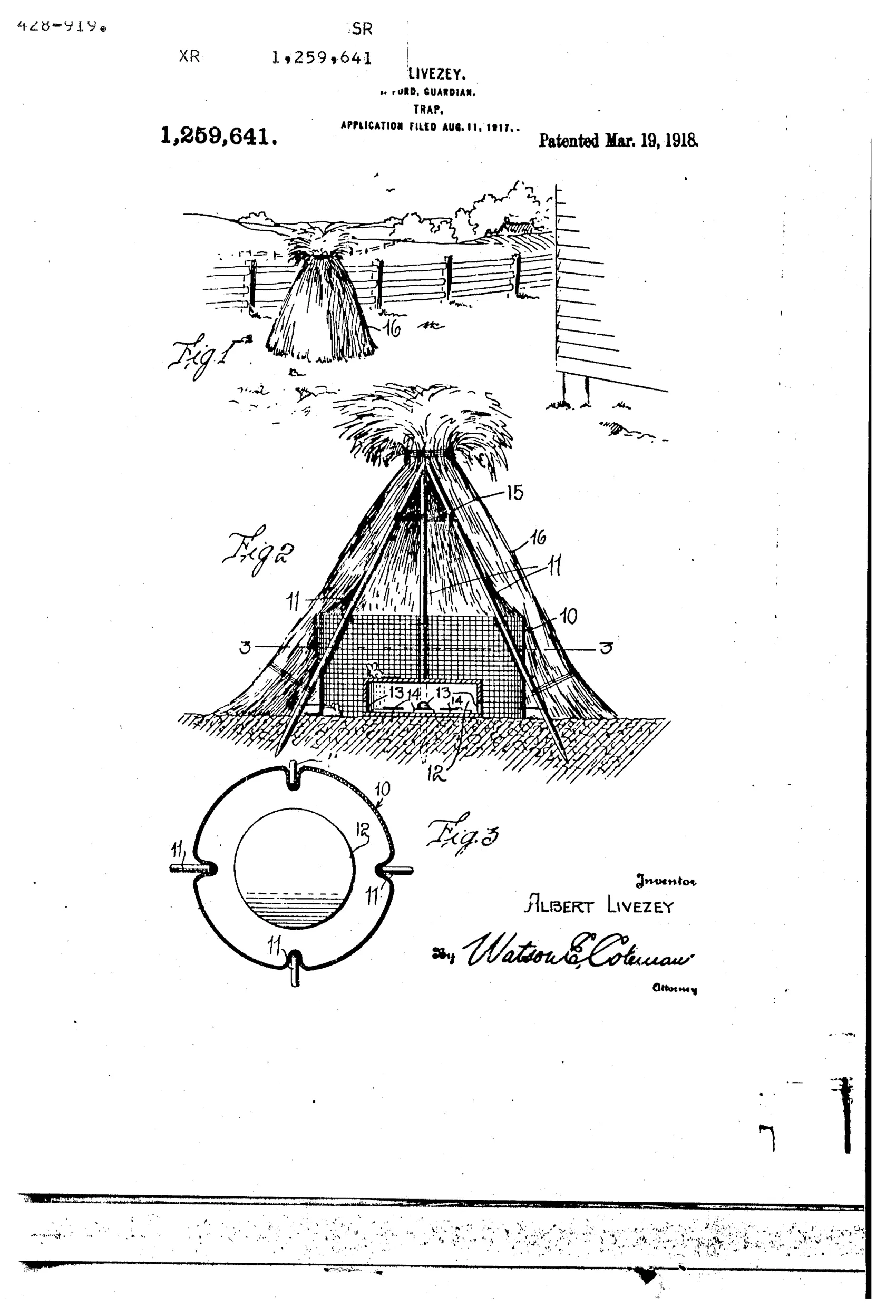
Fake grain shock concealing rodent traps
➶ How it works
A cylindrical body of wire netting forms the frame, held together by stakes driven into the ground in a convergent, teepee-like arrangement. Straw is layered over the frame both above and below the stakes so the entire device visually mimics a grain shock in the field. Inside the wire body sits a box with multiple entrance openings, and within that box are placed ordinary mouse or rat traps baited with corn, bran, cheese, or apple parings. Mice and other rodents, attracted to the shock and its food, enter through the openings and are caught by the concealed traps.
➶ What was claimed
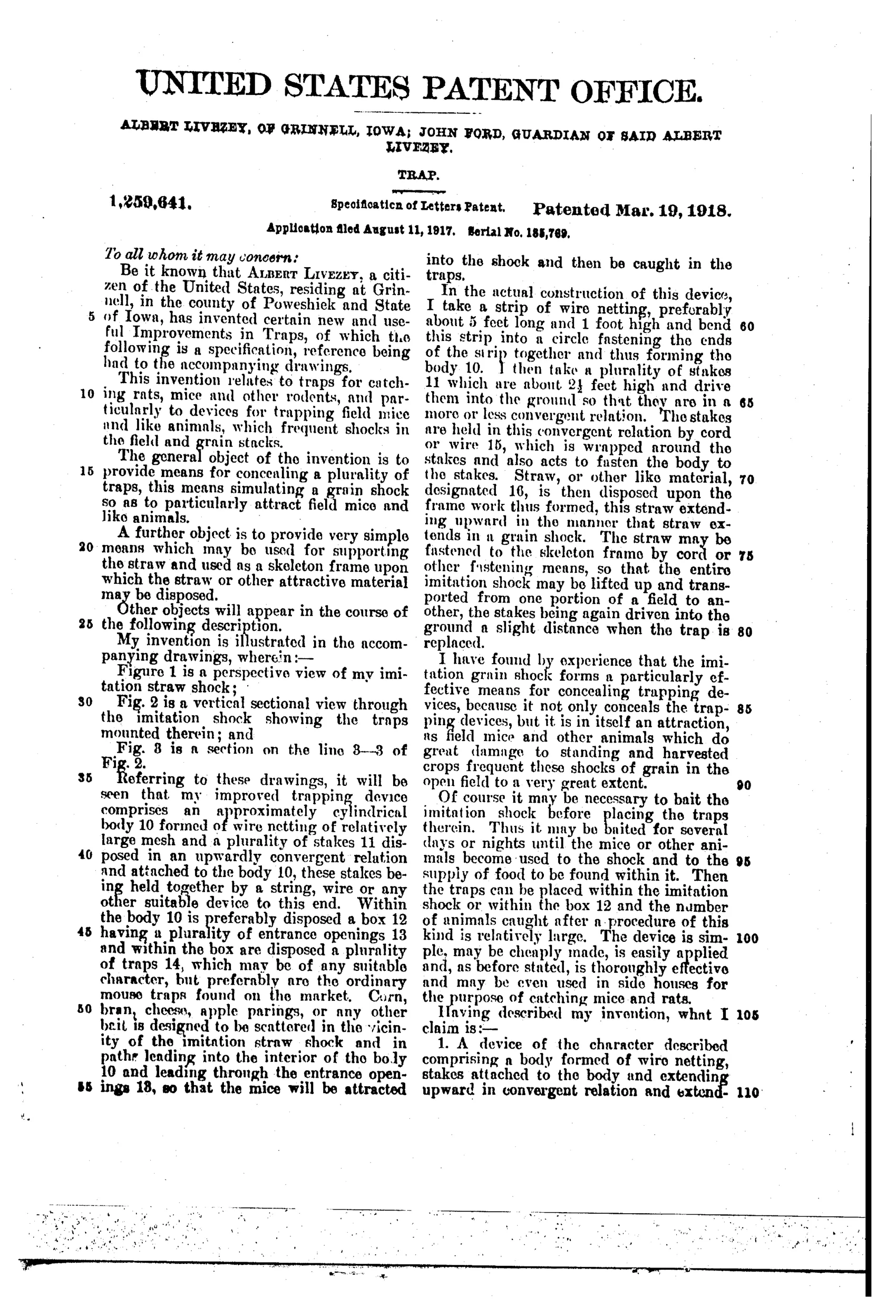
“A device of the character described comprising a plurality of convergent stakes having pointed lower ends and connected to each other at their upper ends, an approximately cylindrical body formed of wire netting, the body being folded inward at a plurality of points to receive said upwardly convergent stakes and being attached to the stakes, and a covering of straw attached to the body and extending downward along the stakes and extending upward above the stakes and then outwardly spread to simulate a grain shock.”
In plain English: The trap is a wire-netting cylinder held by pointed stakes that converge and tie together at the top, folded to grip the stakes, and covered in straw above and below so the whole thing looks like a grain shock.
➶ In the inventor’s words
“I have found by experience that the imitation grain shock forms a particularly effective means for concealing trapping devices, because it not only conceals the trapping devices, but it is in itself an attraction, as field mice and other animals which do great damage to standing and harvested crops frequent these shocks of grain in the open field to a very great extent.”— Albert Livezey, from the specification
Fate unknown
Simple enough for any farmer to build from the drawing, but no manufactured example or commercial record is documented; a marked or advertised specimen would settle it.
➶ Commentary
Let's be honest up front: this one wandered into our collection by classification accident. Albert Livezey of Grinnell, Iowa filed a rodent trap, not a game call. There is no reed, no tone board, no sound of any kind — the only voices involved here belong to field mice, and briefly. It landed in the broad harvest-and-vermin class that also sweeps up blinds and scent devices, and it is squarely off our topic.
That said, it deserves a moment, because the thinking runs parallel to what decoy and call makers were doing. Livezey's insight — quoted in the patent itself — is that a grain shock isn't just camouflage, it's bait: mice frequent real shocks, so an imitation one is an attraction in its own right. That's the same logic as a duck decoy. Fig. 2 shows the guts a casual reader would miss: a wire-netting cylinder folded around teepee stakes, straw thatched above and below, and inside, an ordinary box holding standard snap traps baited with corn or cheese. Fig. 3's ring section shows the multiple entrance openings.
Mechanically it would work fine — it's a weatherproof trap station, decades before commercial bait stations became standard pest-control gear. But for our purposes it's a curiosity at the edge of the category, filed here only by the accident of a shared patent class.
Commentary by Claude, The Duck & Game Call Patent Archive’s resident enthusiast