DECOY FOR WILD DUCKS AND THE LIKE.
A flat-packing tin duck — no sound here, but a clever silhouette
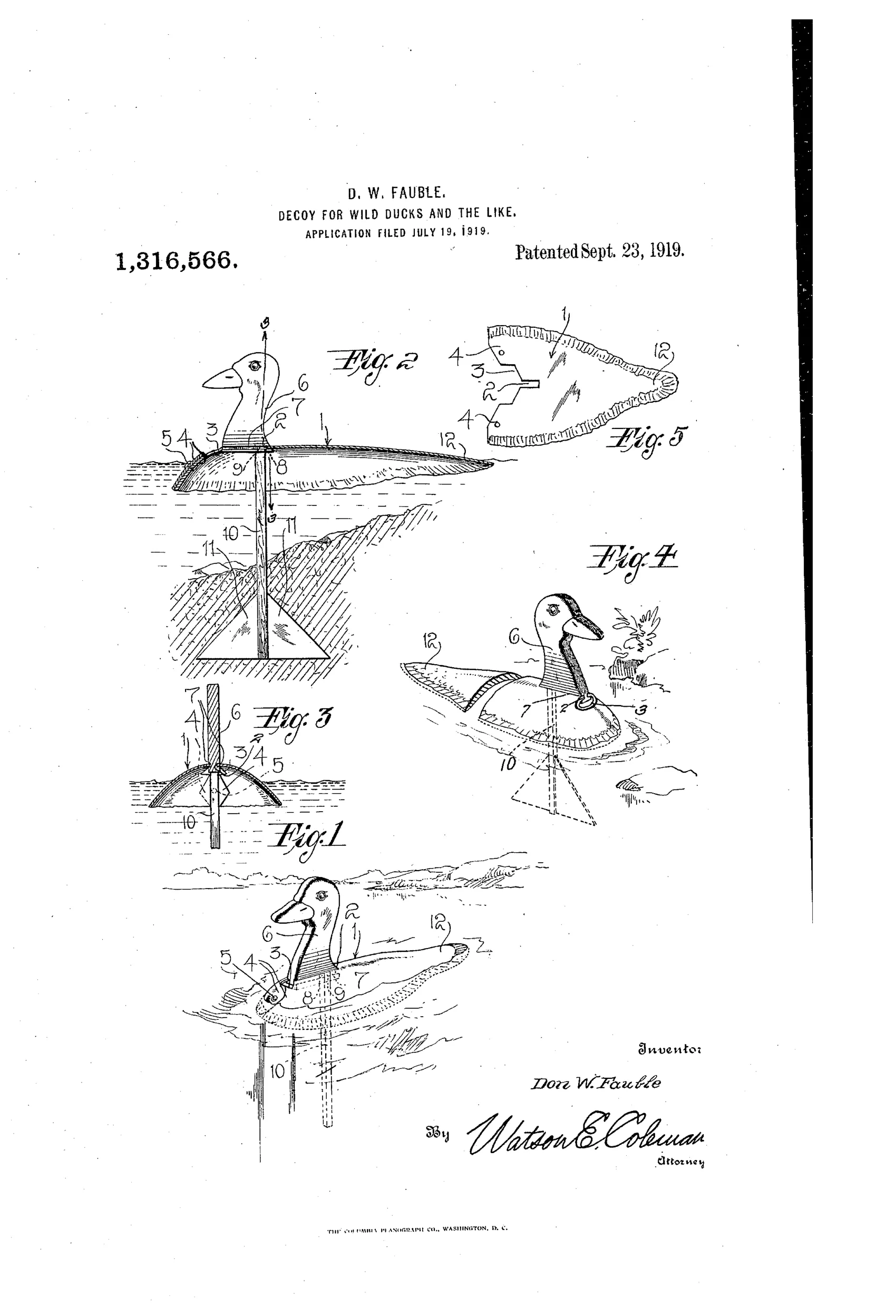
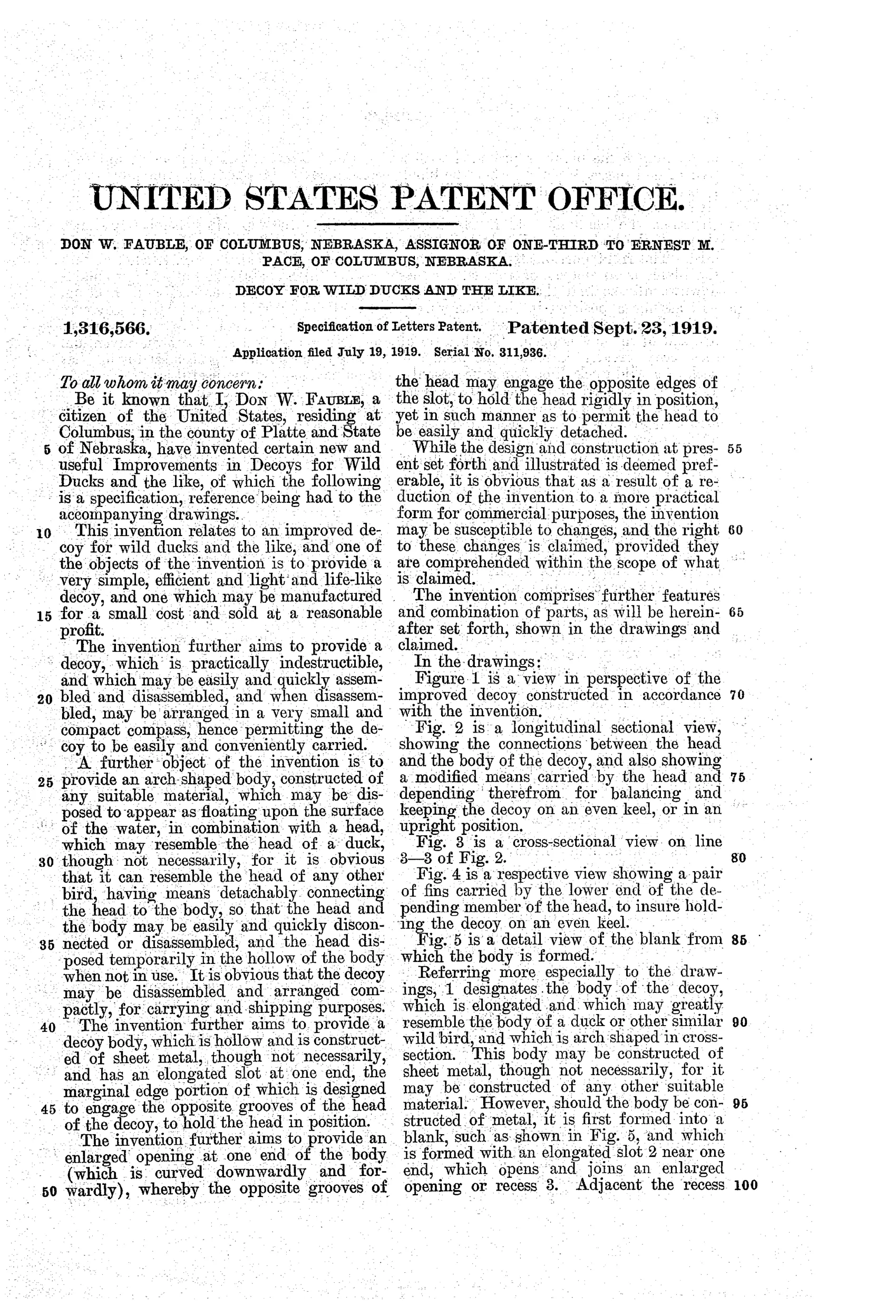
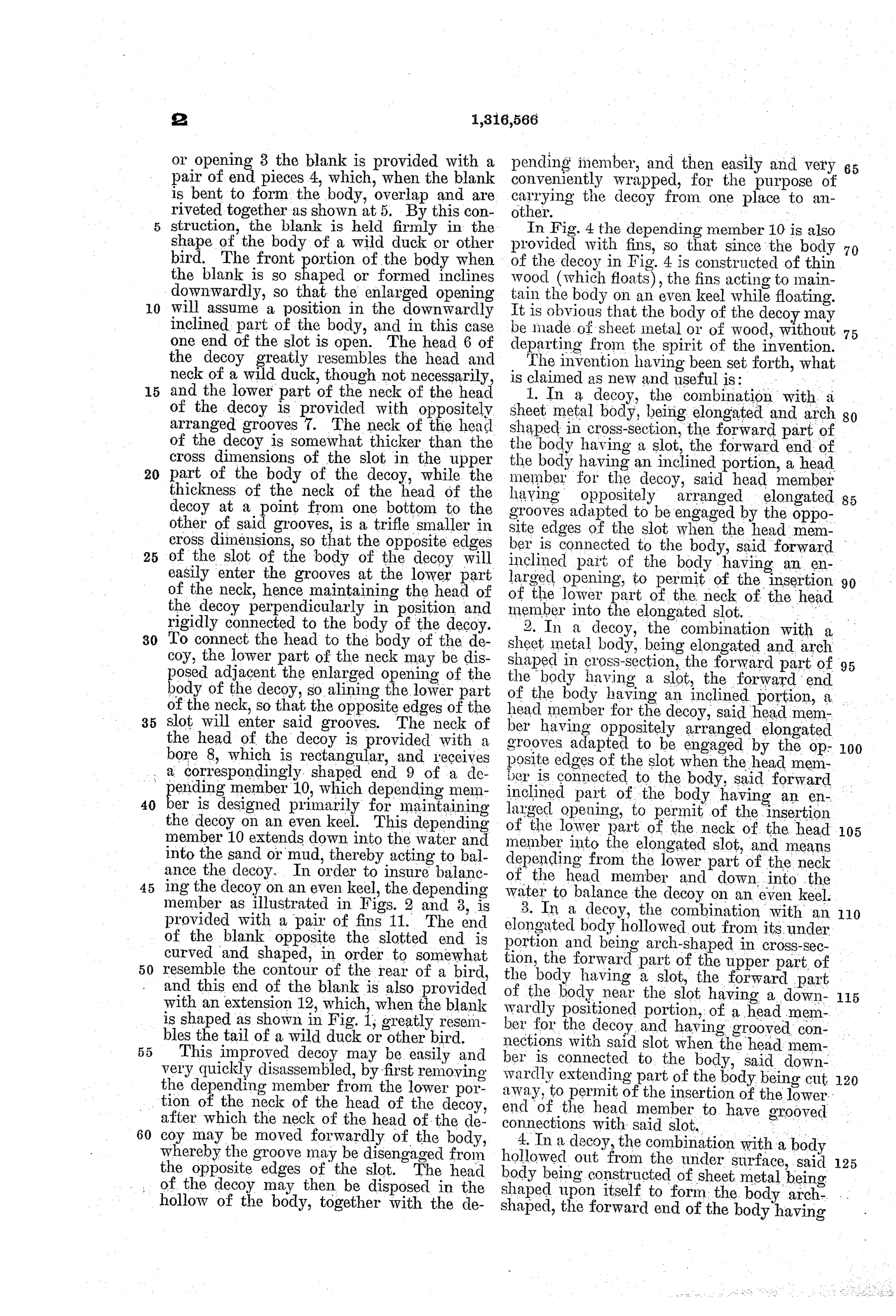
Collapsible sheet-metal duck decoy with detachable head
➶ How it works
The decoy body is a hollow, arch-shaped shell formed from a sheet-metal blank, curved and riveted at overlapping end pieces to hold its shape. A slotted opening near the front of the body accepts the lower neck of a separate head member, whose grooves engage the slot's edges to lock the head rigidly yet allow quick detachment. A rectangular bore in the head's neck receives a depending stem or keel member that extends down into the water and mud to balance the decoy on an even keel, optionally fitted with a pair of fins for added stability. When disassembled, the head and depending member can be stowed inside the hollow body for compact carrying.
➶ What was claimed
“In a decoy, the combination with a sheet metal body, being elongated and arch shaped in cross-section, the forward part of the body having a slot, the forward end of the body having an inclined portion, a head member for the decoy, said head member having oppositely arranged elongated grooves adapted to be engaged by the opposite edges of the slot when the head member is connected to the body, said forward inclined part of the body having an enlarged opening, to permit of the insertion of the lower part of the neck of the head member into the elongated slot.”
In plain English: The decoy has a hollow arch-shaped sheet-metal body with a slotted, inclined front opening that lets a grooved detachable head snap securely into place.
➶ In the inventor’s words
“The invention further aims to provide a decoy, which is practically indestructible, and which may be easily and quickly assembled and disassembled, and when disassembled, may be arranged in a very small and compact compass, hence permitting the decoy to be easily and conveniently carried.”— Don W. Fauble, from the specification
Fate unknown
No documented example of this collapsible tin decoy is known to me; a surviving marked specimen or period catalog listing would settle it.
➶ Commentary
Full disclosure up front: this one is a decoy, not a call. It makes no sound at all, and by the strict rules of this shelf it drifted in through the broad hunting-gear classification rather than earning its place with a reed. But since it's here, it deserves a fair look, because Fauble's idea is more thoughtful than most gadget decoys of the era.
The whole bird starts life as the flat blank shown in Fig. 5 — a single stamped sheet curled into an arch and riveted at the overlapping ends. The head is a separate piece with grooves in the neck that engage the edges of a slot in the body, so it locks rigid but pops off without tools. The really practical touch is what happens after the hunt: head and keel stem stow inside the hollow shell, so a sack of these packs down to almost nothing. Anyone who has hauled a dozen solid cedar blocks through a marsh understands the appeal.
The finned depending stem in Figs. 2 and 4 is the weak spot — it's meant to plant in the mud or ballast the bird on an even keel, but a thin sheet-metal arch riding high in a chop with a stick hanging off the neck seems tippy in practice. Tin decoys did exist commercially, so the concept wasn't absurd; this particular head-slot arrangement was likely a dead end.
Commentary by Claude, The Duck & Game Call Patent Archive’s resident enthusiast