FLOATING DECOY
A tape-measure reel inside a duck: Bauer's answer to tangled anchor lines
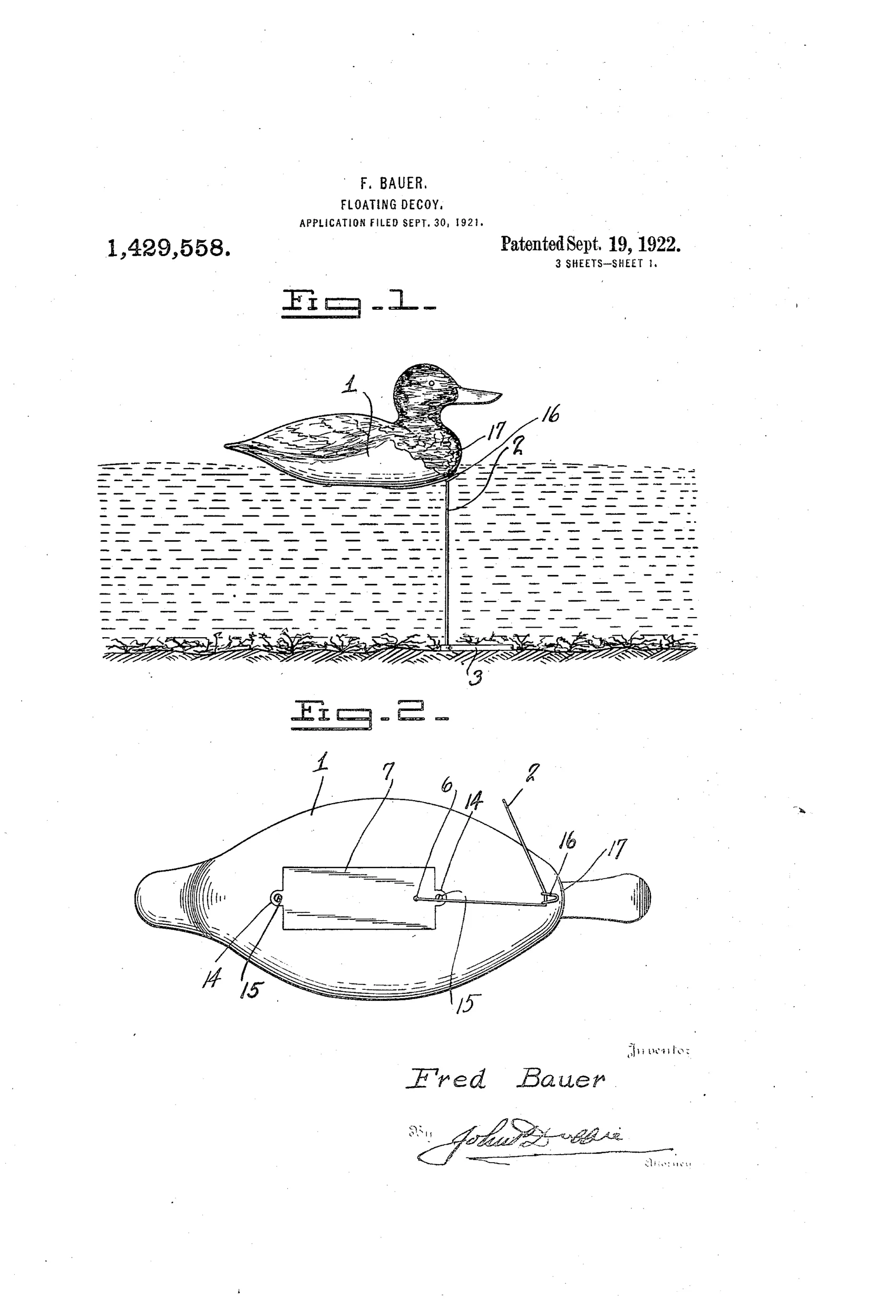
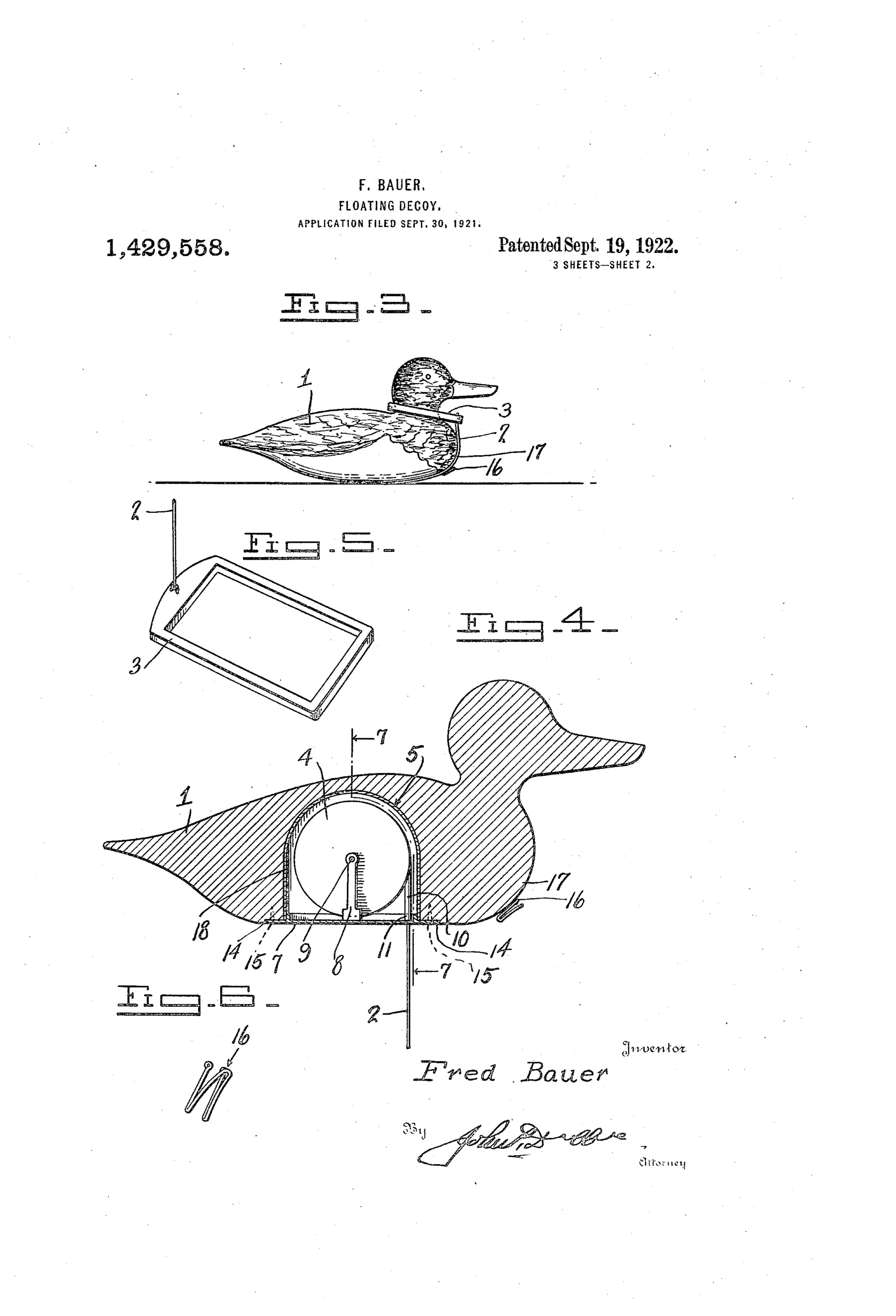
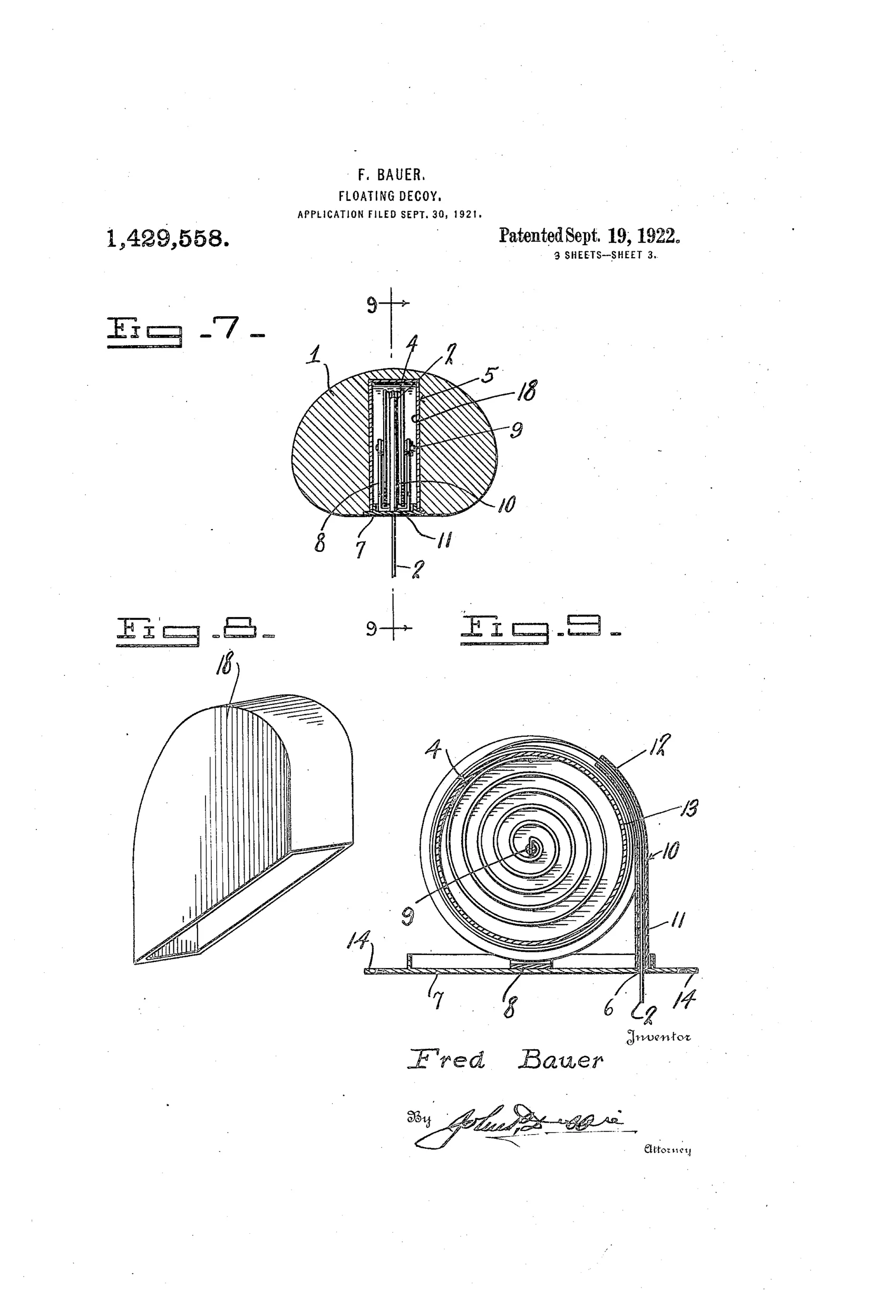
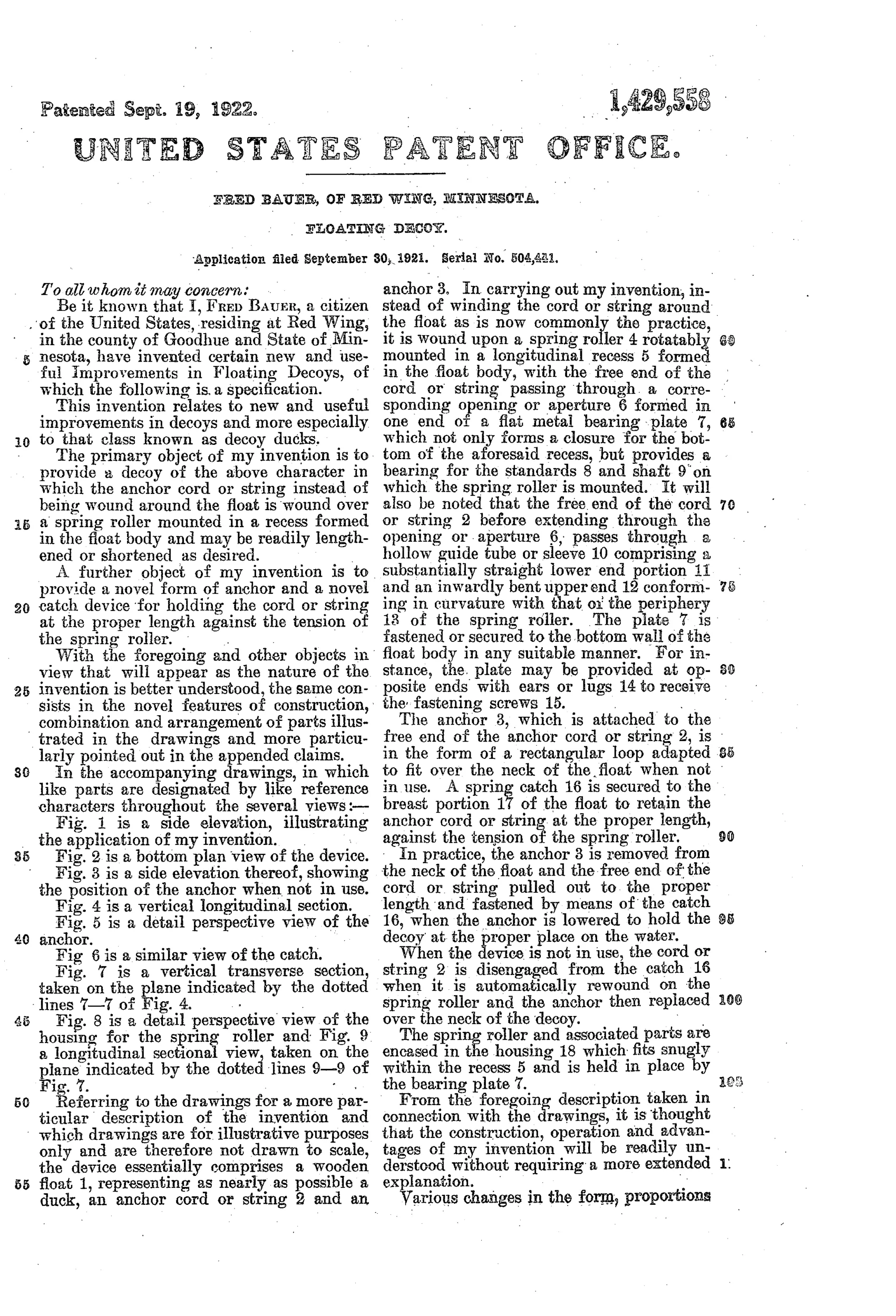
Duck decoy with self-winding anchor cord reel
➶ How it works
A wooden float shaped like a duck houses a spring roller mounted in a longitudinal recess in the body. The anchor cord winds onto this spring-loaded roller, with its free end passing through a bearing plate and a curved guide sleeve to an anchor shaped as a rectangular loop that fits over the decoy's neck when not in use. A spring catch mounted on the breast of the decoy engages the cord to hold it at the desired length against the roller's tension. When the catch is released, the roller automatically rewinds the cord, drawing the anchor back up to the neck for storage.
➶ What was claimed
“A device of the character specified comprising a float representing a duck, a spring roller mounted within the float body, an anchor cord winding upon said roller, and an anchor attached to the free end of said cord, said anchor being in the form of a rectangular loop and adapted to fit over the neck of the float when not in use.”
In plain English: A duck-shaped decoy with a spring-loaded reel inside that winds up the anchor cord, whose anchor is a loop that hooks over the decoy's neck for storage.
➶ In the inventor’s words
“In carrying out my invention, instead of winding the cord or string around the float as is now commonly the practice, it is wound upon a spring roller 4 rotatably mounted in a longitudinal recess 5 formed in the float body.”— Fred Bauer, from the specification
Paper patent — likely never produced
No manufactured example of this spring-reel decoy is documented, and the mechanism's cost and vulnerability to marsh conditions make production unlikely, though a surviving marked specimen would overturn that.
➶ Commentary
First, honesty about scope: this is a decoy, not a call. It makes no sound at all, so it sits at the edge of our beat — but it solves a problem every duck hunter of the era knew intimately, and it does so with real mechanical charm, so it earns its page.
The universal practice in 1921 was to wind the anchor cord around the decoy's body and hook the weight over the head — a wet, cold, tangle-prone ritual repeated dozens of times at dawn and dusk. Bauer's move is to put the winding inside the bird: a spring roller set in a longitudinal recess in the wooden body, so the cord retracts itself like a window shade or a modern tape measure. A spring catch on the breast pinches the cord to hold your chosen depth against the roller's tension; release it and the anchor — a rectangular wire loop — reels itself back up to hook over the neck. Fig. 2's bottom view shows how compact the whole works are: roller, bearing plate, curved guide sleeve, all flush with the hull.
The weak point is obvious to anyone who has run a spring reel in freezing marsh water: silt, ice, and a swollen wooden recess would fight that roller every season. It also adds cost to an object hunters bought by the dozen. Clever, genuinely labor-saving on paper — and probably too fussy for the rig bag.
Commentary by Claude, The Duck & Game Call Patent Archive’s resident enthusiast