DUCK DECOY.
A pocket-flat nesting decoy — and a reminder decoys aren't calls
A collapsible, nesting sheet-metal duck decoy
➶ How it works
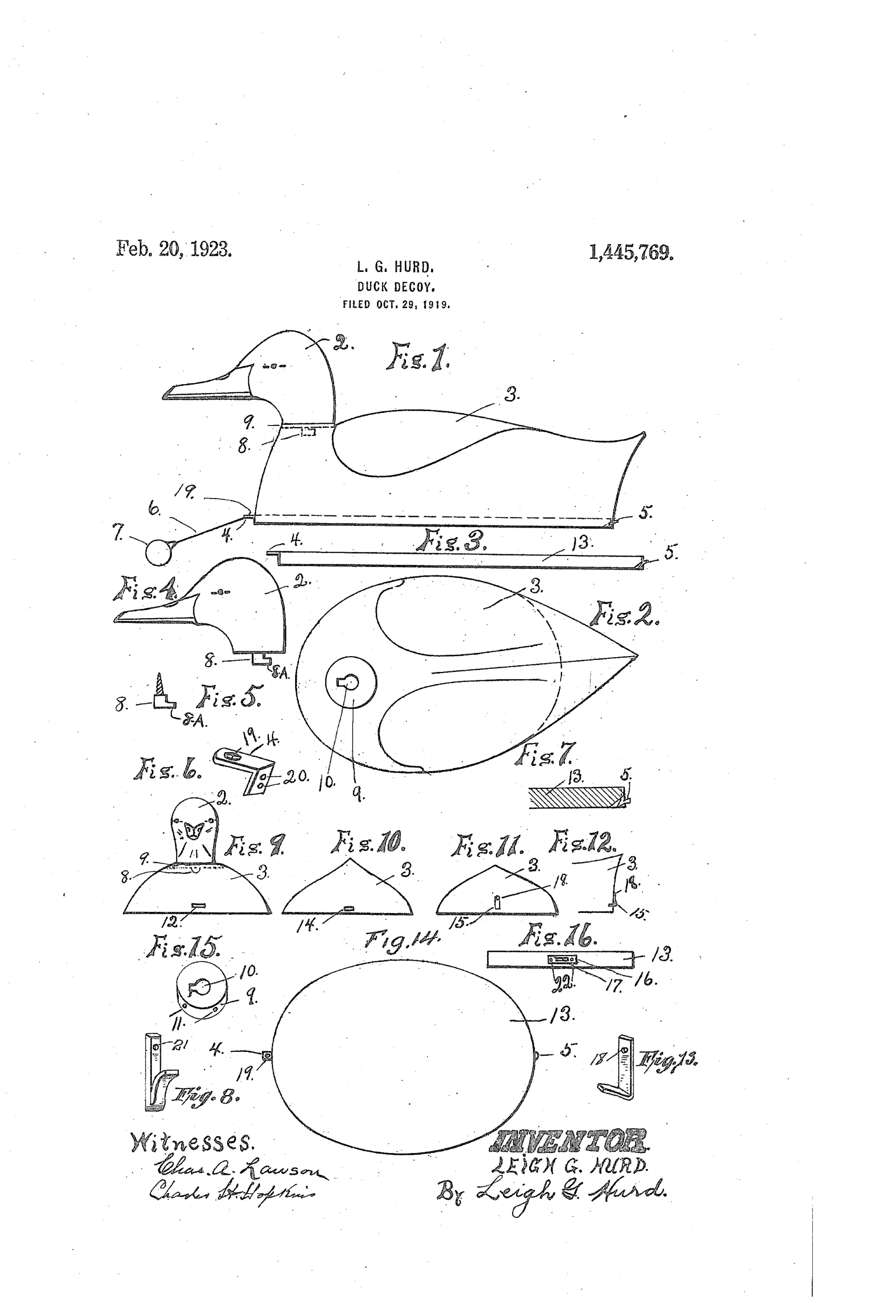
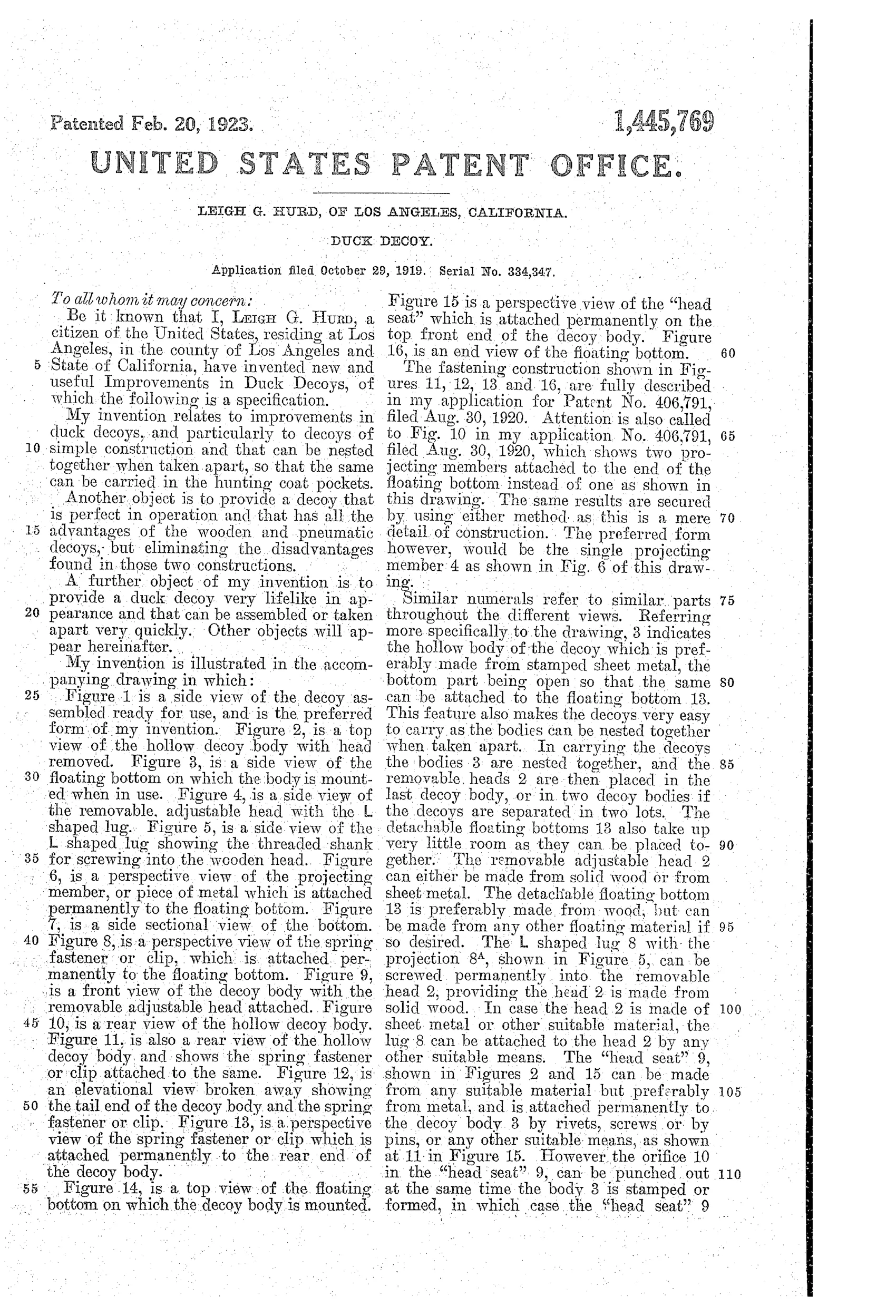
The decoy has a hollow stamped-metal body open at the bottom that mounts on a separate floating bottom, with a projecting metal member engaging an orifice in the body and a spring fastener or clip snapping into a second orifice to lock the two together. A removable, adjustable wooden or sheet-metal head with an L-shaped lug fits into a head seat orifice on the body, and turning the head a fraction of a turn locks it in any desired position. When disassembled, the bodies nest together and the heads and floating bottoms stack separately, allowing the decoy to be carried flat in a hunting coat pocket. An anchor cord with a weight attaches to the projecting member at the front of the decoy.
➶ What was claimed
“1. A decoy comprising the combination of a hollow body with the bottom part open, a removable head, a detachable floating bottom permanently equipped with a projecting member to be inserted in an orifice in the hollow body adjacent its open under side, said projecting member equipped with means for attaching the anchor cord to the same, and the aforesaid projecting member co-operating with other means in detachably securing the hollow body over the detachable floating bottom.”
In plain English: The decoy combines an open-bottomed hollow body, a removable head, and a floating bottom fitted with a permanent projecting piece that fits into a hole in the body and also holds the anchor cord, working together with another fastener to lock the body onto the floating base.
➶ In the inventor’s words
“Wooden and collapsible decoys as a general rule sit too high on the water, and generally roll with the waves on account of having round bottoms.”— Leigh G. Hurd, from the specification
Fate unknown
No documented examples are known to me; a marked sheet-metal specimen or a period catalog listing would settle it.
➶ Commentary
Full disclosure up front: this one is a decoy, not a call. The harvest class sweeps in blinds, scents, and decoys alongside our sound-makers, and Hurd's patent is one of those neighbors. It makes no noise at all — but since it wandered onto the page, it's worth a fair look, because the problem it attacks is real.
Hurd's complaint, quoted in the specification, is that wooden and collapsible decoys "sit too high on the water, and generally roll with the waves on account of having round bottoms." His answer is a three-part kit: a hollow stamped-metal body open underneath, a separate flat floating bottom that snaps on with a projecting lug and a spring clip, and a removable head that locks with a quarter-turn — so it can be posed at any angle, which is a genuinely nice touch for varying a rig. Disassembled, the bodies nest like measuring cups and the flat bottoms stack, so a hunter could carry a spread in a coat pocket instead of a gunny sack.
The weak point a casual reader might miss: the anchor cord ties to the same projecting member that locks the body on, so every tug of current works directly on the fastening. And thin stamped metal dents, rusts, and — worst for a decoy — glints. Folding and knockdown decoys were a busy little genre in the 1910s–20s, and most, like this one, left no trace beyond the drawing.
Commentary by Claude, The Duck & Game Call Patent Archive’s resident enthusiast