IMPROVEMENT IN DECOY-BIRDS FOR SPORTSMEN.
Not a call at all: Boston's famous folding tin decoys, patented
Nestable sheet-metal decoy birds for hunters
➶ How it works
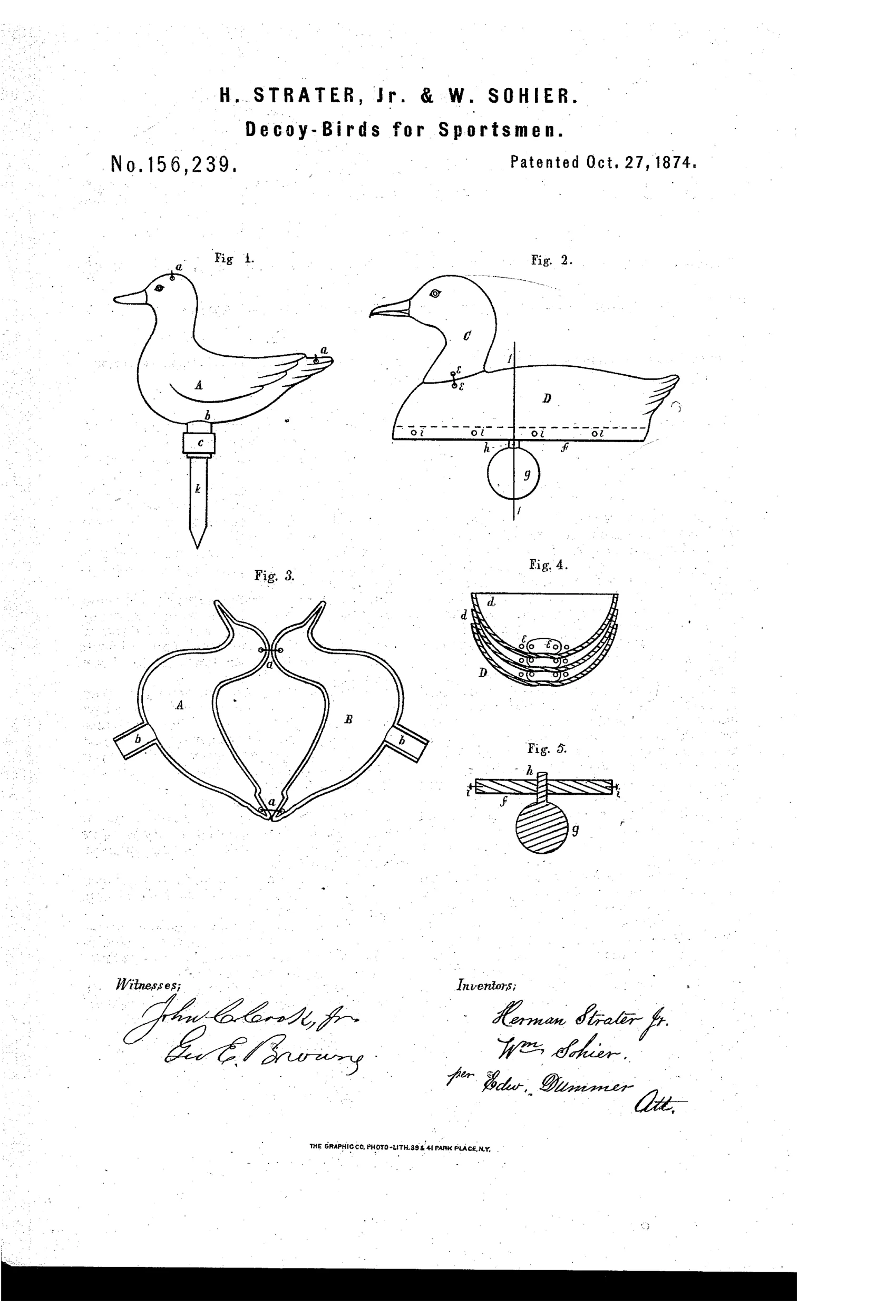
The decoy body is formed of two semi-cylindrical halves hinged together and joined by a surrounding band, into which a supporting stake is thrust and driven into the ground. For water-fowl, the head and neck piece is made separable from the body, joined by eyelets and a string or wire, and a light wooden float with a screwed-in weight is fixed inside the body to keep the decoy upright and floating naturally. Because the parts are thin sheet metal and separate into halves, several decoys can be nested one inside another for compact transport.
➶ What was claimed
“4. A decoy-bird consisting of a body, D, head and neck portion C, float f, and balancing-weight g, substantially as described.”
In plain English: A floating decoy made of a separate body, head/neck piece, internal float, and weight to balance it upright in water.
➶ In the inventor’s words
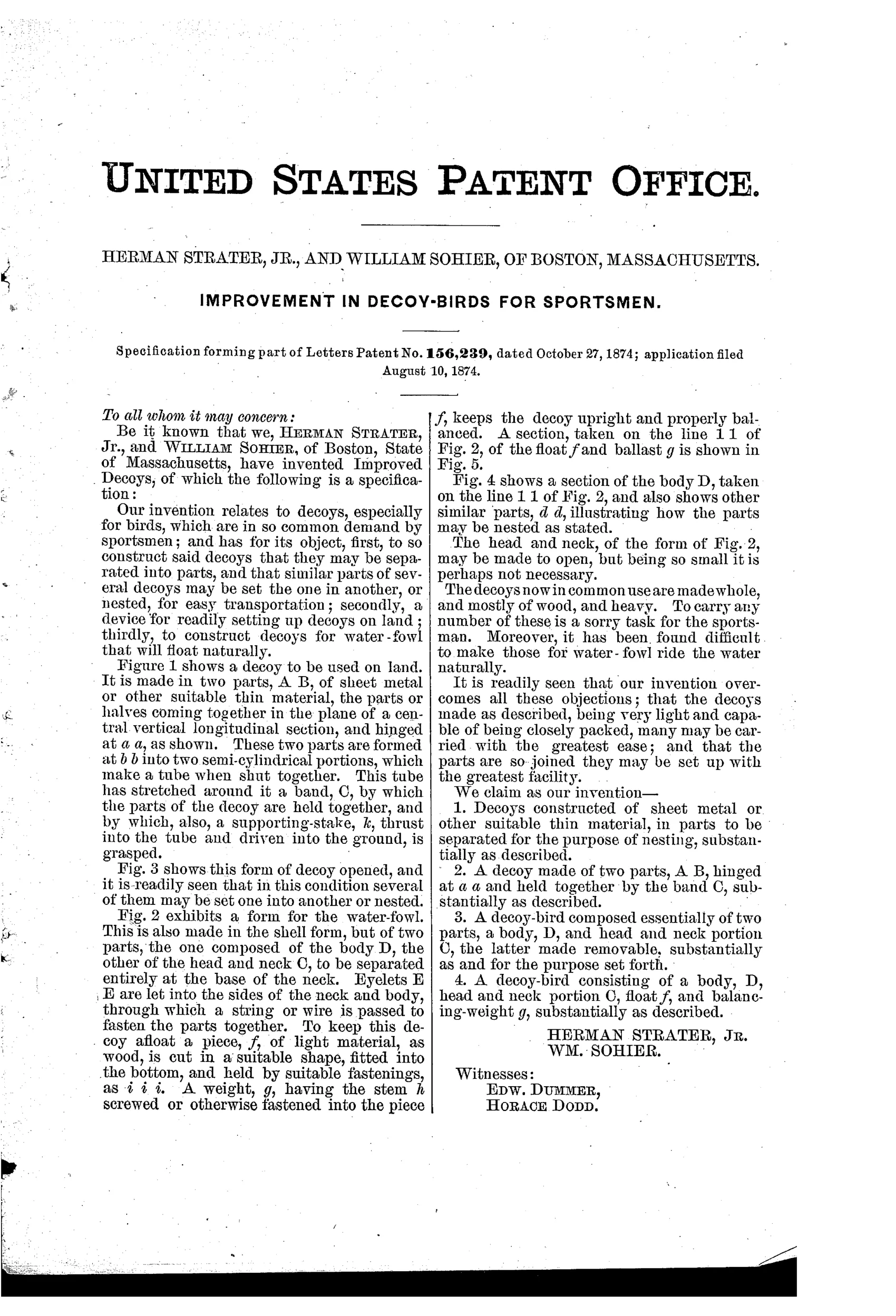
“The decoys now in common use are made whole, and mostly of wood, and heavy.”— Herman Strater, Jr. and William Sohier, from the specification
Manufactured and sold
Strater & Sohier folding tin decoys, especially shorebirds, were commercially produced and are well documented in decoy-collecting literature, with marked examples surviving.
➶ Commentary
A housekeeping note first: this one wandered into our files because the Patent Office lumps all 'harvesting' gear together, but there is no reed, no barrel, and no sound in it anywhere. It is a decoy patent — and as decoy patents go, a genuinely important one, so it earns a page rather than a shrug.
The problem Strater and Sohier attack is stated flat in the specification: wooden decoys are 'made whole... and heavy.' A market hunter carrying two dozen solid-pine blocks to a mudflat felt every pound. Their answer is a bird stamped from thin sheet metal in two hinged halves. Fig. 3 is the drawing to linger on — the decoy opened flat like a book — and Fig. 4 shows the payoff, a whole stack of bodies nested one inside another like measuring cups. A dozen decoys in the space of one.
The floating version is the cleverer half of the patent. Tin is buoyant but tippy, so they screw a wooden float inside the shell with a ballast weight hung below it (Fig. 5), giving the bird a low center of gravity so it rides upright. The detachable head, laced on with eyelets and wire, packs flat too. This is thoughtful production engineering, not a novelty — and unlike most curiosities in this class, it went into real manufacture and is beloved by decoy collectors today.
Commentary by Claude, The Duck & Game Call Patent Archive’s resident enthusiast