ANCHOR FOR DECOYS
Not a call at all: an anchor that clips over the decoy's neck
Metal grappling anchor designed for duck decoys.
➶ How it works
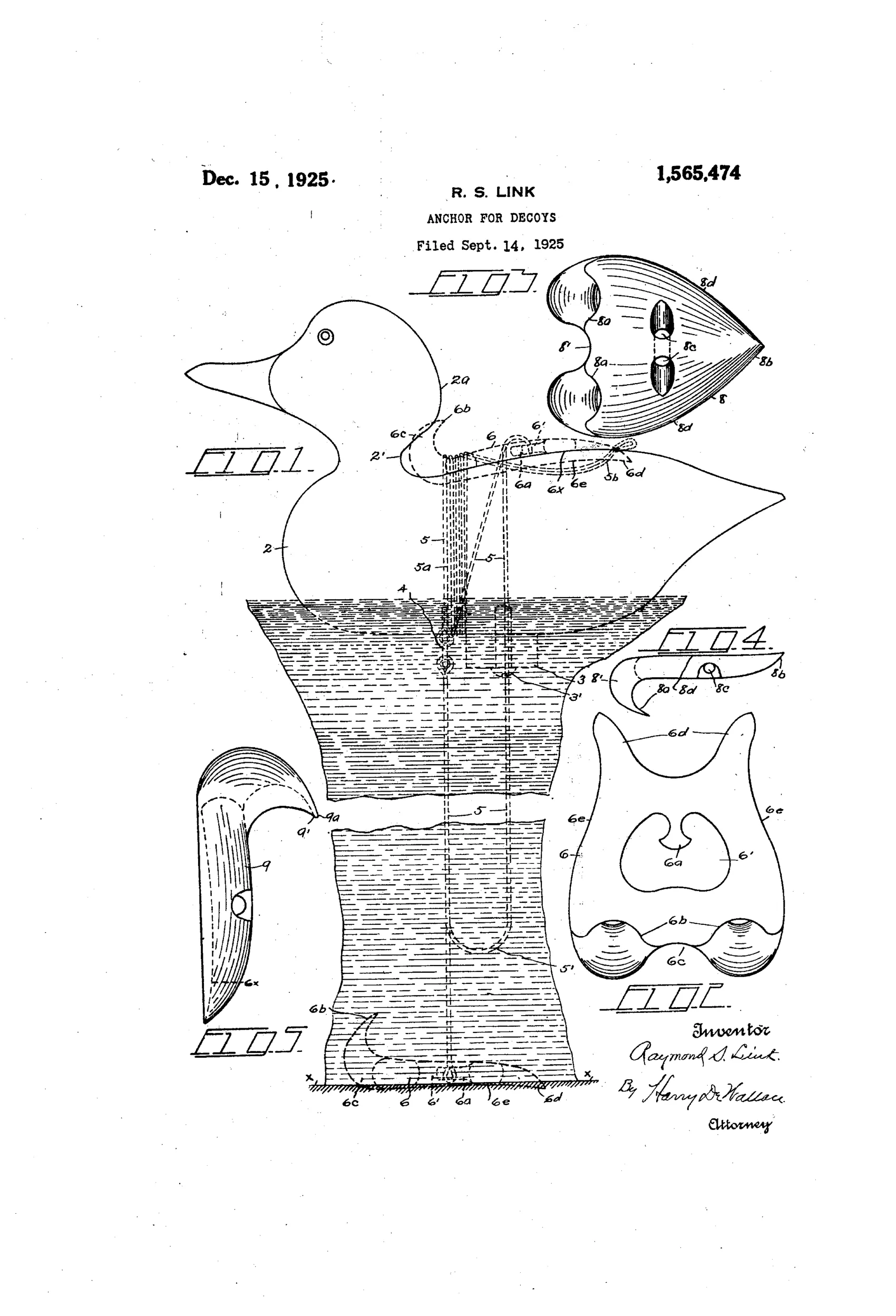
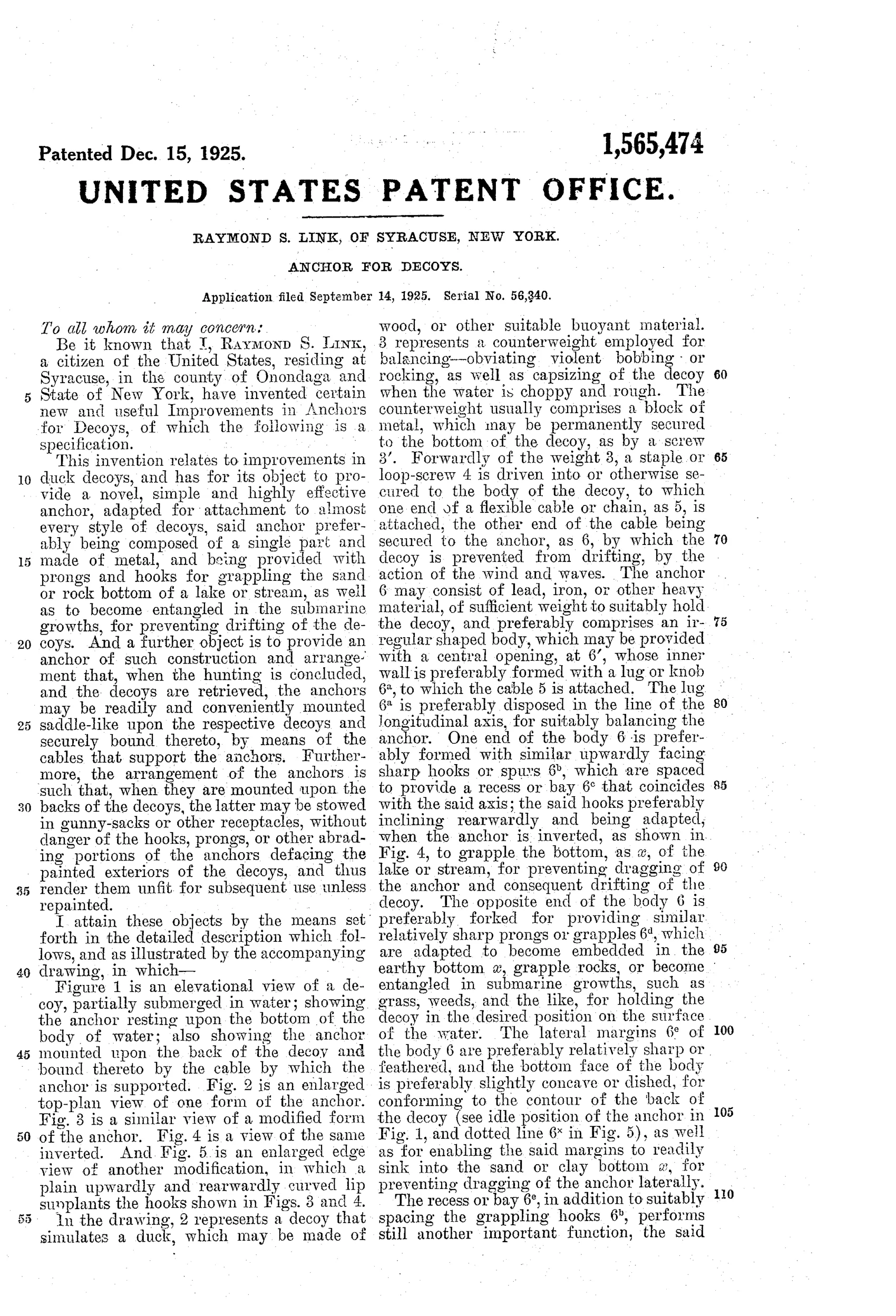
An irregular metal body has upwardly-facing sharp hooks or spurs at one end, spaced to form a recess that straddles the decoy's neck. The opposite end is forked into diverging prongs or sharp points that embed in the lakebed, grapple rocks, or snag weeds to prevent dragging. A flexible cable or chain runs from a staple driven into the decoy's body to a lug inside a central opening in the anchor, while a separate counterweight screwed to the decoy's underside balances it against rocking. When retrieved, the anchor is set saddle-like on the decoy's back, the cable is folded and wound around both anchor and decoy, and the sharp hooks are shielded by the overhanging rearward bulge of the decoy's head so they cannot mar other decoys in storage.
➶ What was claimed
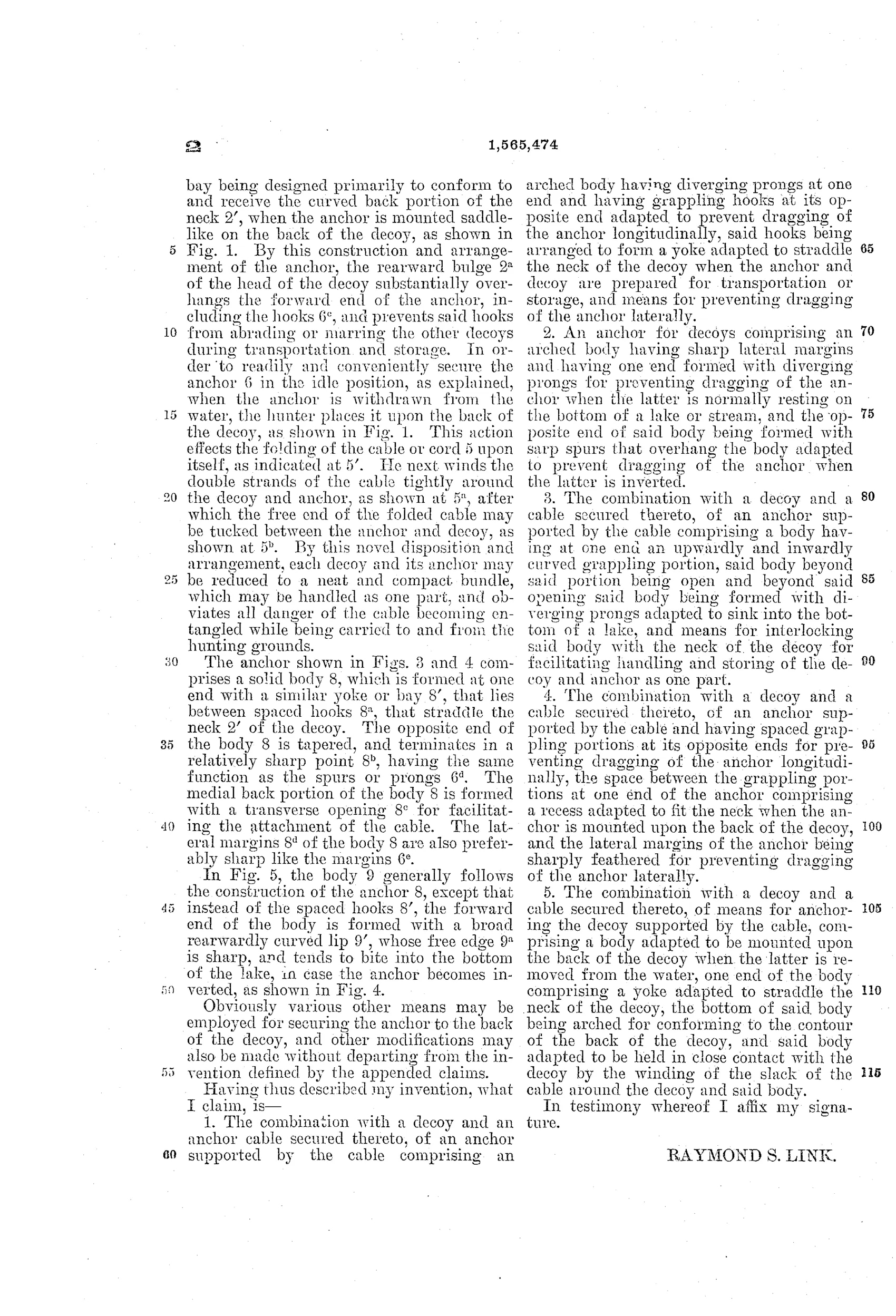
“1. The combination with a decoy and an anchor cable secured thereto, of an anchor supported by the cable comprising an arched body having diverging prongs at one end and having grappling hooks at its opposite end adapted to prevent dragging of the anchor longitudinally, said hooks being arranged to form a yoke adapted to straddle the neck of the decoy when the anchor and decoy are prepared for transportation or storage, and means for preventing dragging of the anchor laterally.”
In plain English: The anchor is an arched metal body with digging prongs on one end and hook-shaped grapples on the other that also form a yoke to clip over the decoy's neck for storage, plus sharp edges that stop it from sliding sideways.
➶ In the inventor’s words
“By this novel disposition and arrangement, each decoy and its anchor may be reduced to a neat and compact bundle, which may be handled as one part, and obviates all danger of the cable becoming entangled while being carried to and from the hunting grounds.”— Raymond S. Link, from the specification
Fate unknown
Grapple-style decoy anchors were common, but no marked example of Link's specific yoke design is documented; a surviving cast anchor matching the drawings would settle it.
➶ Commentary
Full disclosure: this one is a stray. Raymond Link's patent lives in the broad hunting-gear class alongside the calls, but it makes no sound — it's decoy hardware, the plumbing behind the spread that a caller works over. Still, it earns a look, because it answers the one question every waterfowler of the era cursed over: what do you do with a sharp anchor and six feet of wet cable when the hunt is over?
Link's answer is unusually integrated. The anchor is an arched grapple — diverging prongs at one end to dig into mud or snag weed, hooks at the other to stop it skidding sideways — and the clever part is that those same hooks are spaced to form a yoke. When you pull the rig, the anchor saddles onto the decoy's back, the yoke straddles the neck, and you wind the cable around the whole bundle. The drawing shows the detail most readers miss: the rearward bulge of the decoy's head overhangs the stowed hooks, so the points can't gouge the next bird in the sack.
Would it work? Mostly yes — grapple anchors of this general sort became standard, and neck-wrap stowage is exactly how hunters still carry weights today. Link's specific cast shape, with its counterweight screwed to the belly, is fussier than the lead teardrops that won out. A thoughtful, workmanlike piece of rigging, but a dead end as a product design.
Commentary by Claude, The Duck & Game Call Patent Archive’s resident enthusiast