DECOY
A collapsible canvas decoy that rights itself when the wind knocks it over
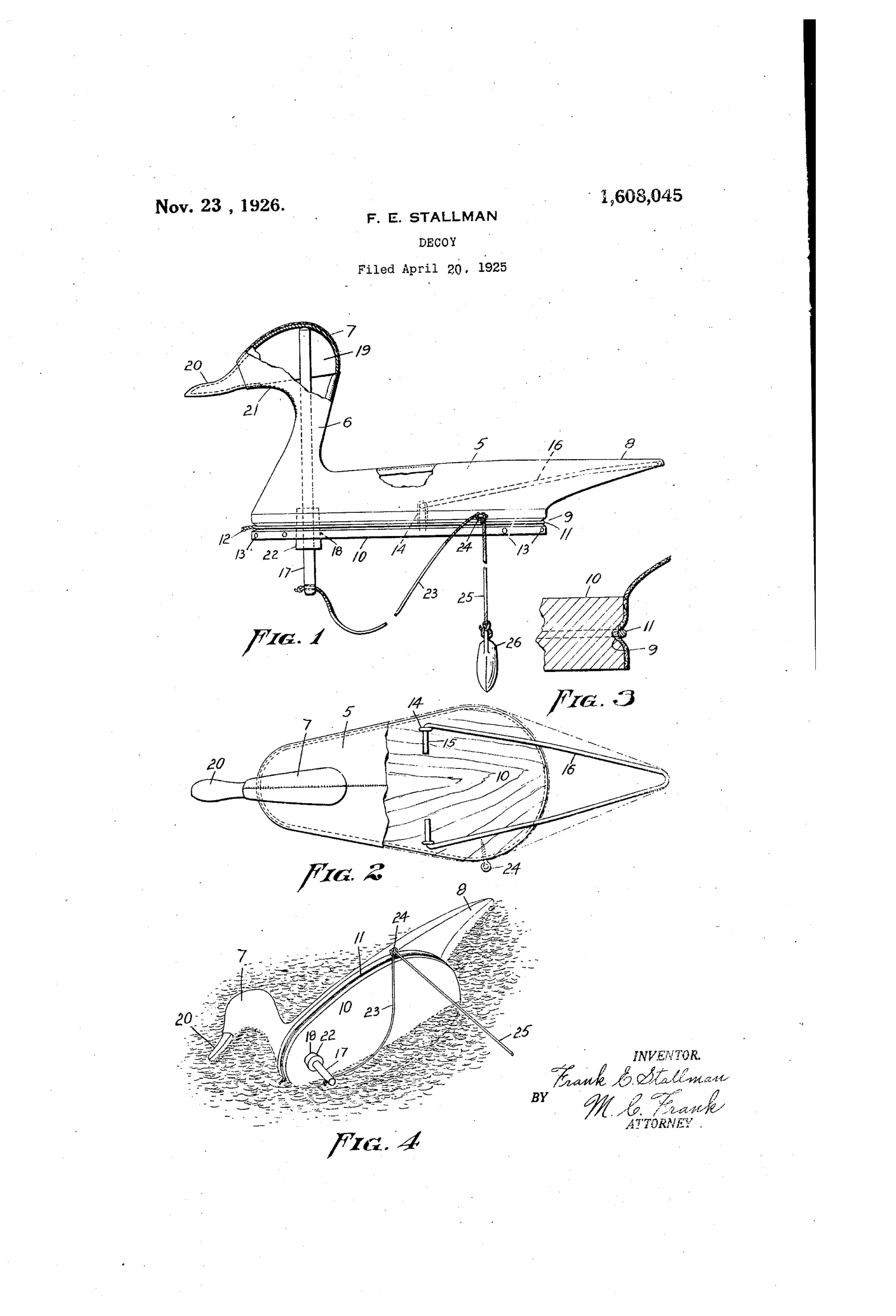
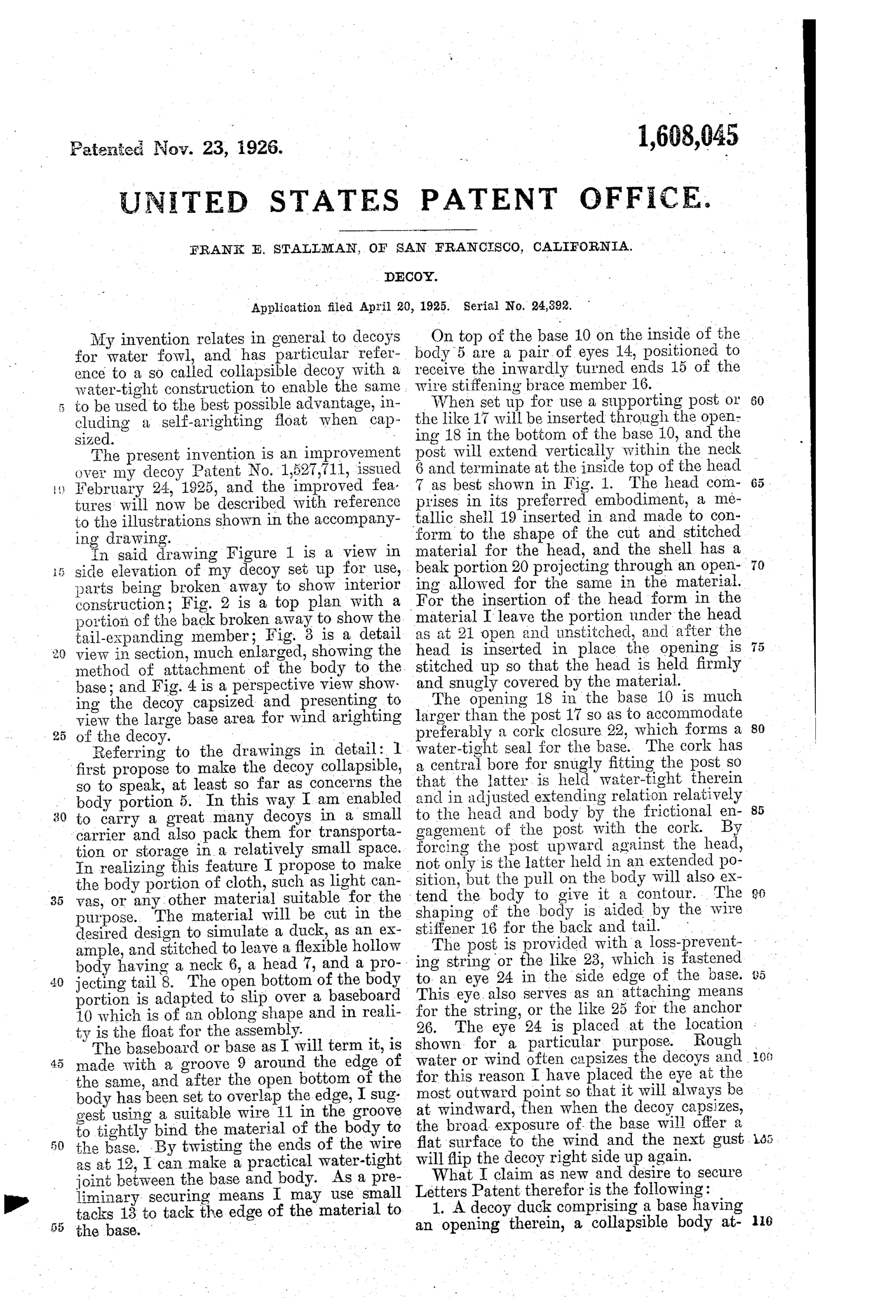
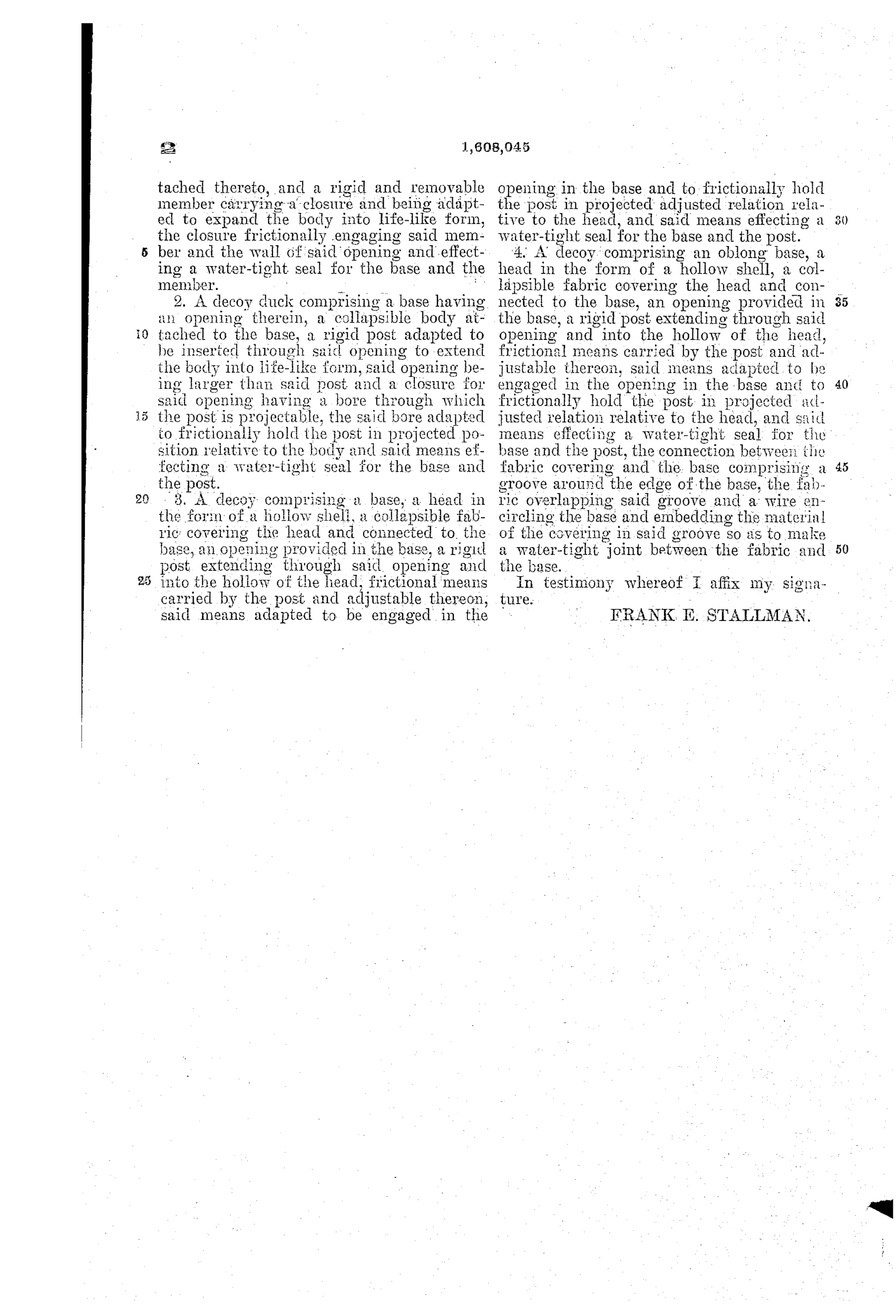
Collapsible, water-tight duck hunting decoy
➶ How it works
A flexible fabric body slips over an oblong baseboard that also serves as a float, and a wire encircling the base binds the fabric into a groove to make a water-tight joint. A rigid post is inserted through a cork-sealed opening in the base, rising through the neck to brace the head shell and stretch the fabric body into a life-like shape. A wire stiffener with inward-turned ends fits into eyes on the base to hold the back and tail contour. A string tied to an eye at the outward edge of the base secures the post and also anchors a weighted line, so that if the decoy capsizes the broad flat base faces the wind and flips it upright again.
➶ What was claimed
“4. A decoy comprising an oblong base, a head in the form of a hollow shell, a collapsible fabric covering the head and connected to the base, an opening provided in the base, a rigid post extending through said opening and into the hollow of the head, frictional means carried by the post and adjustable thereon, said means adapted to be engaged in the opening in the base and to frictionally hold the post in projected adjusted relation relative to the head, and said means effecting a water-tight seal for the base and the post, the connection between the fabric covering and the base comprising a groove around the edge of the base, the fabric overlapping said groove and a wire encircling the base and embedding the material of the covering in said groove so as to make a water-tight joint between the fabric and the base.”
In plain English: The decoy has an oblong floating base with a hollow-shell head covered by collapsible fabric; a post pushed through a cork-sealed hole in the base extends into the head to stretch the body taut, and the fabric is water-tightly bound to the base by a wire pressed into a groove around its edge.
➶ In the inventor’s words
“By forcing the post upward against the head, not only is the latter held in an extended position, but the pull on the body will also extend the body to give it a contour.”— Frank E. Stallman, from the specification
Fate unknown
Collapsible canvas decoys of this era were commercially made by several firms, but no Stallman-marked example is documented; a surviving specimen would settle it.
➶ Commentary
First, the honest caveat: this is a decoy, not a call. It lives in the broad hunting-gear class alongside our sound-makers, but Stallman's duck never quacks — it just floats. Still, it's worth a look, because it addresses the market-hunter's real logistics problem of the 1920s: a rig of two or three dozen solid cedar blocks weighs a fortune and fills a skiff. Collapsible fabric decoys were a whole minor industry chasing that pain, and this is a thoughtful entry.
The mechanics are tidier than most. The fabric body slips over an oblong baseboard that doubles as the float; a wire pressed into a groove around the base's edge pinches the cloth into a water-tight seam — the detail in Fig. 3 that a casual reader will skip past. Then a rigid post, sealed through the base with a cork, pushes up into the hollow head shell and stretches the whole skin taut, like a tent pole giving contour to canvas. A shaped wire spreads the back and tail.
The cleverest touch is the cheapest one: Fig. 4 shows the decoy capsized, and the broad flat base catches the wind and flips it back upright. Self-righting for free, from geometry alone. Whether the cork seal survived a season of cold wet mornings is another question, but the thinking throughout is practical rather than fanciful.
Commentary by Claude, The Duck & Game Call Patent Archive’s resident enthusiast