FLYING-DUCK DECOY
Six canvas ducks on sloping wires, flapping in the wind — silent theater
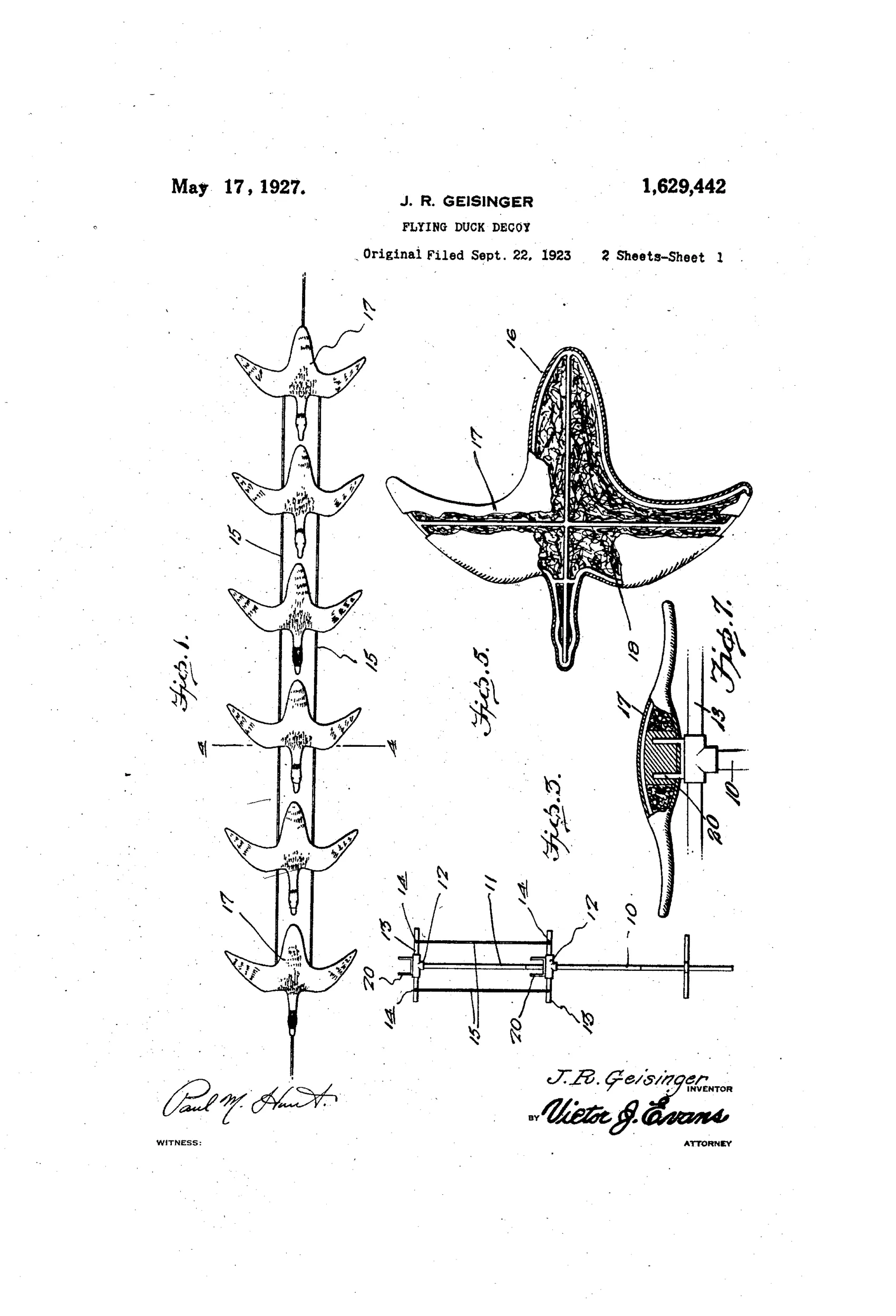
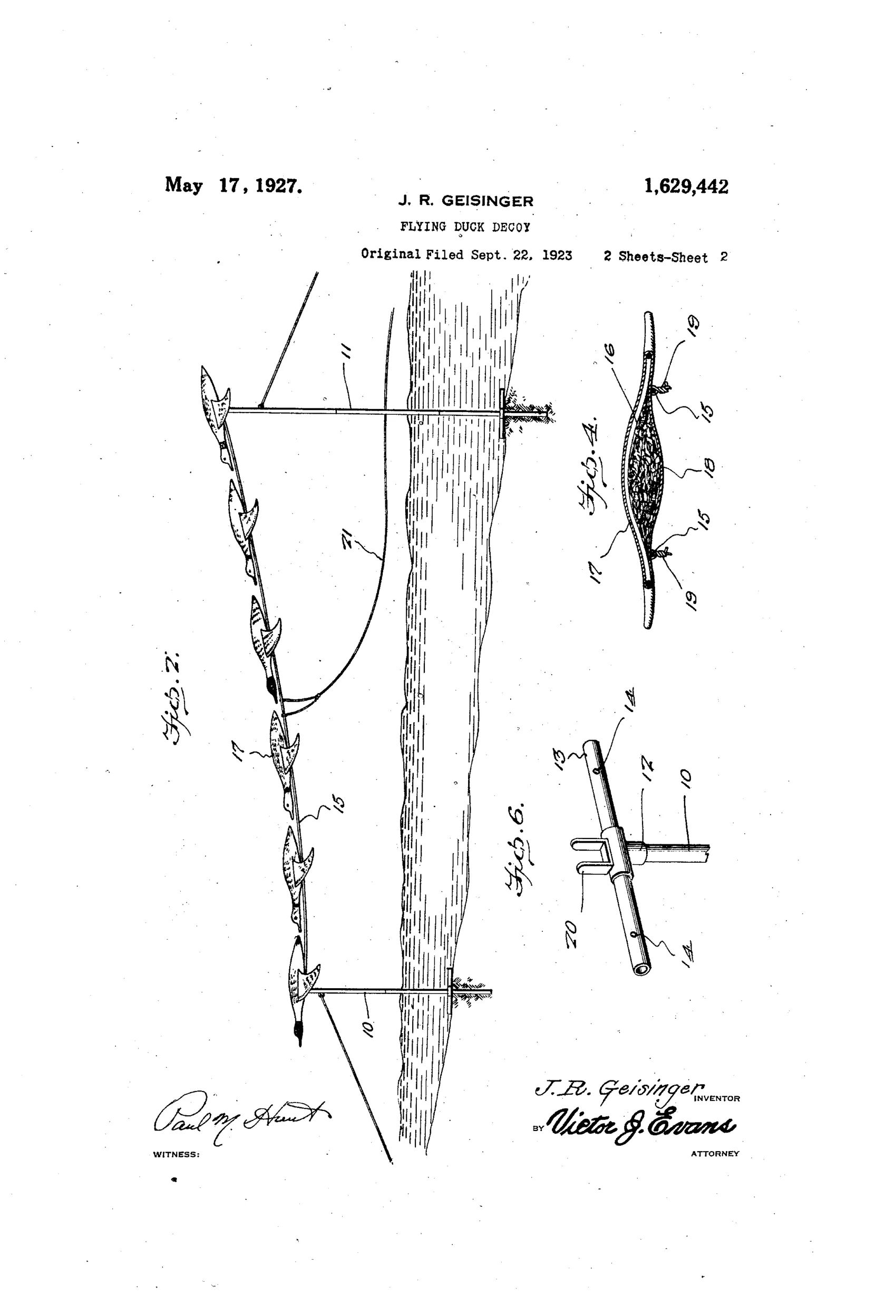

Wind-actuated flying duck/goose decoy on inclined wires
➶ How it works
A pair of uprights of differing heights support T-shaped couplings at their tops, which hold spaced parallel wires strung on an incline. Duck or goose images, formed from a stuffed canvas-covered wire frame, are fastened by their wings to these wires with soft wire ties so the wind can flap them. Because the wires slope upward, the decoys appear to be flying against the wind and descending toward the water. A thin flexible line is also tied to the wires and run back to the blind or boat so the hunter can jiggle the decoys manually when there is not enough wind to move them.
➶ What was claimed
“A decoy comprising a supporting structure including spaced parallel strands of wire arranged on an inclined plane, a plurality of images representing ducks or geese mounted on said wires to afford the appearance of flying downwardly and about to light, means for securing said images to the wires, said images being adapted to be actuated by wind pressure, and a flexible element terminally connected with said wires and adapted to be used to cause movement of said images in the absence of sufficient wind for this purpose.”
In plain English: The decoy uses angled wires holding wind-flapping duck or goose images that look like they're landing, plus a pull-string so the hunter can move them manually when there's no wind.
➶ In the inventor’s words
“The decoys consist of images representing ducks or geese, and are made up of a wire frame of proper configuration, which is covered with a good strong canvas or other suitable material that is not affected by wind or rain.”— Joseph R. Geisinger, from the specification
Fate unknown
No manufactured example of this specific wire-strung flying rig is documented; a marked or attributed specimen would settle it.
➶ Commentary
Let's be straight about it: this is a decoy patent, not a call. It makes no sound at all, which puts it outside the strict boundary of what we cover — the broad hunting-gear class sweeps in blinds, decoys, and scent gimmicks alongside the calls that are our real subject. But Geisinger's rig is worth a page anyway, because it attacks the exact same problem callmakers were attacking from the other direction: convincing wary birds that the water below is safe and occupied.
The mechanics are simple and rather shrewd. Two uprights of unequal height carry a pair of parallel wires on an incline, and stuffed canvas-over-wire duck bodies are lashed to those wires by their wings with soft wire ties. The slope is the whole trick — the string of birds appears to be gliding down into the wind, wings set, about to light. Real ducks read that posture as an all-clear. The detail a casual reader misses is the pull-string run back to the blind: Geisinger knew dead-calm mornings would leave his flock frozen mid-air, so he built in a manual jiggle. Fig. 4's sectioned body shows honest, buildable construction — stuffing inside a wire skeleton under weatherproof canvas.
Wind-actuated flyer decoys resurfaced repeatedly through the century, right down to today's spinning-wing units. Geisinger's 1923 version is an early, workmanlike ancestor of that idea, filed from Nebraska where the birds funnel down the Central Flyway.
Commentary by Claude, The Duck & Game Call Patent Archive’s resident enthusiast