DECOY
Trapped-air pockets instead of hollowing: a Gulf Coast decoy that floats on cushions
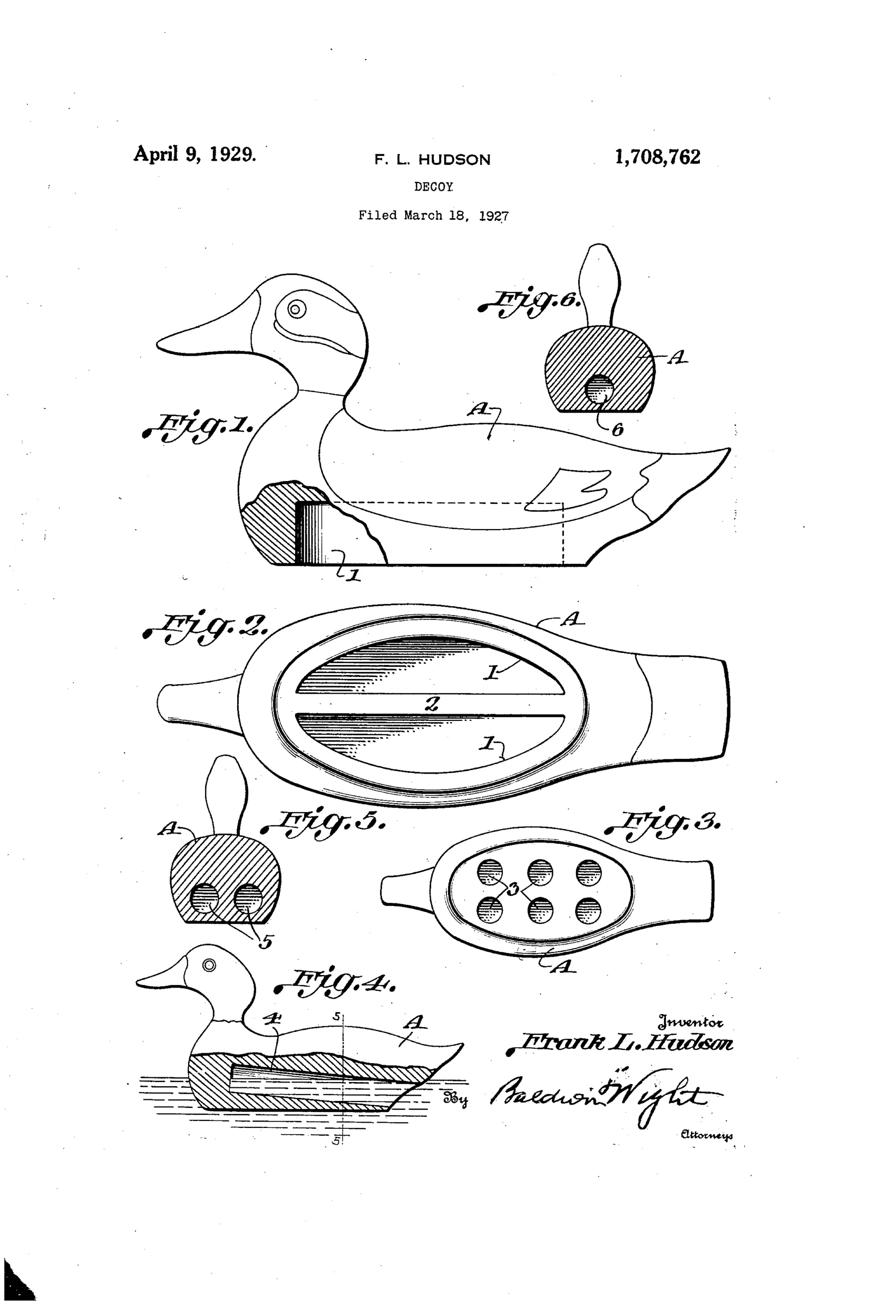
Wooden waterfowl hunting decoy with air-trapping cavities
➶ How it works
The decoy body is formed as a single piece of wood, fibre, or papier mache with cavities cut into its lower or side portions. These cavities are arranged symmetrically about the longitudinal centerline so that when the decoy floats, the outer ends of the openings are closed by contact with the water. This traps a cushion of compressed air inside each cavity, which stabilizes and cushions the decoy against tipping. Variations include semi-elliptical cavities separated by a rib, multiple circular holes, or bores drilled inward from the ends and slightly inclined so the rear opening seals against the waterline.
➶ What was claimed
“1. A decoy comprising a body portion having a plurality of non-communicating cavities formed in the lower part thereof and symmetrical with regard thereto said cavities being closed to the entrance of air when the decoy is in normal position.”
In plain English: The decoy has several separate cavities in its underside, arranged symmetrically, that seal shut when the decoy floats normally so air stays trapped inside.
➶ In the inventor’s words
“The heavier the decoy is, the larger the cavities should be to properly support and stabilize the decoy.”— Frank L. Hudson, from the specification
Fate unknown
No documented commercial production of Hudson's cavity decoys is known to me; a Pascagoula-area decoy with these characteristic bottom bores would settle it.
➶ Commentary
First, an honest housekeeping note: this is a decoy, not a call. It lands in our files because the Patent Office lumps all hunting gear together, but Hudson's duck makes no sound — it just floats. That said, the way it floats is genuinely interesting.
The standard problem with a solid wooden decoy is weight and tippiness; the standard fixes are hollowing the body (two halves glued around a void, prone to leaking) or ballasting the keel. Hudson's answer splits the difference. He cuts cavities into the underside of a one-piece body — paired ovals divided by a rib in Fig. 2, a cluster of drilled circles in Fig. 3, inclined end-bores in Fig. 6 — arranged so that when the bird sits on the water, the openings seal against the surface and trap compressed air inside. No glue joint to fail, no plug to leak, and the trapped air acts as a pneumatic cushion against rocking. His line that heavier decoys need larger cavities shows he was actually thinking about the physics, not just poking holes.
The weak spot is obvious in Fig. 4: the seal depends on the waterline meeting the openings just so. Chop, a lodged wave, or a tipped bird lets the air burp out, and then you have a solid decoy with holes in it. Clever in flat water, fragile everywhere else — which may be why hollowing and keel weights, not air pockets, won the long game.
Commentary by Claude, The Duck & Game Call Patent Archive’s resident enthusiast