CHAIR FOR HUNTERS
A duck-blind chair built entirely from hardware-store pipe fittings
Adjustable-height swiveling hunter's stool chair
➶ How it works
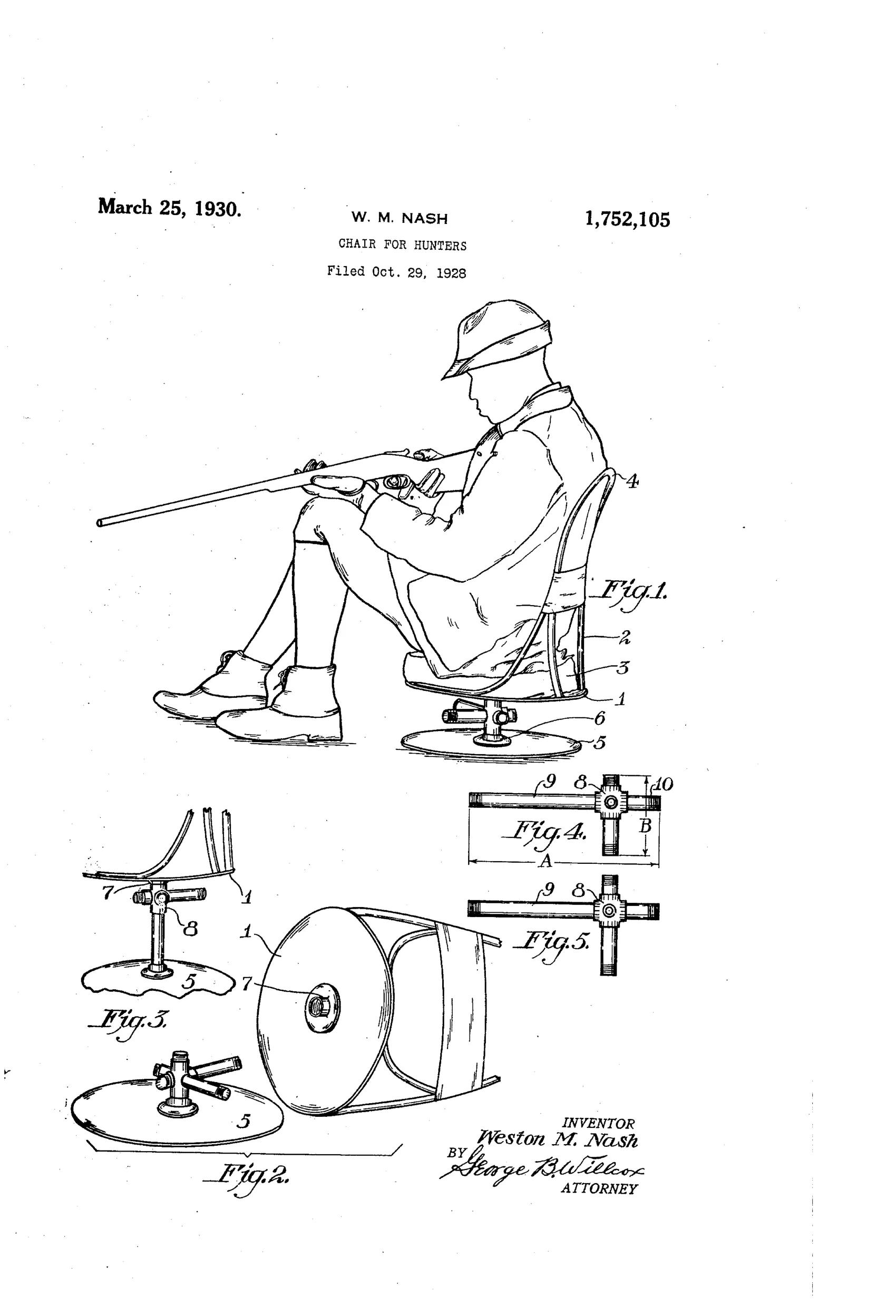
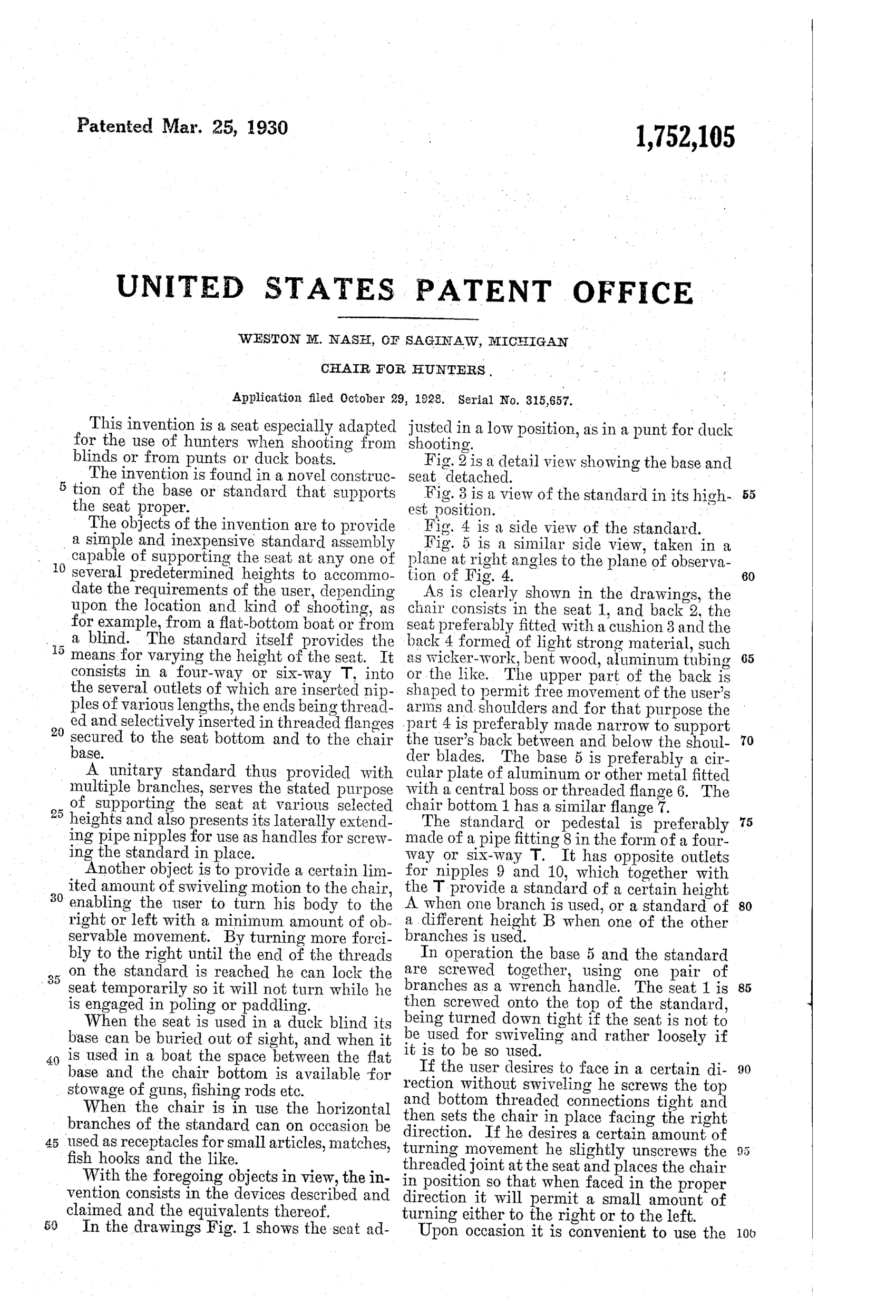
The chair uses a unitary pipe-fitting standard, a four-way or six-way T, with threaded nipples of various lengths screwed into its outlets. Selecting which pair of opposite nipples connects the flat base plate to the seat's threaded socket sets the overall seat height. The base and seat each carry a threaded flange or boss so the standard can be screwed tightly for a fixed position or left loose for limited swiveling. The unused horizontal nipple branches double as handles for installation and as small receptacles or gun-barrel rests when the chair is in use.
➶ What was claimed
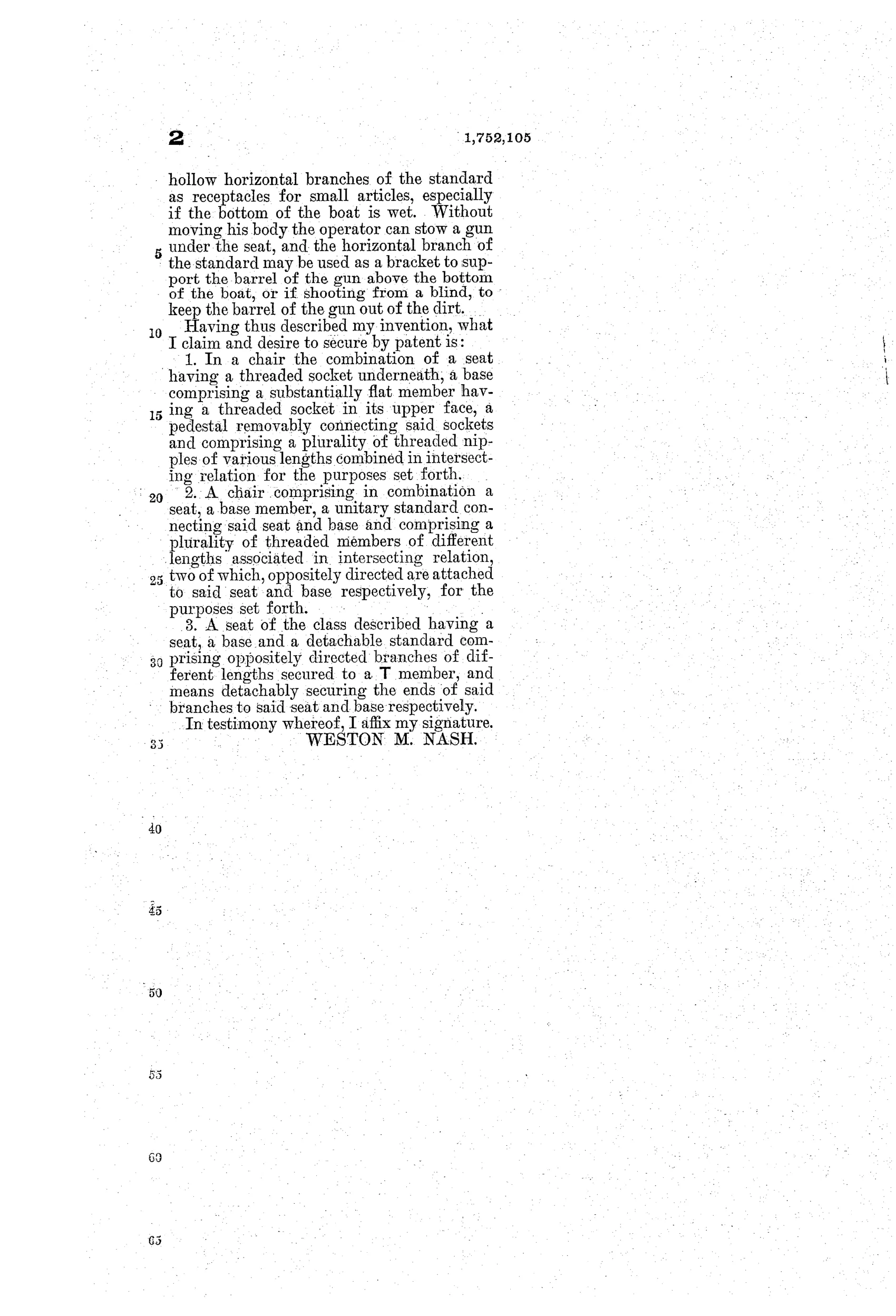
“1. In a chair the combination of a seat having a threaded socket underneath, a base comprising a substantially flat member having a threaded socket in its upper face, a pedestal removably connecting said sockets and comprising a plurality of threaded nipples of various lengths combined in intersecting relation for the purposes set forth.”
In plain English: A hunting chair whose seat and flat base each have a threaded socket, joined by a removable pedestal made of intersecting threaded nipples of different lengths so the height can be adjusted.
➶ In the inventor’s words
“When the seat is used in a duck blind its base can be buried out of sight, and when it is used in a boat the space between the flat base and the chair bottom is available for stowage of guns, fishing rods etc.”— Weston M. Nash, from the specification
Fate unknown
No manufactured example or maker is documented, though the design could be assembled from stock plumbing parts; a marked commercial specimen would settle it.
➶ Commentary
Let's be upfront: this isn't a call at all. Weston Nash of Saginaw patented a seat, and it wanders into our orbit only because it lives in the same broad hunting-gear class as blinds and decoys. Still, it's worth two minutes, because the mechanism is charmingly frugal.
The whole pedestal is a plumbing cross fitting — a four- or six-way T with threaded nipples of different lengths screwed into it. Height adjustment isn't a telescoping tube or a screw jack; you simply choose which pair of opposite nipples runs vertically between the flat base plate and the seat socket. Figures 4 and 5 make this plain: dimension A one way, dimension B the other. Rotate the cross ninety degrees, re-screw, and you've changed your seat height. The unused horizontal stubs then serve as handles for tightening, or as little rests for a gun barrel. Leave the joints slightly loose and the seat swivels — a genuine virtue when you're tracking a bird across the sky, as Fig. 1's hunter demonstrates.
The best line in the specification is the practical one: in a blind you bury the base out of sight; in a boat the gap under the seat stows guns and rods. It would absolutely work — pipe fittings are as strong as anything — though the two-position height adjustment is crude, and any machinist could assemble one without paying Nash a cent. That, more than anything, probably doomed it as a product.
Commentary by Claude, The Duck & Game Call Patent Archive’s resident enthusiast