DECOY
A retractable tape-measure anchor for decoys — clever hardware, but not a call
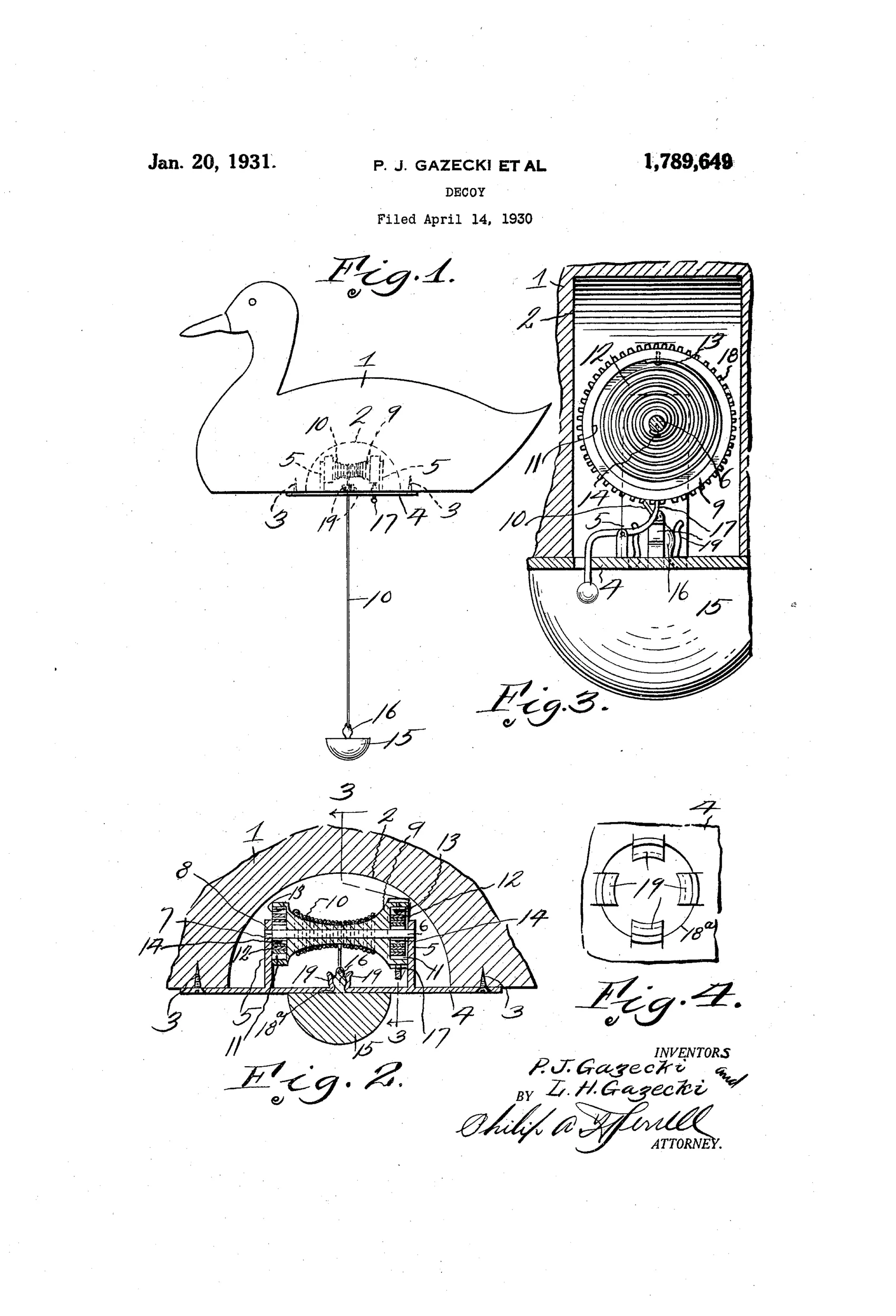
Self-retracting spring-wound anchor mechanism for duck decoys
➶ How it works
A plate secured to the underside of the decoy carries upstanding arms holding a stationary shaft, on which a reel is rotatably mounted. A coiled spring connects the reel to the shaft so that pulling the anchor cord downward tensions the spring, and a weighted detent engaging a gear on the reel holds the cord extended until released. When the detent is rocked free, the spring automatically rewinds the anchor cord and its weighted anchor onto the reel, and the anchor's enlarged head is then frictionally gripped by spring arms in the plate to hold it snugly for storage.
➶ What was claimed
“The combination with a decoy, of an anchor controlling device, said device comprising a single plate secured to the decoy adjacent a chamber in said decoy, spaced arms carried by said plate within the chamber, a reel mounted between said arms, spring means for rotating said reel in one direction, an anchor line extending around said reel and through an aperture in the plate, an anchor carried by said anchor line and detent means cooperating with said reel for holding the same against rotation or releasing the reel and allowing the same to rotate under the influence of the spring means.”
In plain English: A decoy with a spring-loaded reel mounted on a plate under the body, around which an anchor line winds, with a detent that can lock the reel or let it spin to automatically reel in the anchor.
➶ In the inventor’s words
“From the above it will be seen that an anchoring device is provided for decoys which is formed as a unit so it may be easily and quickly applied to decoys now in use, and said device is provided with means for automatically winding the anchor line on a reel and means for frictionally holding the anchor in inoperative position.”— Philip John Gazecki and Leonard Henry Gazecki, from the specification
Fate unknown
No manufactured example of this reel-anchor decoy is documented; a surviving decoy with the plate-mounted reel would settle it.
➶ Commentary
Full disclosure: this one sits at the edge of our beat. It's a decoy anchor, not a sound-maker — the patent class that covers duck calls also sweeps in every piece of hunting kit, and the Gazecki brothers of Menasha, Wisconsin were solving a rigging problem, not a calling one. Still, anyone who has ever untangled a dozen frozen anchor cords at 5 a.m. will understand exactly what they were after.
The mechanism is essentially a tape measure turned upside down. A plate screws to the decoy's flat bottom over a recessed chamber; inside, a reel rides on a fixed shaft with a coiled spring between them. Pull the anchor down and the spring winds; a weighted detent drops into a gear on the reel rim and holds the line at whatever depth you've paid out. Rock the detent free and the spring reels the whole works back up, with the anchor's mushroom head snapping into spring gripper arms (Fig. 4) so nothing dangles or clanks in the decoy bag. The self-contained unit design — 'easily and quickly applied to decoys now in use' — is the sensible part.
The dubious part is everything wet. A coiled spring and toothed detent living an inch above lake water, in a chamber open at the bottom, is a rust and grit trap. Wrapping cord around the keel cost nothing and never seized. That economics, more than any flaw in the geometry, is why hunters kept wrapping.
Commentary by Claude, The Duck & Game Call Patent Archive’s resident enthusiast