HUNTER'S DUCK DECOY
A decoy, not a call — and its head steers itself with an underwater rudder
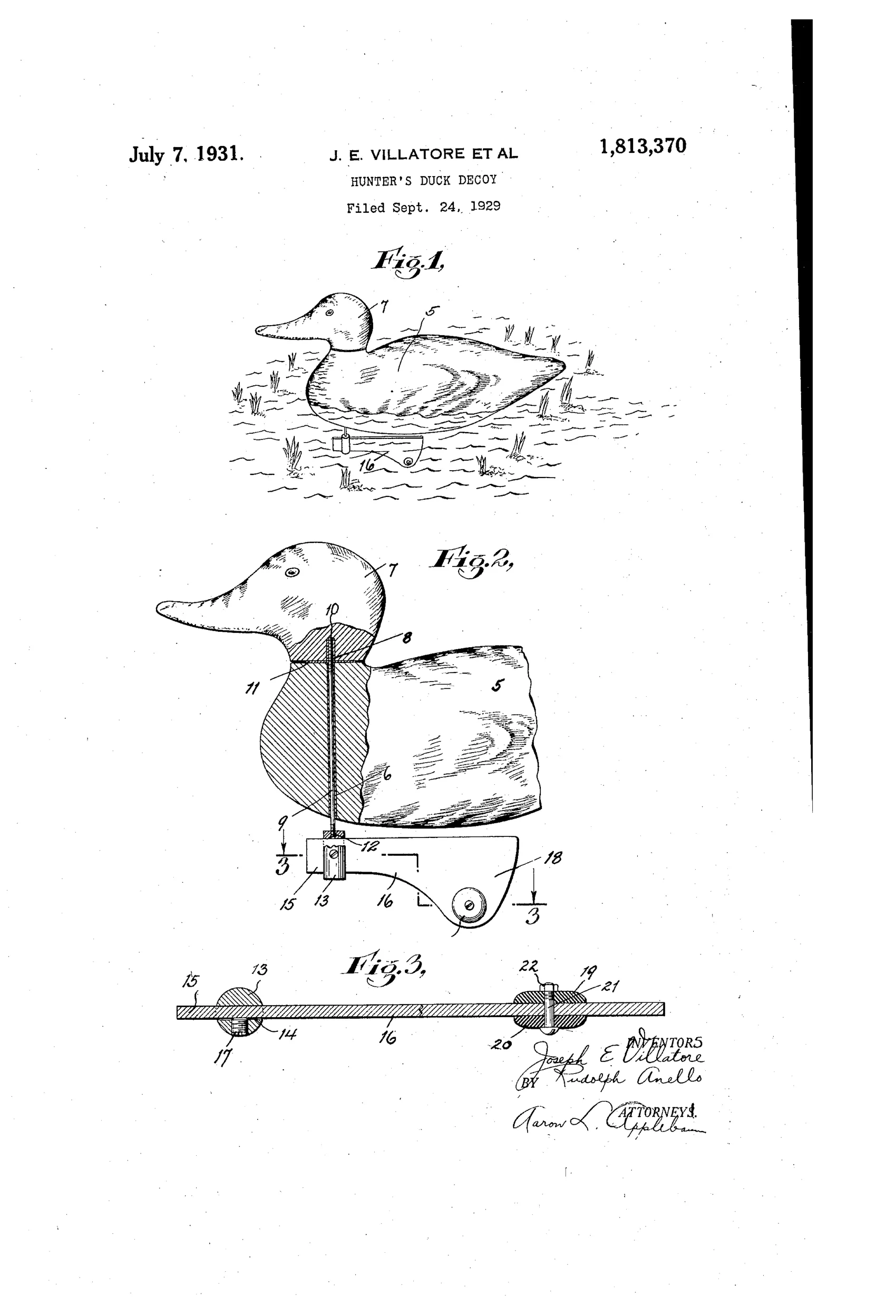
A self-righting, head-turning floating duck decoy
➶ How it works
The decoy body contains a vertical journal bushing through which a rod or stem passes, with a freely rotatable carved head fastened to the threaded upper end. The lower threaded end of the stem attaches to a slotted counterbalancing post that holds a spatula-shaped blade or vane extending in the opposite direction from the head. The vane has a rear rudder portion with attached weights on each side, balanced so that natural wave motion, currents, and eddies rotate and oscillate the vane, stem, and head together to simulate lifelike movement while preventing the body from tilting or capsizing.
➶ What was claimed
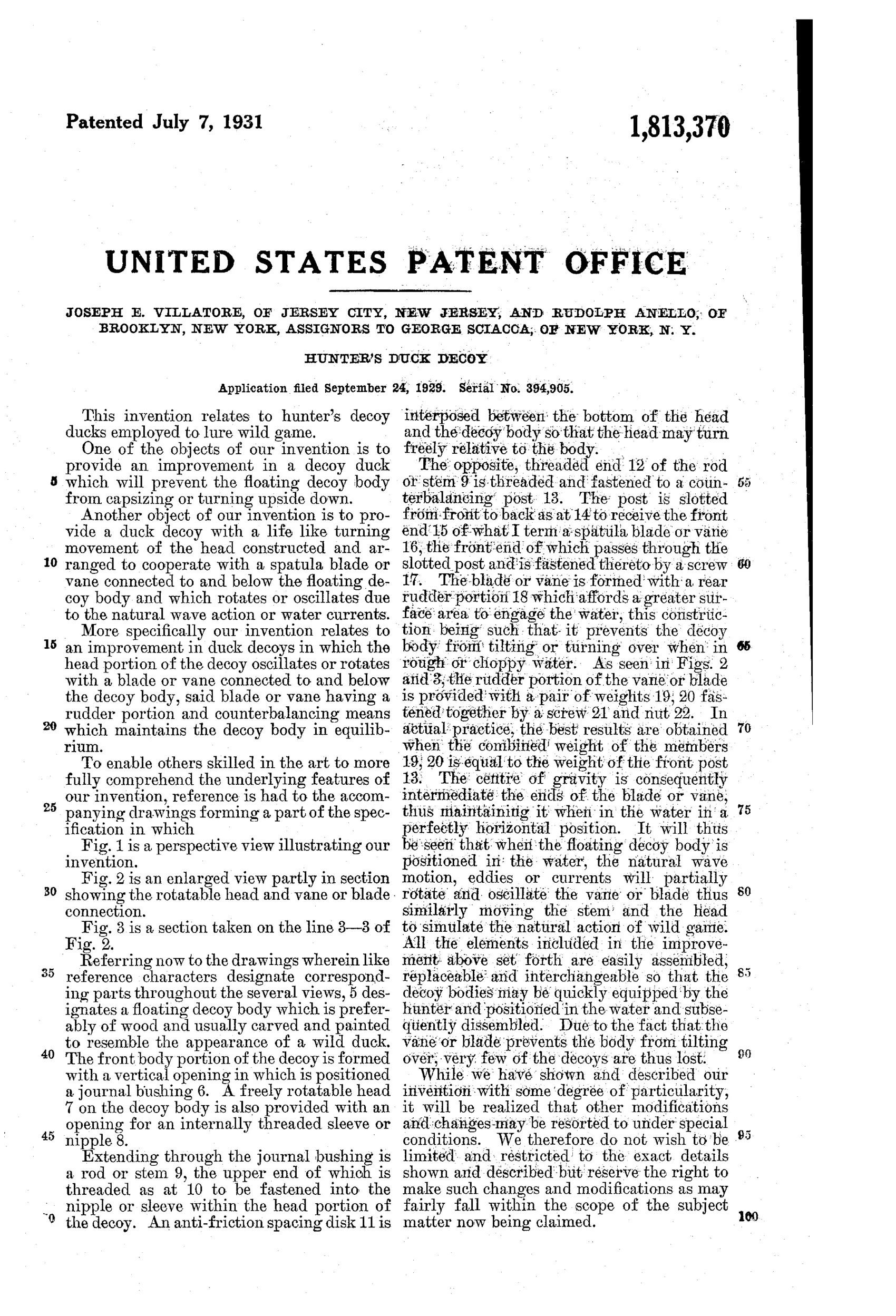
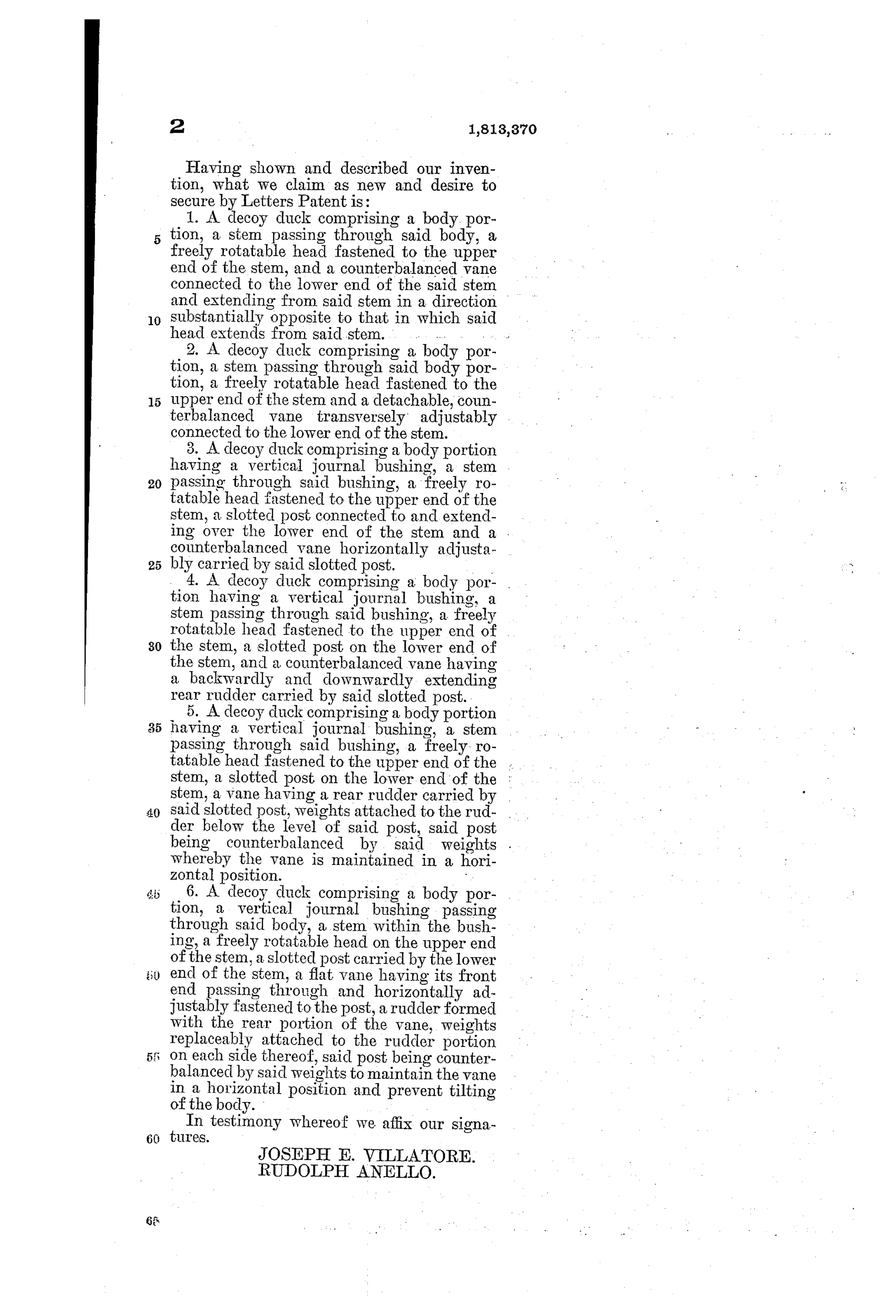
“1. A decoy duck comprising a body portion, a stem passing through said body, a freely rotatable head fastened to the upper end of the stem, and a counterbalanced vane connected to the lower end of the said stem and extending from said stem in a direction substantially opposite to that in which said head extends from said stem.”
In plain English: The decoy has a body with a stem through it, a head that spins freely on top of the stem, and a weighted vane on the bottom of the stem pointing the opposite way from the head.
➶ In the inventor’s words
“Due to the fact that the vane or blade prevents the body from tilting over, very few of the decoys are thus lost.”— Joseph E. Villatore, from the specification
Fate unknown
No documented commercial production of this design is known to me; a marked or attributable surviving decoy would settle it.
➶ Commentary
Full disclosure: this one is a stray in our category. Villatore's patent makes no sound at all — it is a floating decoy, and it belongs to the broad hunting-gear class that catches everything from blinds to scent bombs. But it earns a look for the mechanism alone, because it solves two decoy problems with one part.
The trick is the vertical stem running clear through the body. The carved head sits on the threaded top end and spins freely; the bottom end carries a spatula-shaped vane pointing the opposite direction, with small weights riveted to a rear rudder portion (the little numerals 19–22 in Fig. 3). Any current, eddy, or wave slap pushes the vane, and because head and vane are locked to the same stem, the head swivels with it. Nothing to wind, no clockwork, no cords to the blind — the water itself animates the bird. The same weighted blade doubles as a keel, and Villatore's dry boast that "very few of the decoys are thus lost" to capsizing is the practical selling point.
Where it sits in the story: rigged and mechanized decoys were a busy little patent niche between the wars, most of them fussier than this. Villatore's is refreshingly passive — one moving part, no springs. Whether a randomly wandering head reads as lifelike or as broken-neck to a wary mallard is the open question the drawing can't answer.
Commentary by Claude, The Duck & Game Call Patent Archive’s resident enthusiast