DECOY
A decoy, not a call — but the anchor hides inside the duck's head
Collapsible wild-fowl decoy with detachable head
➶ How it works
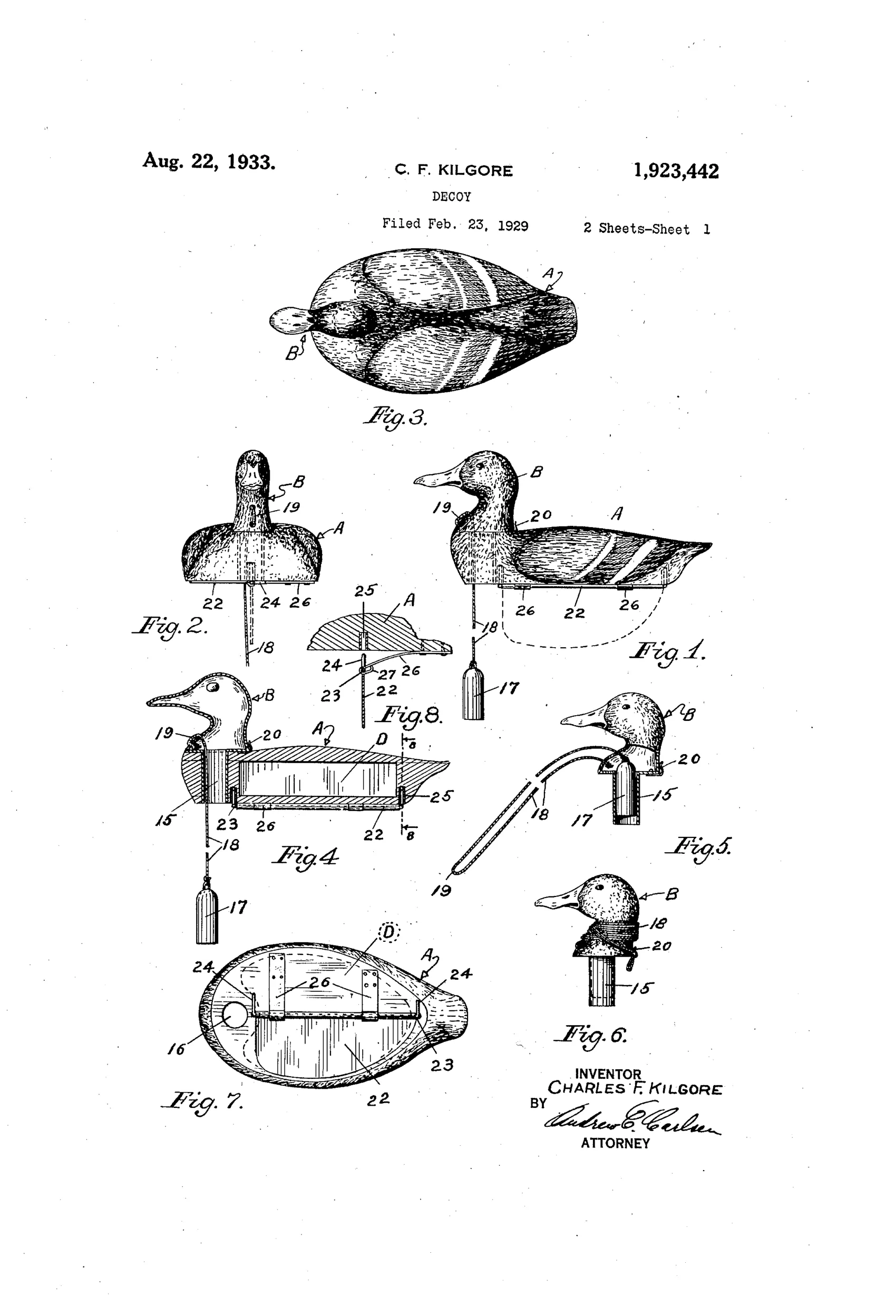
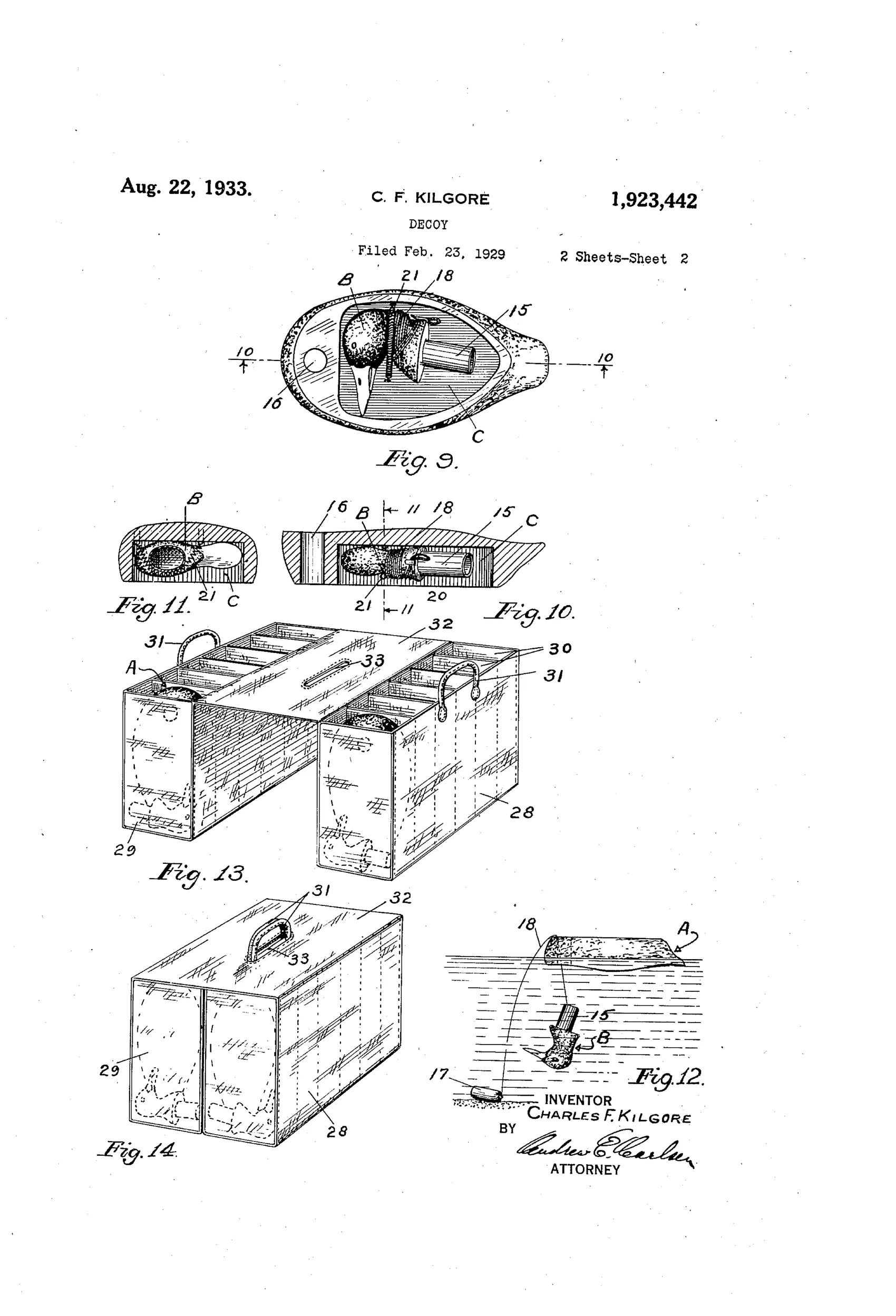
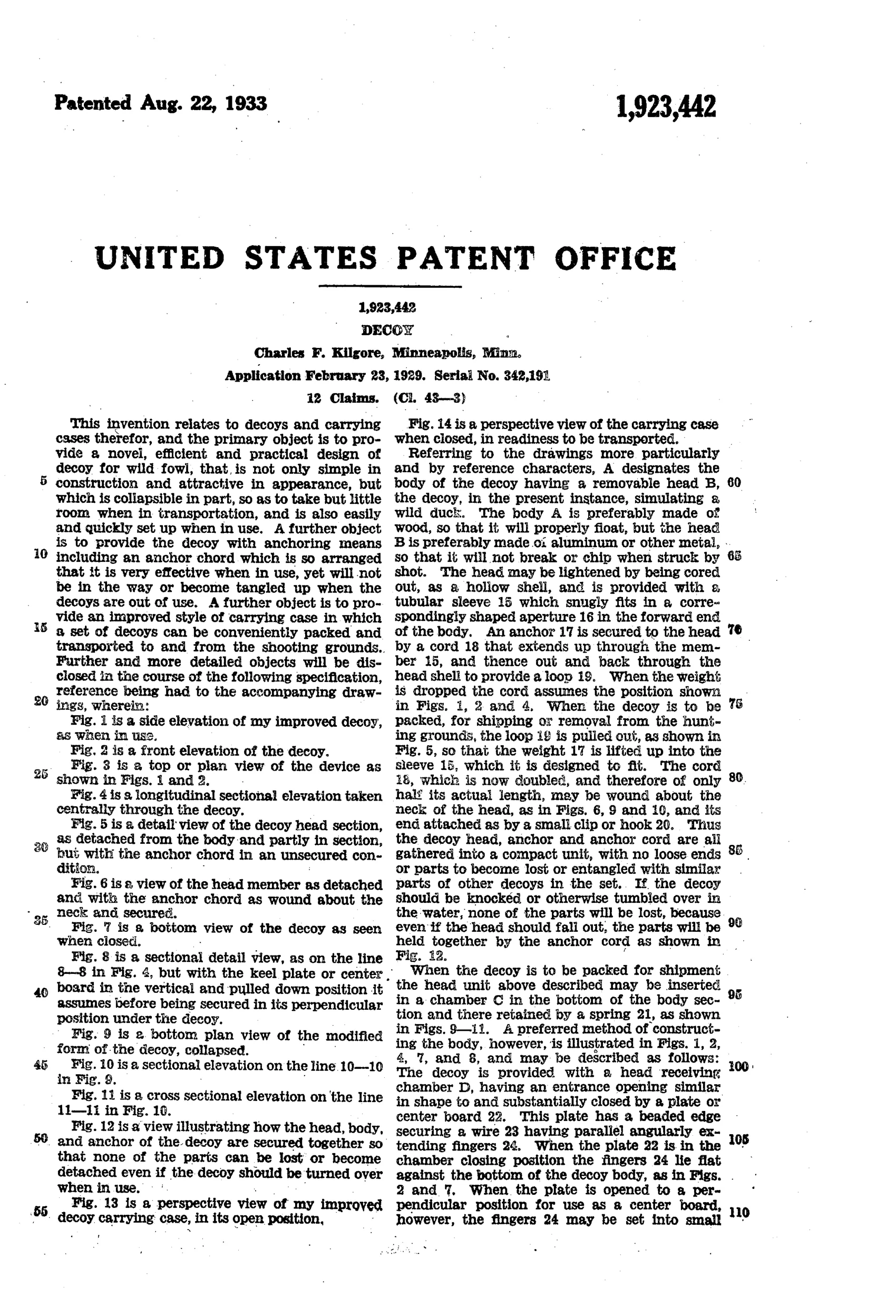
A wooden decoy body has a removable metal head that plugs into a tubular sleeve fitted into an aperture at the bow of the body. An anchor weight is tied by a cord running up through the sleeve and back out through the hollow head shell, forming a finger-loop at the head so the anchor can be pulled up into the sleeve for storage. The body also contains a hinged keel plate with spring-mounted wire fingers that fold flat to close a bottom storage chamber or swing down perpendicular to act as a stabilizing centerboard when in use. A companion carrying case with paired partitioned compartments and interlocking handles lets several collapsed decoys be packed and closed under one cover member.
➶ What was claimed
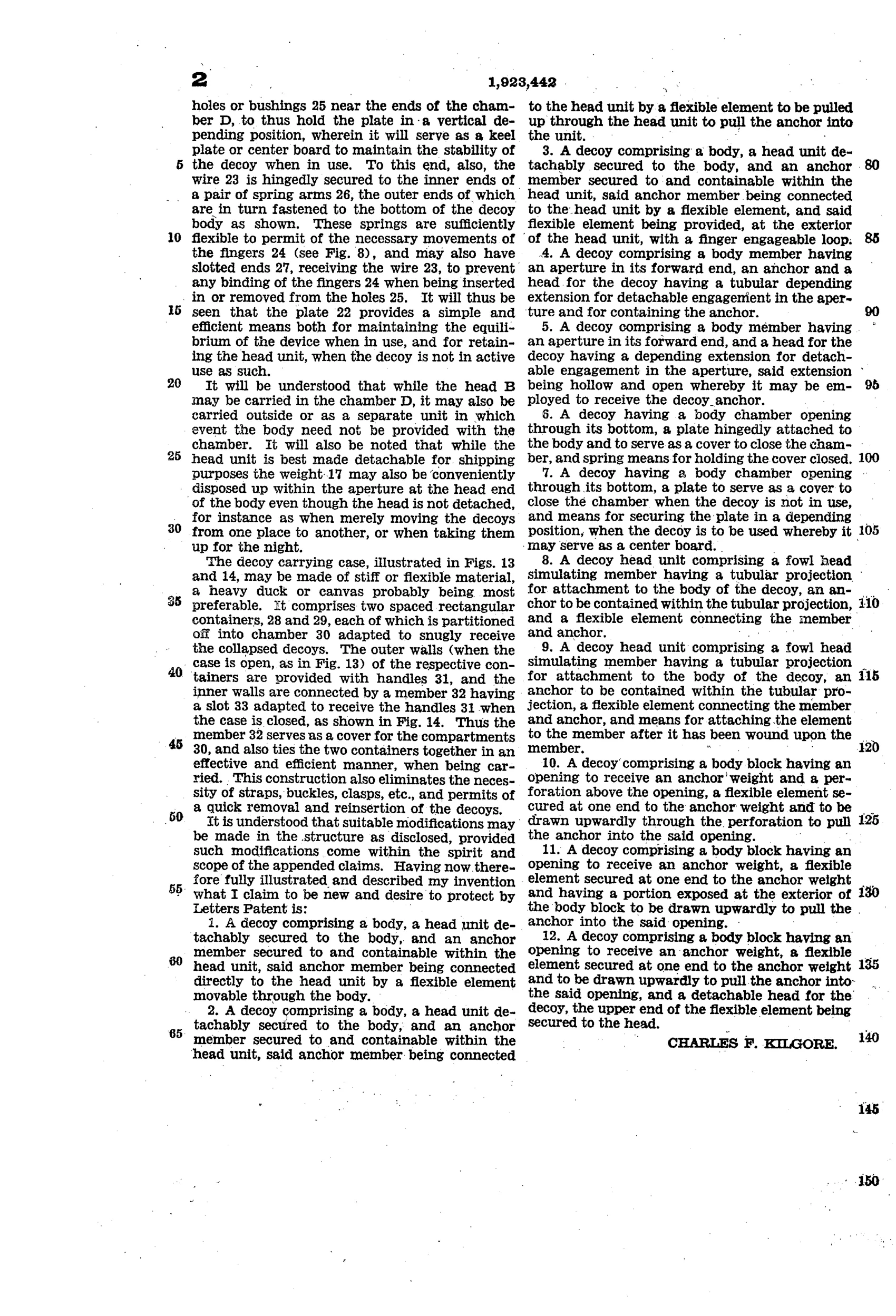
“A decoy comprising a body, a head unit detachably secured to the body, and an anchor member secured to and containable within the head unit, said anchor member being connected to the head unit by a flexible element to be pulled up through the head unit to pull the anchor into the unit.”
In plain English: The decoy has a body, a removable head, and an anchor stored inside the head, connected by a cord that can be pulled up through the head to draw the anchor in.
➶ In the inventor’s words
“If the decoy should be knocked or otherwise tumbled over in the water, none of the parts will be lost, because even if the head should fall out, the parts will be held together by the anchor cord as shown in Fig. 12.”— Charles F. Kilgore, from the specification
Paper patent — likely never produced
The multi-part metal-and-wood construction plus fitted case would have been expensive for a Depression-era decoy market; no manufactured Kilgore example is known to me, and a marked specimen would change this call.
➶ Commentary
Fair warning to readers of this site: Kilgore's patent is a decoy, which puts it in the broader hunting-gear class rather than among the sound-makers we usually cover. It landed in our stack because the harvest class sweeps in blinds, decoys, and calls alike, and it's worth a paragraph anyway because it solves a problem every duck hunter who ever lugged a sack of blocks will recognize.
The clever bit is where the anchor lives. The cord runs from the weight up through a tubular sleeve in the body, out through the hollow metal head, and ends in a finger loop — so when you pick up your rig, you haul the anchor straight up into the sleeve and the whole assembly rides as one unit. Fig. 6 shows the head detached with the cord wound around its neck like a spool, which is a genuinely tidy piece of packaging. Add the hinged spring-wire keel that folds flat to close the bottom chamber, and you have a decoy engineered like a pocketknife.
The honest question is weight and cost. A wooden body with a metal head shell, an internal sleeve, a hinged keel, and a fitted partitioned carrying case is a lot of manufacturing for an object hunters bought by the dozen and treated roughly. The 1929 filing sat four years before issuing in 1933 — not a friendly market for a premium decoy. Ingenious, probably workable, and likely priced out of its own audience.
Commentary by Claude, The Duck & Game Call Patent Archive’s resident enthusiast