DECOY
A decoy, not a call — but its wind-swinging head earns a look
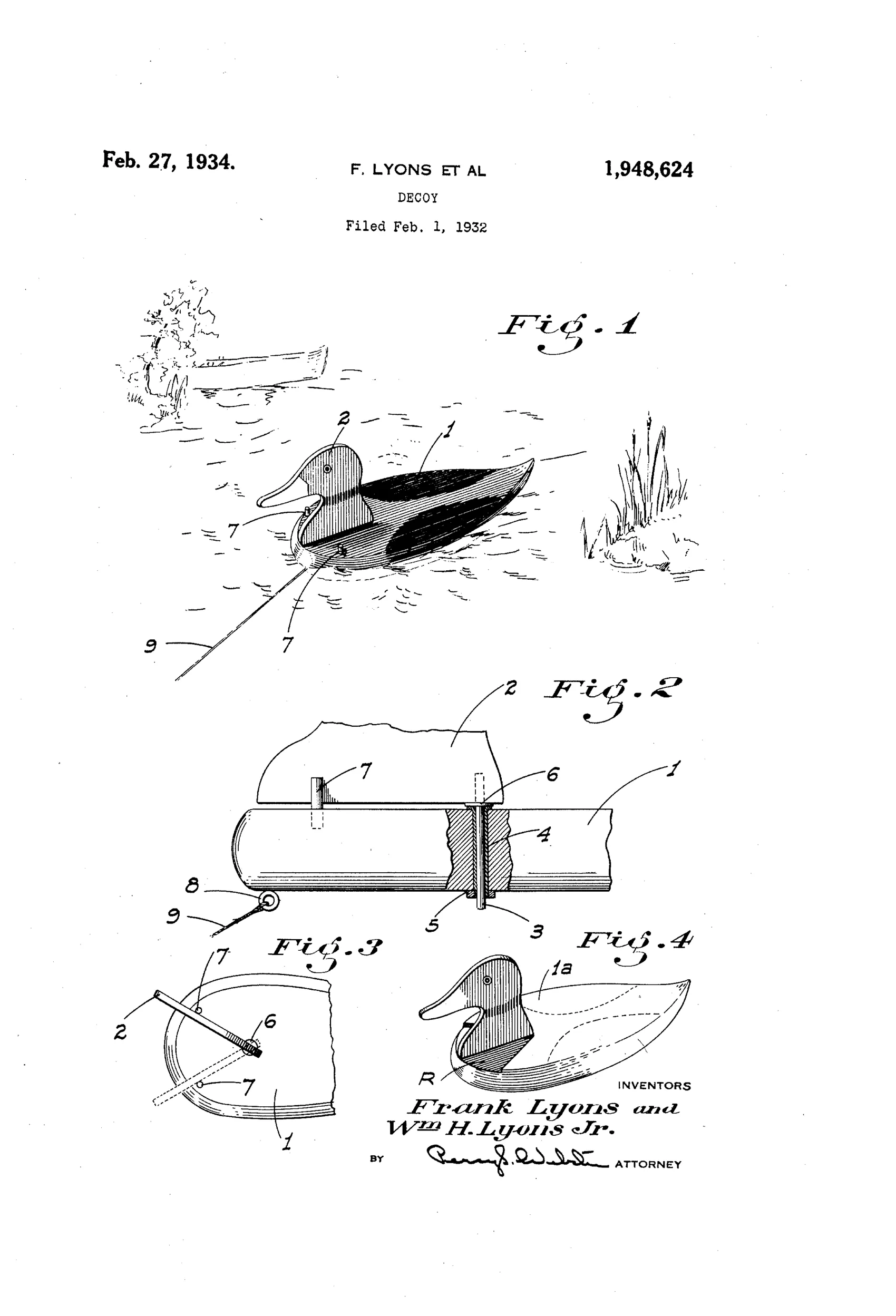
Wooden duck decoy with pivoting, wind-swinging head
➶ How it works
The decoy has a flat balsa wood body shaped like a duck, with a separate thin flat head pivoted near its rear end by a pin passing through a vertical flange bushing. This pin fits loosely in the bushing to allow the head to swing side to side on a horizontal plane, held in place by a nut and a non-removable washer that spaces the head above the body. Symmetrically placed stop pins (or alternatively an arcuate recess) limit the head's swing to about 60 degrees of arc. As wind catches the flat head, it swings until hitting a stop, which then pushes against the body via the pivot, causing the whole decoy to swing and wiggle in the water, imitating a live swimming duck; a ring and cord anchored at the front keep the decoy facing into the wind so this oscillation continues.
➶ What was claimed
“A decoy comprising a body, a head separate therefrom, a pivot between the body and head toward the rear end of the latter; the top surface of the body having a recess into which the base of the head in front of the pivot depends, the side edges of the recess being disposed to limit the turning of the head to an arc of predetermined degree.”
In plain English: A duck decoy with a body and separate head joined by a rear pivot, where a recess in the body's top surface limits how far the head can swing side to side.
➶ In the inventor’s words
“The principal object of our invention is to provide a decoy that will float upon the surface of the water and slowly turn from one direction to another in such a manner as to simulate the swimming action of a live duck etc.”— Frank Lyons and William H. Lyons, Jr., from the specification
Fate unknown
No documented commercial production is known; a marked Lodi-area specimen with the pivoting head would settle it.
➶ Commentary
Housekeeping first: this is a decoy, not a game call. It makes no sound, so it sits outside our proper beat — the broad hunting-gear class sweeps decoys, blinds, and calls into the same drawer, and this one fell out with the mail. But since the Lyons father-and-son pair from Lodi solved the same problem callmakers were chasing — convincing a wary duck that something dead is alive — it's worth a paragraph before we send it home.
The mechanism is genuinely economical. The head is a thin flat blade pivoted near its rear edge, loose on a pin through a bushing, with stop pins limiting the swing to about sixty degrees. Wind pushes the flat head like a weathervane until it hits a stop; the impact then transmits through the pivot to the whole body, which swings and wiggles at anchor. The single anchor ring at the bow keeps the decoy nosed into the wind so the cycle repeats. No springs, no clockwork, no strings back to the blind — the wind does all the labor, which is exactly the right instinct for gear that lives in cold water.
Fig. 2 rewards a close look: the non-removable washer spacing the head above the body is the detail that keeps the swinging head from binding on a swollen wooden deck. That's a hunter's fix, not a draftsman's. Balsa body, dead-simple joinery — this could be built in a garage, and probably was, at least once.
Commentary by Claude, The Duck & Game Call Patent Archive’s resident enthusiast