DECOY DUCK ANCHOR
A tape-measure reel inside a wooden duck — decoy hardware, not a call
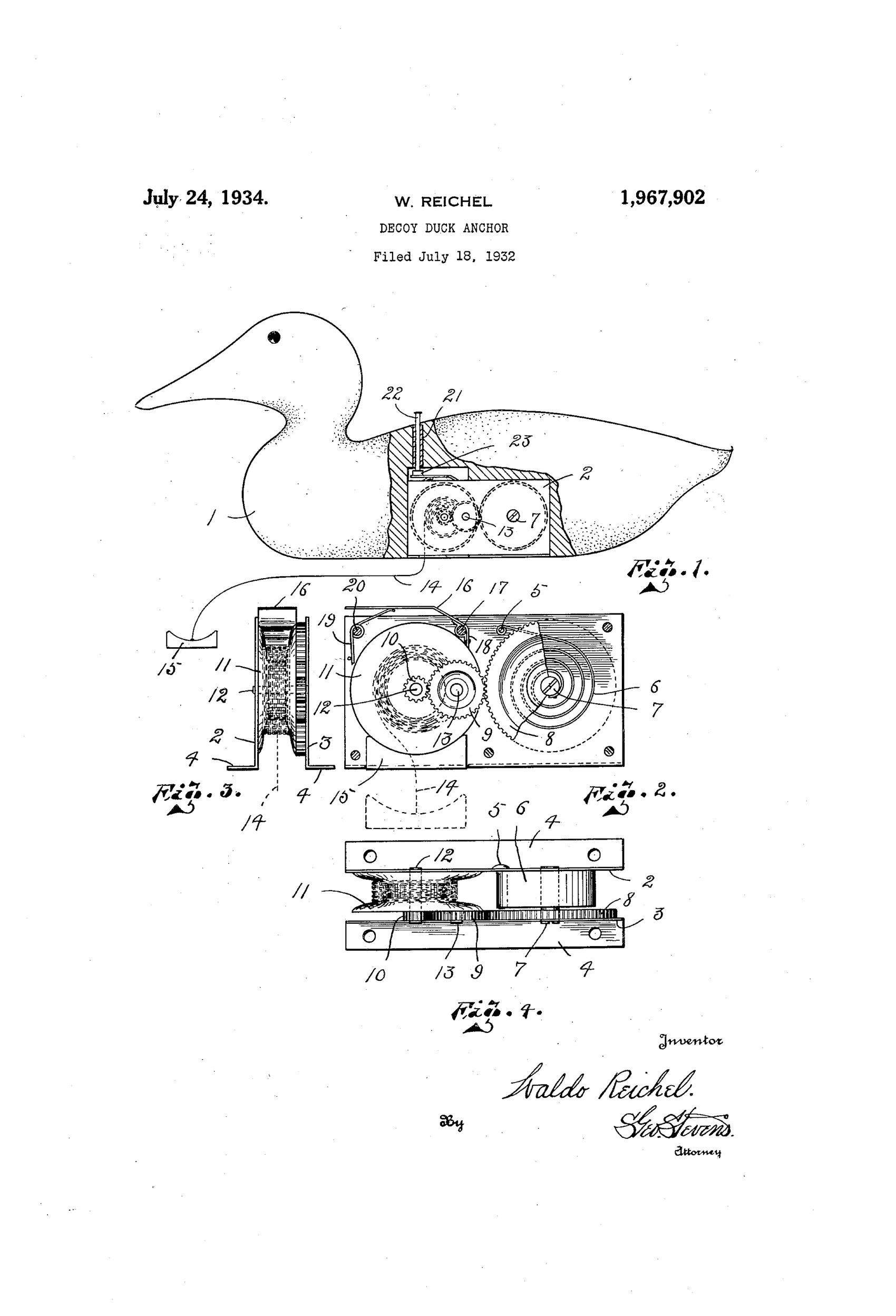

Spring-wound retractable anchor line mechanism for duck decoys
➶ How it works
A gear-driven drum housed inside the hollow body of a wooden decoy winds and retracts the anchor line. A coiled helical spring on a through shaft drives a train of power gears that turn a line-carrying drum many times per single spring revolution, allowing a compact spring to do the work. A pivoted flat metal brake strip normally locks the drum until a spring-loaded release pin, accessible from the top of the decoy, is pressed to free the brake and let the spring retract the anchor line. The anchor itself is arcuate to seat flush against the drum flanges within a recess in the decoy's underside, with finger holds at each end for manual adjustment of depth.
➶ What was claimed
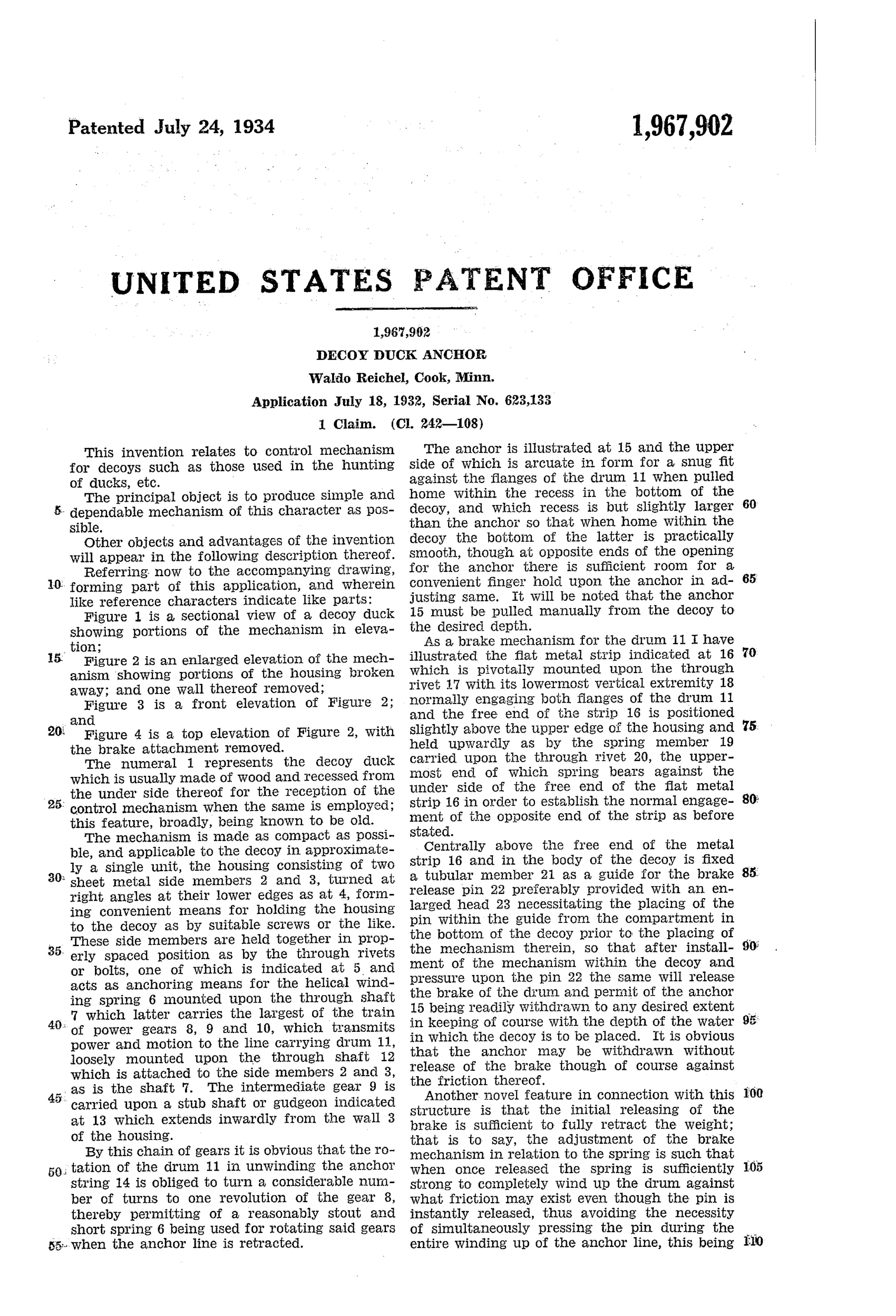
“A winding mechanism of the type described adapted for use in a decoy for operating the anchor line of same comprising spaced supporting members outwardly flanged upon their lowermost edges for attachment to the body of the decoy, means for holding said plates in spaced relation, an anchor line drum and shaft mounted adjacent one end of said members, a similar parallel shaft adjacent the other end, a driving gear keyed to said latter shaft, an expansive spring keyed to said latter shaft, an intermediate gear and stub shaft mounted in one of said supporting members and in constant mesh with the driving gear, and a smaller gear mounted upon the drum shaft and keyed thereto and in mesh with the intermediate gear.”
In plain English: The invention is a compact gear-and-spring winding mechanism, mounted between two flanged side plates fixed inside a decoy, that uses a spring-driven gear train to turn a line-winding drum for retracting the anchor.
➶ In the inventor’s words
“It is obvious that the anchor may be withdrawn without release of the brake though of course against the friction thereof.”— Waldo Reichel, from the specification
Fate unknown
No manufactured example or commercial version is documented; a surviving decoy with this internal reel would settle it, though the cost and corrosion problems make production doubtful.
➶ Commentary
Fair warning to readers who come here for reeds and tone boards: Waldo Reichel's patent makes no sound at all. It lands in our files because it lives in the same broad hunting-gear class as calls, but it belongs to the decoy side of the marsh — and it's an unusually ambitious piece of decoy plumbing, so it earns a look anyway.
The problem is real. Anyone who has picked up a rig of two dozen decoys knows the misery: cold, wet anchor cord wrapped by numb fingers around each bird, tangling in the boat. Reichel's answer is essentially a spring-loaded tape measure buried in the duck's belly. Fig. 2 shows the heart of it — a coiled power spring driving a gear train that steps up to the line drum, so a compact spring can pull in many feet of cord. A flat brake strip locks the drum, and a release pin poking up through the decoy's back (item 21 in Fig. 1) frees it. Press the button, and the anchor reels itself home. The arcuate anchor even seats flush in a recess underneath, so nothing dangles.
Would it work? Mechanically, probably — until pond water, sand, and freezing weather met that gear train. A sealed spring reel in every decoy also means real cost per bird, in the Depression, for gear hunters bought by the dozen. It's clever, honest engineering aimed at a genuine annoyance, and almost certainly too much machine for the job. Simpler wrap-around anchor designs won.
Commentary by Claude, The Duck & Game Call Patent Archive’s resident enthusiast