IMPROVEMENT IN TOYS
A reed larynx and squeezable spring-hinged lips, built to say "Mamma"
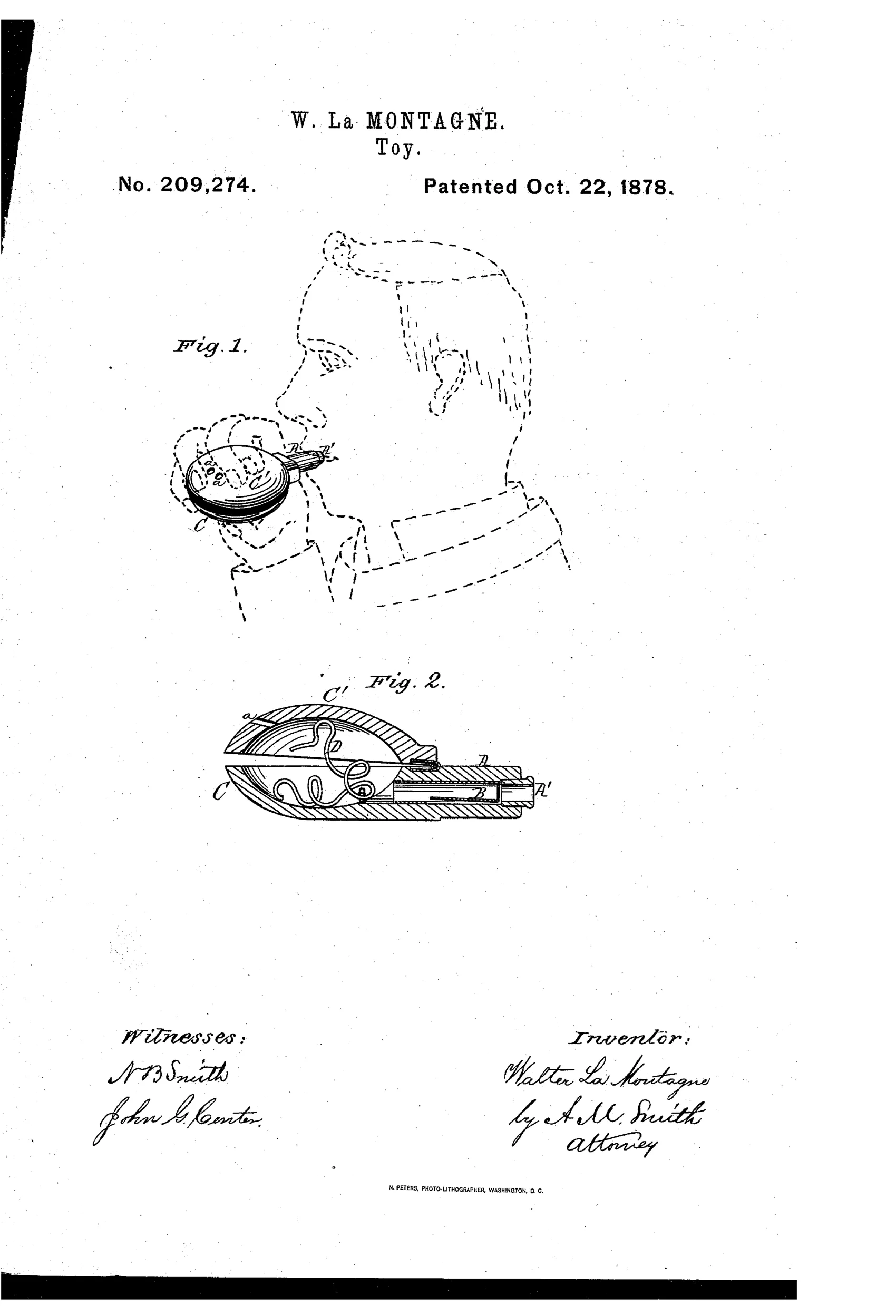
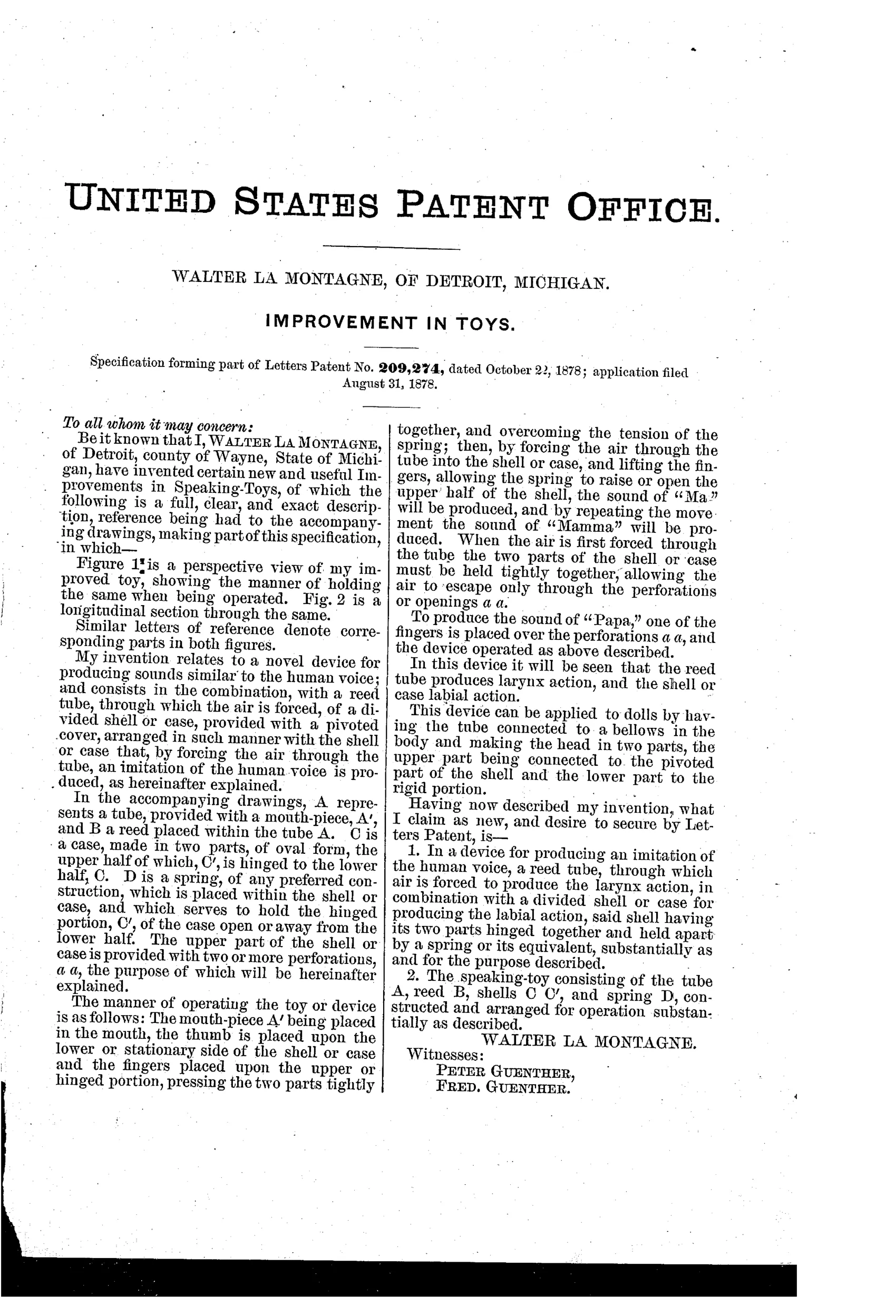
A mouth-blown toy that mimics human speech
➶ How it works
A reed tube with mouthpiece is blown into by the user to produce a larynx-like tone. The tube feeds air into a hinged, divided oval shell held apart by a spring, and squeezing the two shell halves together against the spring produces labial-like sounds. Alternating blowing and squeezing/releasing produces 'Ma' or repeated 'Mamma,' while covering small perforations in the upper shell with a finger changes the sound to 'Papa.' The device can also be adapted into a doll by connecting the tube to a bellows in the body and splitting the head into hinged and rigid parts.
➶ What was claimed
“1. In a device for producing an imitation of the human voice, a reed tube, through which air is forced to produce the larynx action, in combination with a divided shell or case for producing the labial action, said shell having its two parts hinged together and held apart by a spring or its equivalent, substantially as and for the purpose described.”
In plain English: The invention combines a reed tube that makes a larynx-like sound with a spring-hinged, two-part shell that makes a lip-like sound, together imitating human speech.
➶ In the inventor’s words
“This device can be applied to dolls by having the tube connected to a bellows in the body and making the head in two parts, the upper part being connected to the pivoted part of the shell and the lower part to the rigid portion.”— Walter La Montagne, from the specification
Fate unknown
The mechanism is buildable and cheap, but no marked example or licensed production is documented; a surviving specimen or trade-catalog listing would settle it.
➶ Commentary
Let's be honest up front: this is a talking toy, not a duck call, and it wandered into our files because it shares a skeleton with every call on this site — a reed tube driven by breath, feeding a resonating chamber. What La Montagne does with that skeleton is the interesting part. Instead of tuning the chamber for a quack, he splits it into a hinged clamshell held open by a spring, so squeezing it shut interrupts the airflow the way lips do. Reed as larynx, shell as mouth. Blow steadily, pump the shell, and you get 'Ma-ma.' Cover the little perforations in the upper half with a finger and the consonant shifts toward 'Pa-pa.'
Fig. 2 is worth a slow look. The coiled spring sits inside the shell, and the reed tube enters from the side rather than the rear — the acoustic chamber and the mechanical action share one small oval body. That is genuinely economical design, and the physics is sound: interrupting a reed's airflow really does produce plosive-like articulation, which is exactly how later 'mama' doll criers worked.
The claim about adapting it to dolls — bellows in the body, a head split into hinged and rigid halves — points where this idea was actually headed. La Montagne was a decade or two early to a mechanism that eventually filled toy shops, though under other names and other patents. For our readers: it's a reminder that the reed-and-chamber toolkit callmakers used was common property, borrowed freely across trades.
Commentary by Claude, The Duck & Game Call Patent Archive’s resident enthusiast