DUCK CALL
A push-button duck call: spring-loaded bellows blows itself so you don't have to
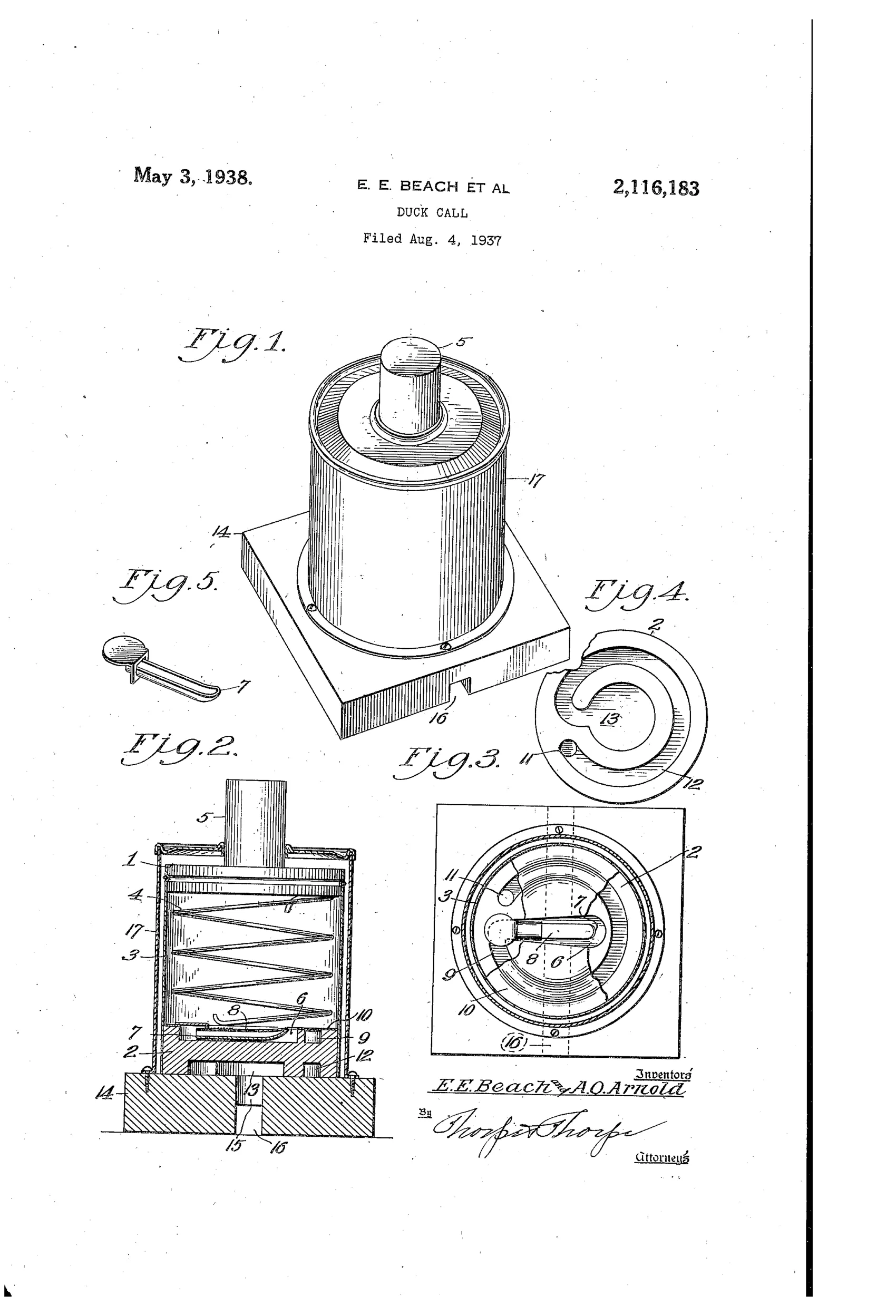
Bellows-operated duck call device
➶ How it works
A pair of end blocks are connected by a flexible, relatively air-tight bellows and urged apart by an expansion spring. One end block carries a projecting operating stem that, when pressed, compresses the bellows and forces air through a sounding reed to imitate a duck call. The other end block has a serpentine passageway machined into its inner and outer faces, sealed by a gasket, connecting the sounding reed well to an external well that registers with a base member's central well and angled exhaust passage. The whole bellows assembly is protected within a removable cylindrical housing secured to the base, with the operating stem projecting through an opening in the housing's closed end.
➶ What was claimed
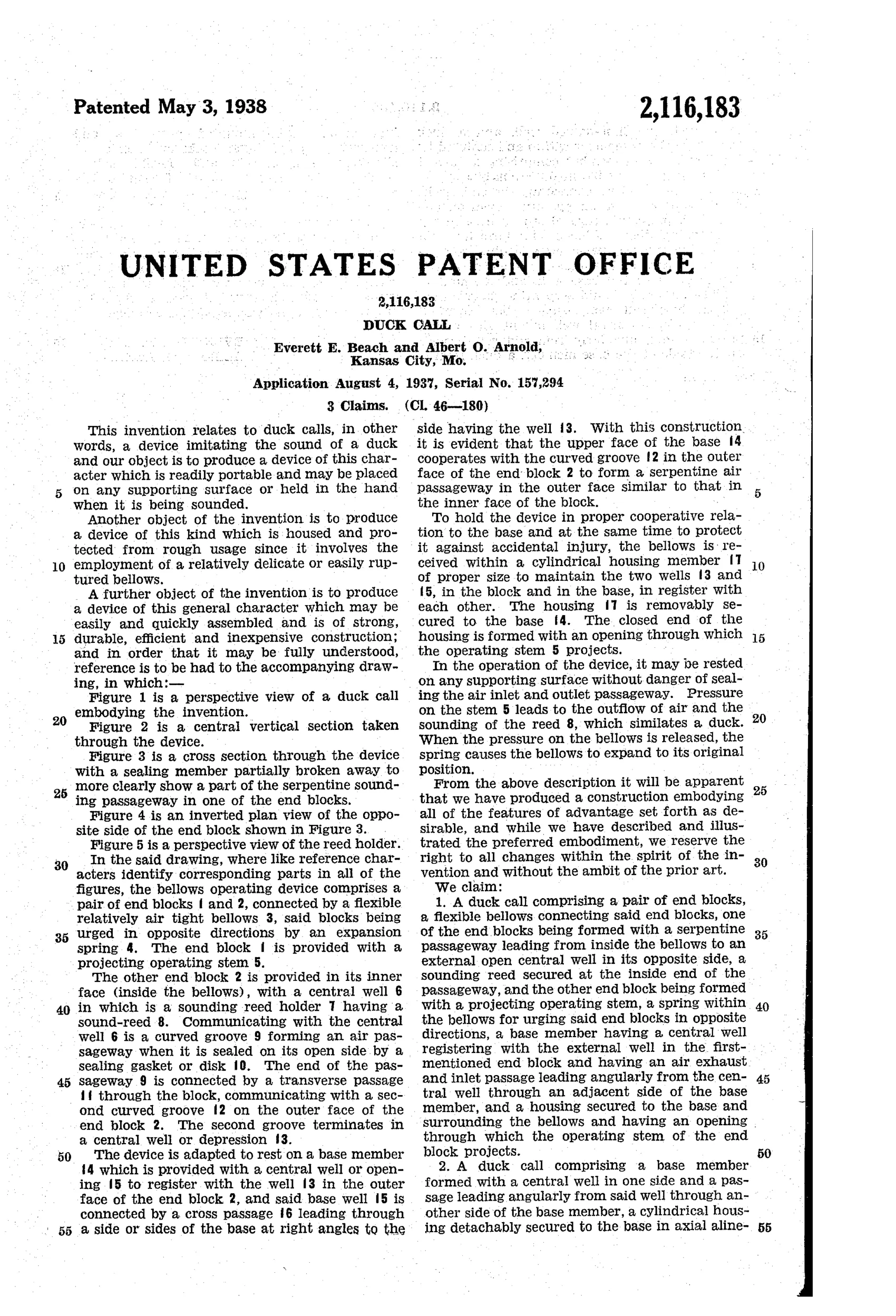
“A duck call comprising a pair of end blocks, a flexible bellows connecting said end blocks, one of the end blocks being formed with a serpentine passageway leading from inside the bellows to an external open central well in its opposite side, a sounding reed secured at the inside end of the passageway, and the other end block being formed with a projecting operating stem, a spring within the bellows for urging said end blocks in opposite directions, a base member having a central well registering with the external well in the first-mentioned end block and having an air exhaust and inlet passage leading angularly from the central well through an adjacent side of the base member, and a housing secured to the base and surrounding the bellows and having an opening through which the operating stem of the end block projects.”
In plain English: The duck call has two end blocks joined by a spring-loaded bellows; pressing a stem on one block compresses the bellows, forcing air through a curved internal passage past a reed in the other block, with the whole assembly mounted on a base and protected by an outer housing.
➶ In the inventor’s words
“Another object of the invention is to produce a device of this kind which is housed and protected from rough usage since it involves the employment of a relatively delicate or easily ruptured bellows.”— Everett E. Beach and Albert O. Arnold, from the specification
Fate unknown
No manufactured example under this design is documented; a marked specimen or period advertisement from Kansas City would settle it.
➶ Commentary
Most duck calls are wind instruments — you supply the air, and everything the patent claims is about shaping it. Beach and Arnold went the other direction: their call carries its own lungs. Press the stem on top, a bellows compresses, air rushes through a reed, and a return spring resets it for the next quack. The angle here is a caller who never puts anything to his mouth — hands stay free of the gun for exactly as long as it takes to thumb the stem.
The genuinely thoughtful bit is the serpentine passageway shown in Figs. 3 and 4. Rather than dumping bellows air straight past the reed, they machine a winding channel into the end block, sealed with a gasket, before the air exits through an angled port in the base. That extra path length is doing acoustic work — smoothing the pressure pulse and giving the note some body, since a short bellows stroke on its own would produce a blunt honk. The cylindrical housing is candid engineering too: the inventors admit outright that the bellows is 'relatively delicate or easily ruptured,' so they armor it like a can of coffee.
As a class, bellows calls found real traction in crow calls, where a repetitive mechanical caw is fine. For ducks, where cadence and inflection carry the deception, a one-note push-button was always going to be a sideline. This is a clean, well-drawn entry in that hopeful mechanical tributary — clever plumbing chasing a problem mouth-blown calls had already solved.
Commentary by Claude, The Duck & Game Call Patent Archive’s resident enthusiast