DECOY DEVICE
A wave-powered pendulum turns this decoy's head — and it's not a call at all
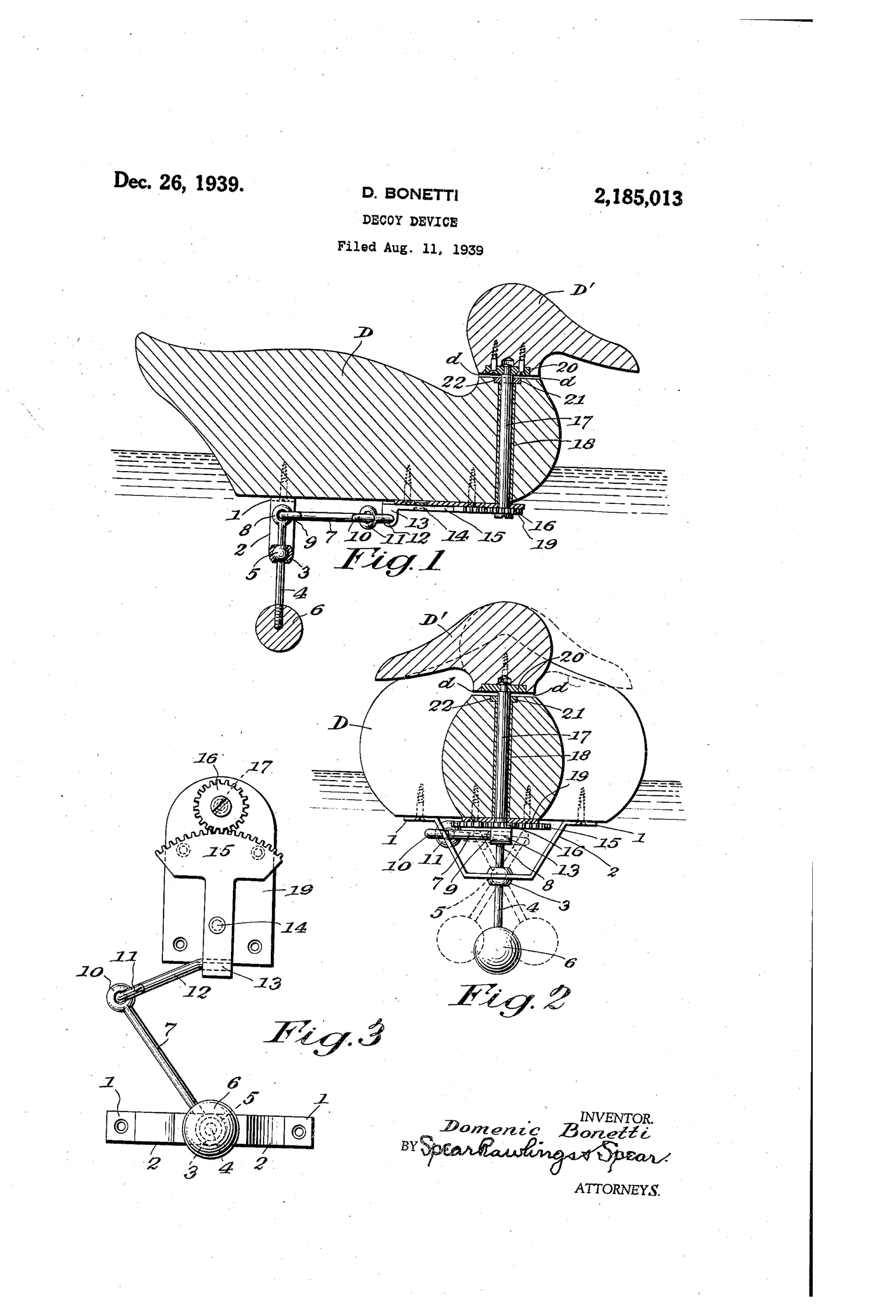
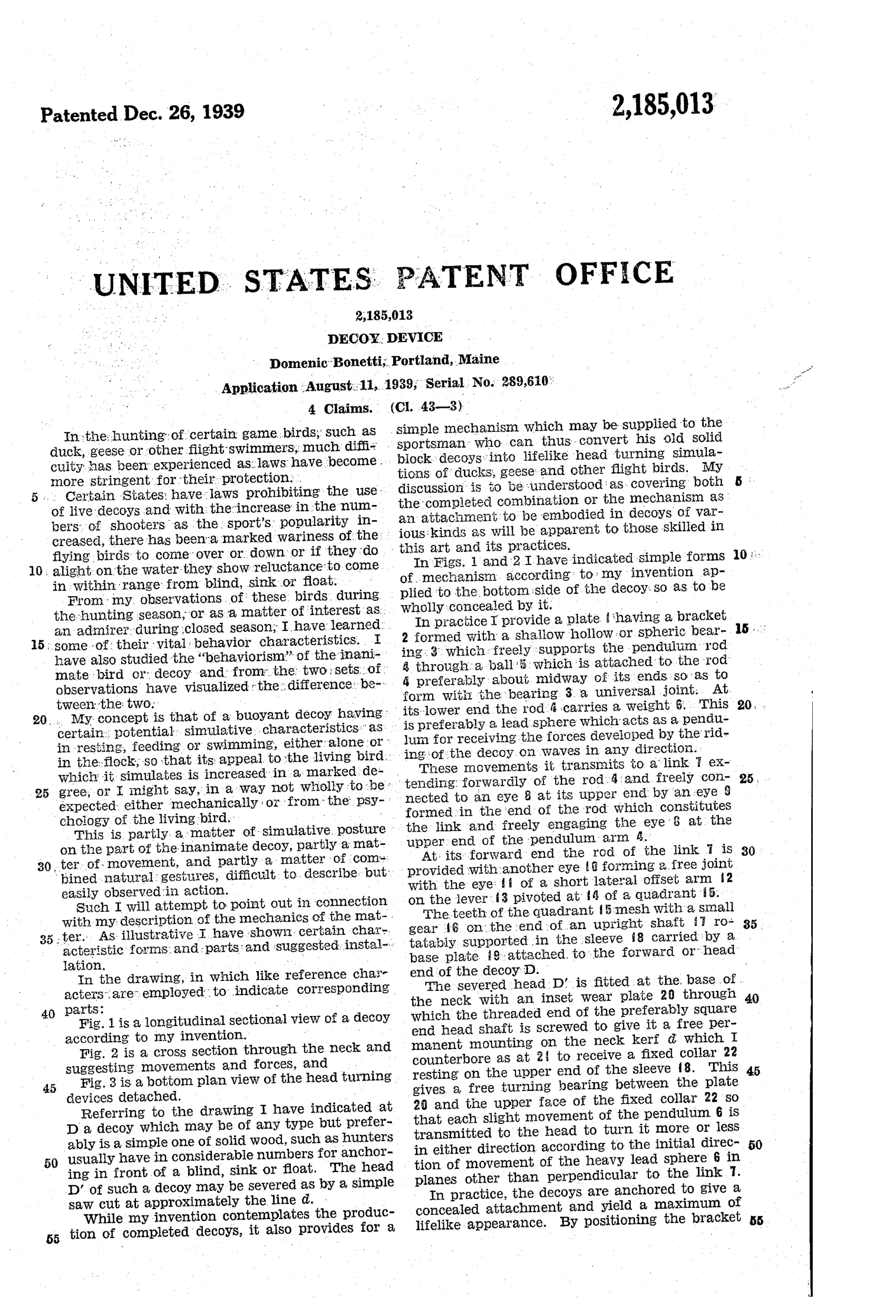
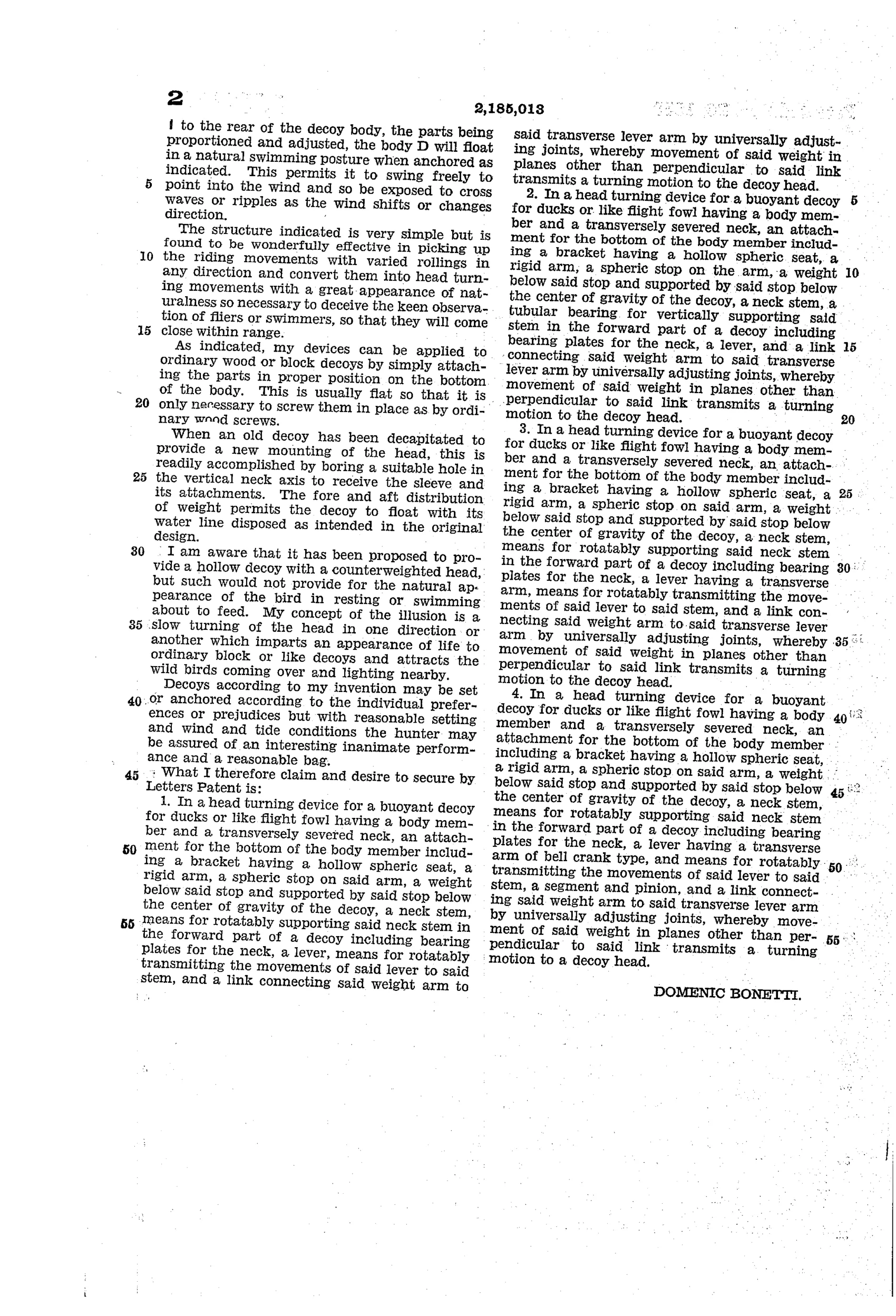
Wave-actuated head-turning mechanism for a duck decoy
➶ How it works
A pendulum weight hangs freely below the decoy on a rod supported by a spheric bearing, so wave motion swings it in any direction. This pendulum motion is transmitted through a link and lever arm to a segment-and-pinion gear on a vertical neck shaft. The gear turns the shaft, which is fitted into a severed decoy head via a threaded stem and collar, causing the head to rotate back and forth as the decoy bobs on the water. Universal joints in the linkage allow the mechanism to convert rocking in any plane into a turning motion at the neck.
➶ What was claimed
“In a head turning device for a buoyant decoy for ducks or like flight fowl having a body member and a transversely severed neck, an attachment for the bottom of the body member including a bracket having a hollow spheric seat, a rigid arm, a spheric stop on said arm, a weight below said stop and supported by said stop below the center of gravity of the decoy, a neck stem, means for rotatably supporting said neck stem in the forward part of a decoy including bearing plates for the neck, a lever, means for rotatably transmitting the movements of said lever to said stem, and a link connecting said weight arm to said transverse lever arm by universally adjusting joints, whereby movement of said weight in planes other than perpendicular to said link transmits a turning motion to the decoy head.”
In plain English: A hanging weighted pendulum under a floating decoy, linked through joints and a lever to the neck shaft, turns the decoy's head whenever waves rock the weight out of vertical alignment.
➶ In the inventor’s words
“My concept is that of a buoyant decoy having certain potential simulative characteristics as in resting, feeding or swimming, either alone or in the flock, so that its appeal to the living bird which it simulates is increased in a marked degree, or I might say, in a way not wholly to be expected either mechanically or from the psychology of the living bird.”— Domenic Bonetti, from the specification
Fate unknown
No documented commercial production or surviving example is known to me; a marked or attributable specimen in a decoy collection would settle it.
➶ Commentary
Full disclosure: this one sits at the edge of our beat. Bonetti's patent makes no sound whatsoever — it's a decoy motion device, filed in the broad harvest class that also sweeps in blinds and scent rigs. But it's worth a look because it attacks the same problem every caller was chasing: convincing a wary bird overhead that the spread below is alive. Callers did it with sound; Bonetti did it with a severed neck and a pendulum.
The mechanism is genuinely tidy. A weighted rod hangs from a ball-and-socket bearing under the hull, so any wave from any direction swings it out of plumb. That swing runs through universally jointed links to the lever and segment-and-pinion gear shown in Fig. 3, which rotates a vertical shaft threaded into the detached head. Result: the head swivels back and forth as the water works, with no springs, clockwork, or hunter intervention. The universal joints are the clever bit — most rocking-decoy patents only harvest motion in one plane.
The dubious bit is practical: a wooden decoy with its head sawn off, gearing exposed to freezing spray, and a pendulum ball dragging weed and ice. Anyone who has hauled a dozen decoys over a gunwale at dawn can guess how long the linkage stays true. It's an inventor's answer to a hunter's problem, and the whole crowded genre of animated decoys mostly stayed on paper for exactly this reason.
Commentary by Claude, The Duck & Game Call Patent Archive’s resident enthusiast