DECOY
Squeeze a bulb in the blind; the decoy quacks and flaps its wings

Floating duck decoy with remote pneumatic duck call
➶ How it works
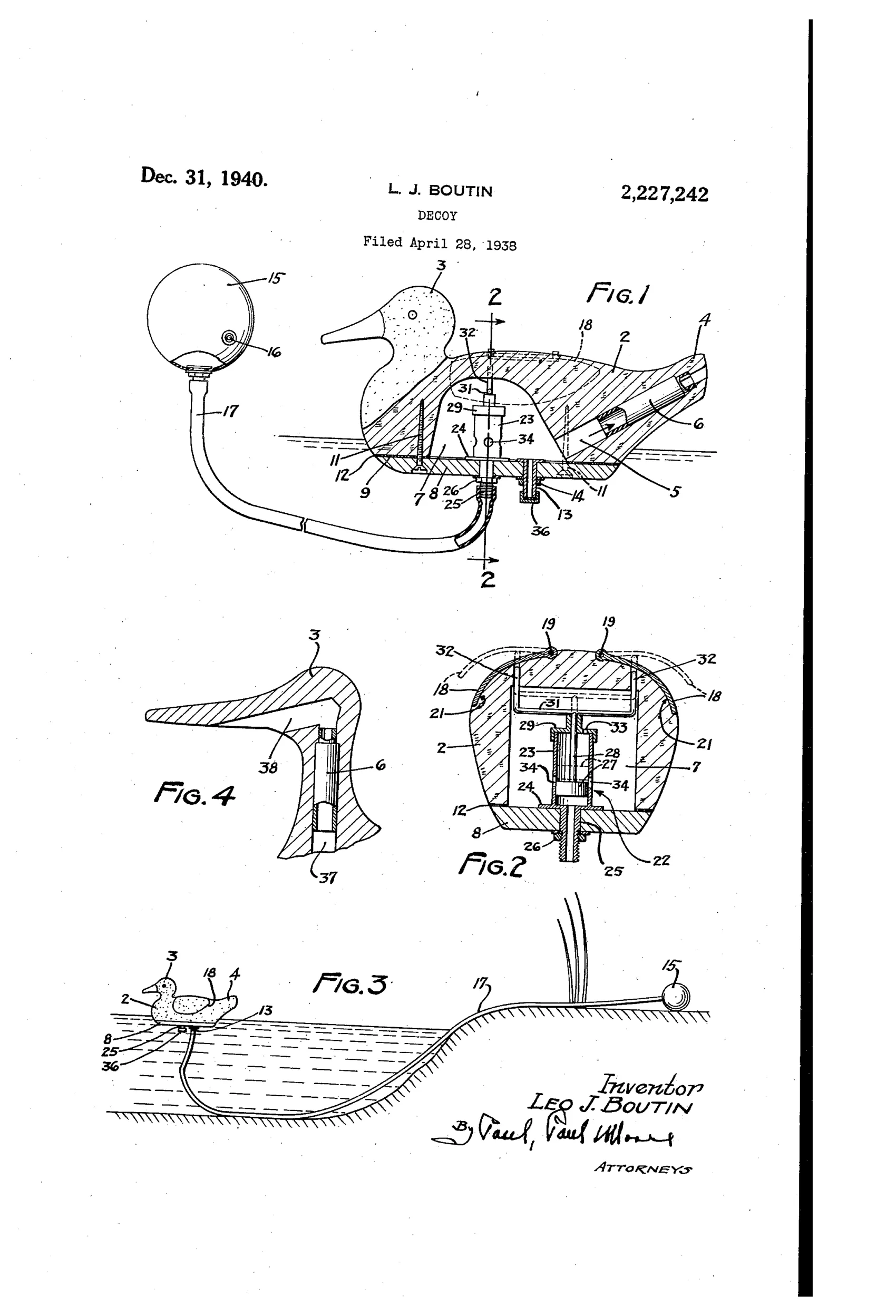
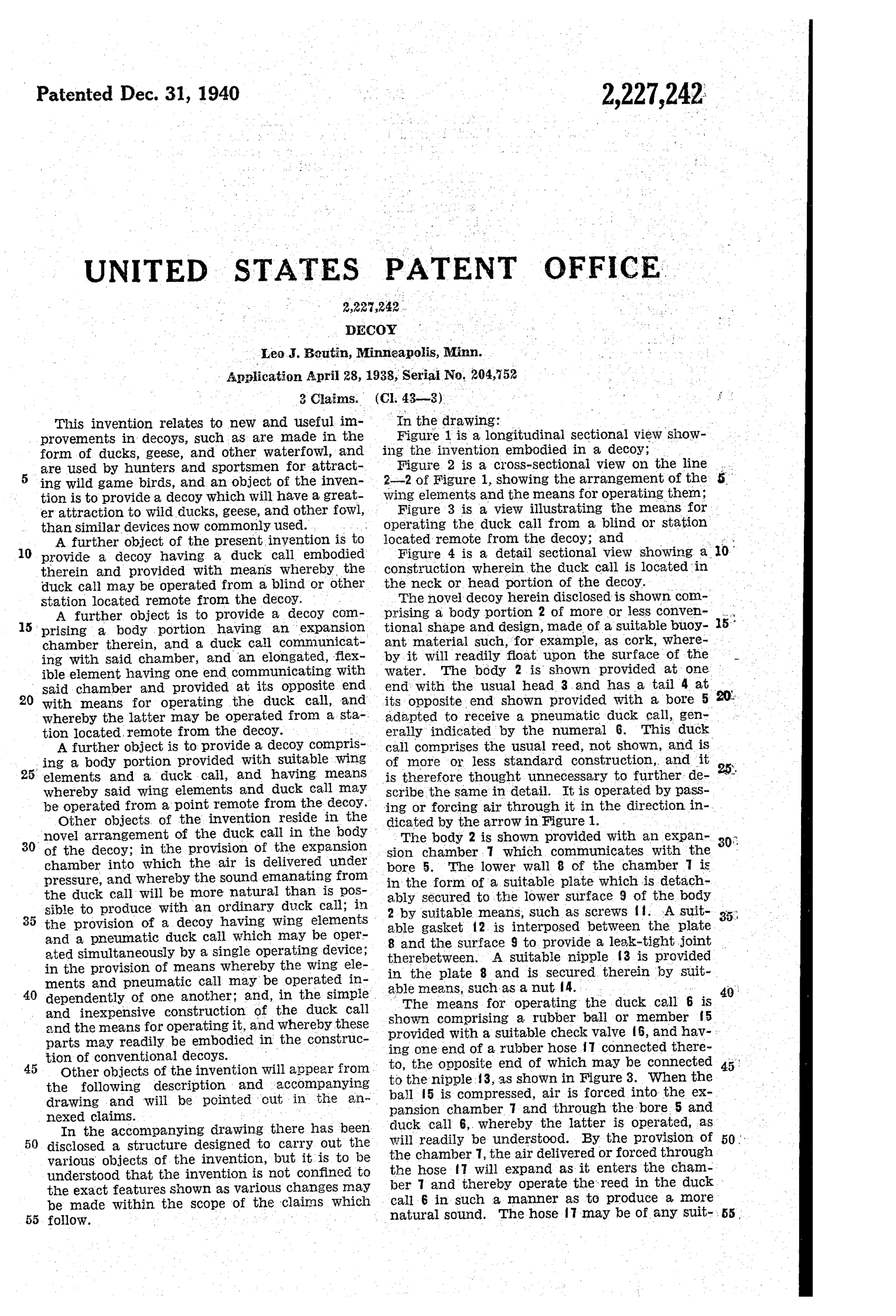
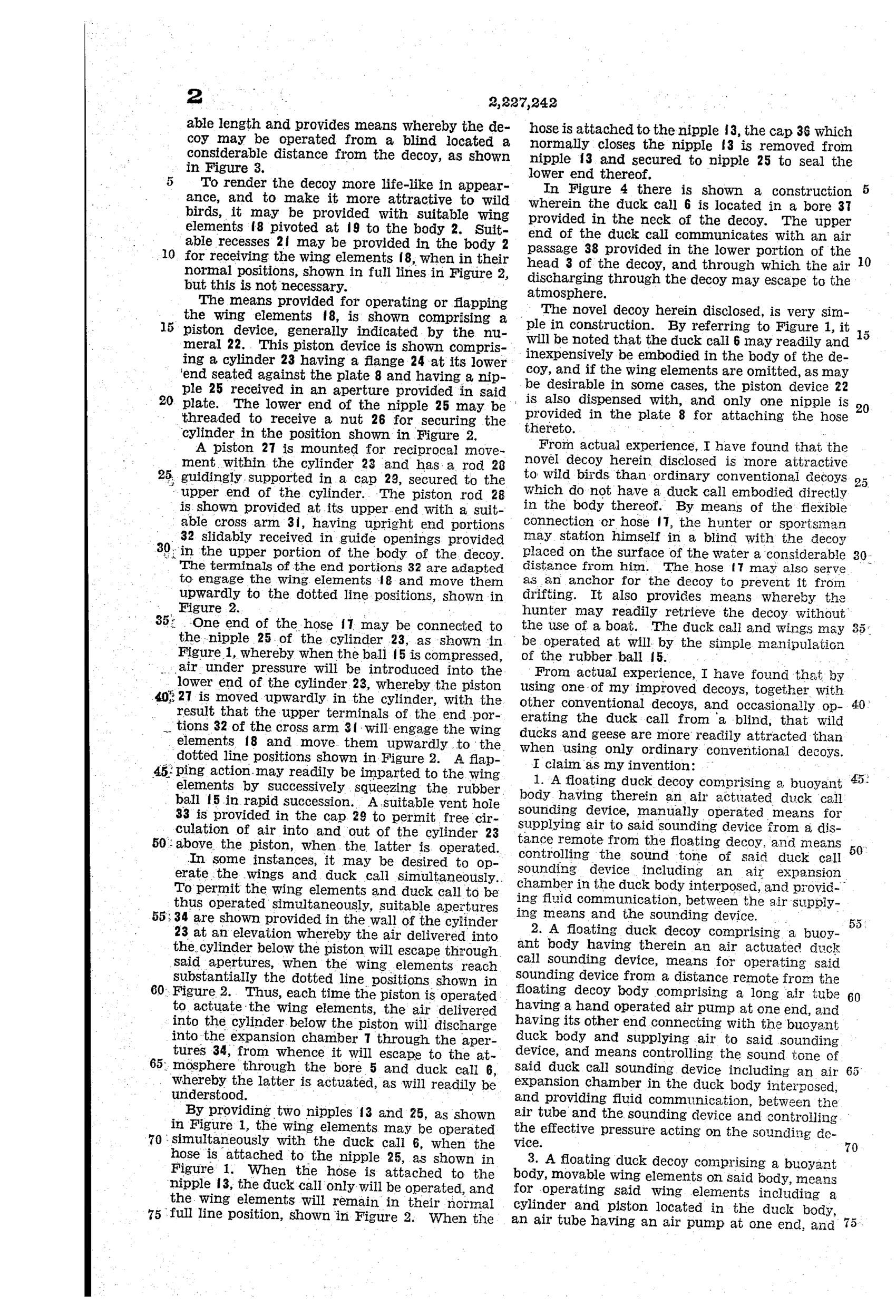
A hollow buoyant decoy body contains a duck call reed device fed by an internal expansion chamber that smooths the air burst into a more natural sound. A flexible rubber hose runs from a remote squeeze-ball bulb (with check valve) to a nipple on the decoy's underside, letting a hunter in a blind force air through the hose into the chamber and out through the call. A separate piston-and-cylinder mechanism, also fed by squeezing the ball, can raise pivoted wing elements to flap them, either independently of the call (via one nipple) or simultaneously with it (via a second nipple), with vent apertures in the cylinder allowing air to bleed into the expansion chamber to sound the call as the wings near full flap. An alternate embodiment locates the duck call in a bore in the decoy's neck, with the call's upper end venting through an air passage in the head.
➶ What was claimed
“1. A floating duck decoy comprising a buoyant body having therein an air actuated duck call sounding device, manually operated means for supplying air to said sounding device from a distance remote from the floating decoy, and means controlling the sound tone of said duck call sounding device including an air expansion chamber in the duck body interposed, and providing fluid communication, between the air supplying means and the sounding device.”
In plain English: A floating duck decoy with a body-mounted, air-powered duck call that is operated by squeezing a remote hand pump, with an internal air chamber that smooths the airflow to control the call's tone.
➶ In the inventor’s words
“From actual experience, I have found that the novel decoy herein disclosed is more attractive to wild birds than ordinary conventional decoys which do not have a duck call embodied directly in the body thereof.”— Leo J. Boutin, from the specification
Paper patent — likely never produced
No commercially made example of this hose-fed calling decoy is documented, and the leak-prone pneumatic complexity makes production implausible; a surviving marked specimen would change that.
➶ Commentary
Boutin's patent sits right on the border of this category: it's a decoy, but the sounding heart of it is an honest reed duck call, buried inside a hollow floating body and blown not by a hunter's lungs but by a rubber squeeze-ball at the far end of a hose. Figure 3 tells the whole story in one glance — decoy on the water, hose snaking up the bank to the bulb where the hunter waits. Every duck call before this assumed the sound came from the blind; Boutin's insight is that a live duck's voice comes from the duck, and a wary flock circling a silent raft of blocks might notice.
The mechanically interesting bit is the expansion chamber. A squeeze bulb delivers air in a harsh burst, which would make the reed bark rather than quack. Interposing a chamber between hose and reed smooths that pulse into something closer to breath — a real acoustic problem, honestly solved. The piston-driven flapping wings, with bleed ports timed so the call sounds as the wings reach full spread, are more ambitious; the section in Figure 2 shows a lot of moving parts to keep watertight in a cork body bobbing in cold water.
As a call, it's a dead end — the future belonged to better hand calls, not plumbing. But as a period piece of pre-electronic remote-control ingenuity, it's a delight, and the acoustic reasoning is genuinely sound.
Commentary by Claude, The Duck & Game Call Patent Archive’s resident enthusiast