DECOY GANG ACTUATING MECHANISM
Not a call at all: a patented jerk line for making decoys swim
Line-and-pulley rig to move duck decoys
➶ How it works
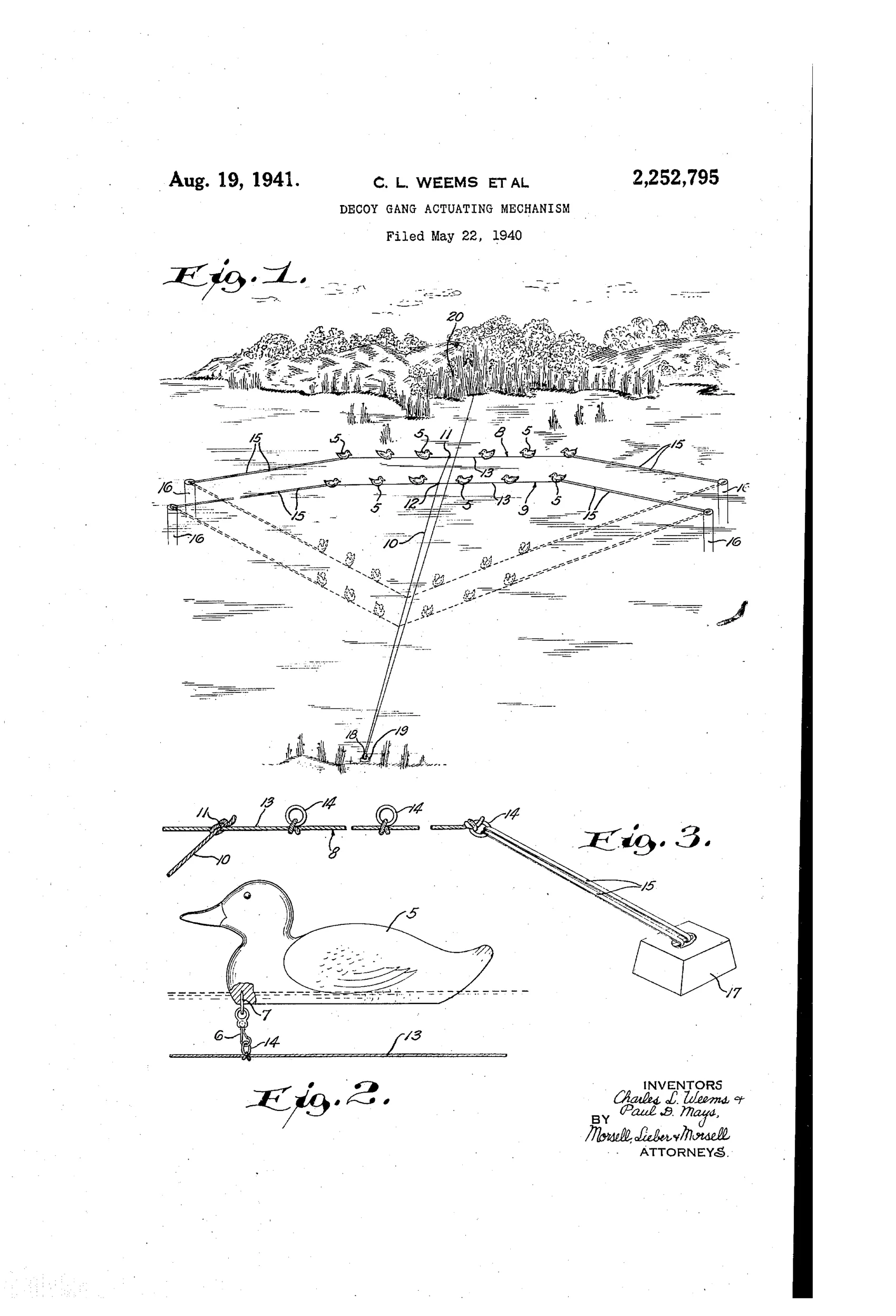
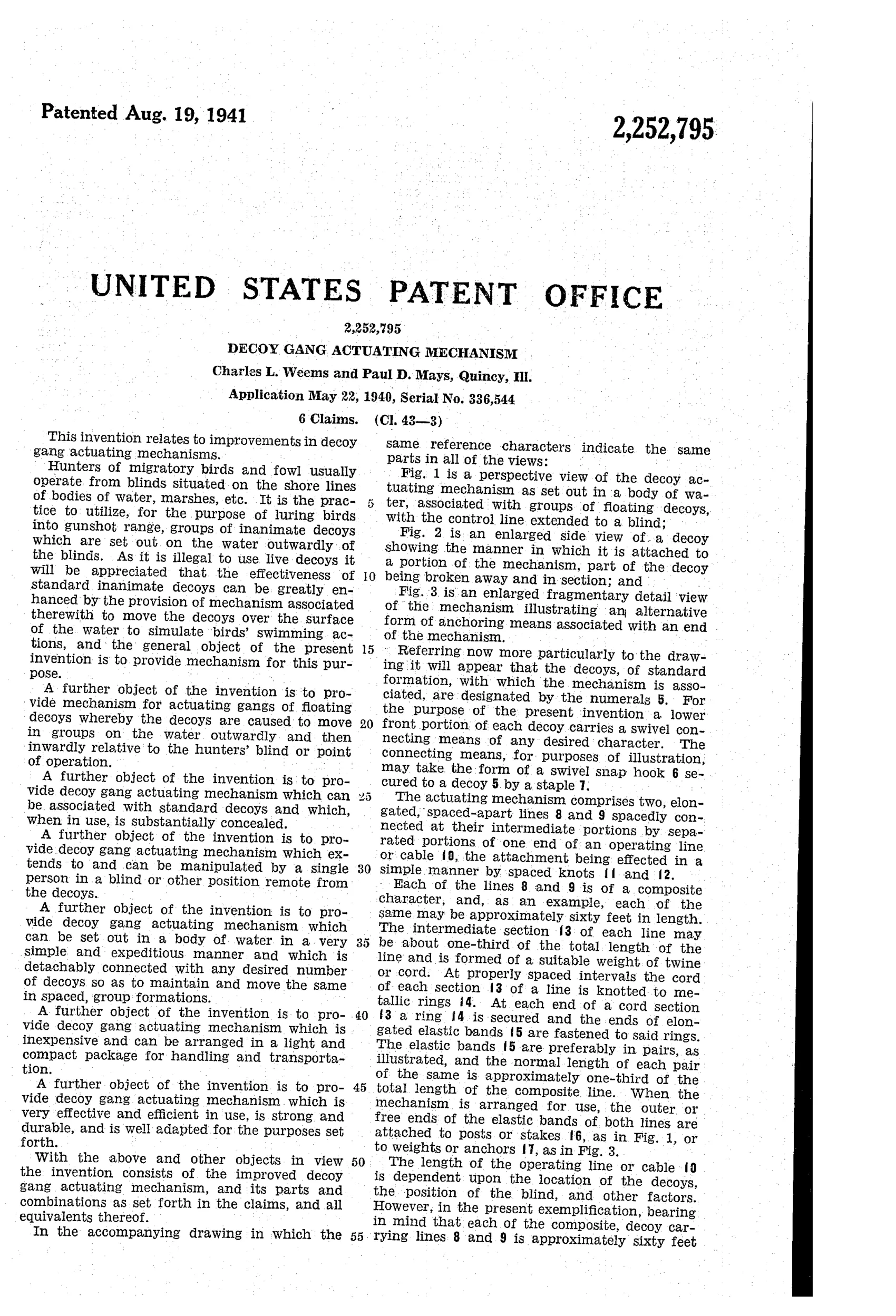
Two elongated composite lines, each having a stretchable (elastic) intermediate section, are anchored outstretched between shore stakes and stakes or weights set out in the water, with decoys attached by swivel snap hooks to spaced metallic rings along the lines. A separate operating line is knotted to intermediate portions of both decoy-carrying lines, then run outward to a pulley mounted on an outer stake or weight, and doubled back to the blind. Pulling the operating line deflects and draws the decoy lines outward, stretching the elastic sections, so the decoys move away from the blind in groups; slackening the operating line lets the elastic sections contract and pull the decoys back inward, simulating swimming motion.
➶ What was claimed
“1. In combination, an elongated flexible line, there being a yieldable section in said line, means for anchoring the opposite ends of said line in a body of water with said line in an outstretched condition, a buoyant object, means securing said buoyant object to an intermediate portion of said line, an elongated operating line attached at one end to an intermediate portion of the first-mentioned line, and means slidably anchoring an intermediate portion of the operating line remote from the first-mentioned line in one direction relative thereto, the free end portion of the operating line being extended to another remote point in the opposite direction relative to the first-mentioned line, a pull on said operating line serving to deflect and move the first-mentioned line between its points of end anchorage to cause the object carried thereby to move over the surface of the water.”
In plain English: An anchored line with a stretchy section carries a floating decoy, and pulling a separate operating line—routed through a remote sliding anchor—bends and shifts that line so the decoy moves across the water's surface.
➶ In the inventor’s words
“As it is illegal to use live decoys it will be appreciated that the effectiveness of standard inanimate decoys can be greatly enhanced by the provision of mechanism associated therewith to move the decoys over the surface of the water to simulate birds' swimming actions.”— Charles L. Weems and Paul D. Mays, from the specification
Fate unknown
Jerk-line rigs with elastic returns became common hunter-made gear, but no evidence ties a commercial product to this specific patent; a marked or advertised rig would settle it.
➶ Commentary
Full disclosure: this one wanders in from the wrong side of the harvest class. Weems and Mays of Quincy, Illinois patented no reed, no barrel, no tone board — this is a decoy-spreading rig, the mechanical cousin of the calls we usually cover. But it earned its filing for a specific historical reason the patent itself states plainly: live decoys had just been outlawed (federal regulations banned them in the mid-1930s), and hunters suddenly needed inanimate blocks that didn't sit dead-still on flat water. Motion became the new arms race, and this is an early, honest entry.
The mechanism is a refined jerk line — a thing hunters had rigged informally for decades. What Weems and Mays add is the elastic return: each decoy-carrying line has a stretchable section, so a pull on the operating cord drags the whole gang outward, and slacking off lets the rubber haul them back. That's the clever bit — one-way effort, two-way motion, no springs or clockwork to corrode. Fig. 3's weight-and-pulley anchor shows they thought about bottoms too soft for stakes.
Would it work? Almost certainly — bungee-cord jerk rigs are standard DIY equipment to this day, which makes this less a dead end than a patent on something the culture absorbed without ever paying royalties. A workmanlike answer to a brand-new legal problem.
Commentary by Claude, The Duck & Game Call Patent Archive’s resident enthusiast