DECOY
A silent Nebraska goose: canvas decoy on a stake, not a call at all
Stuffed fabric hunting decoy with internal reinforcing strut
➶ How it works
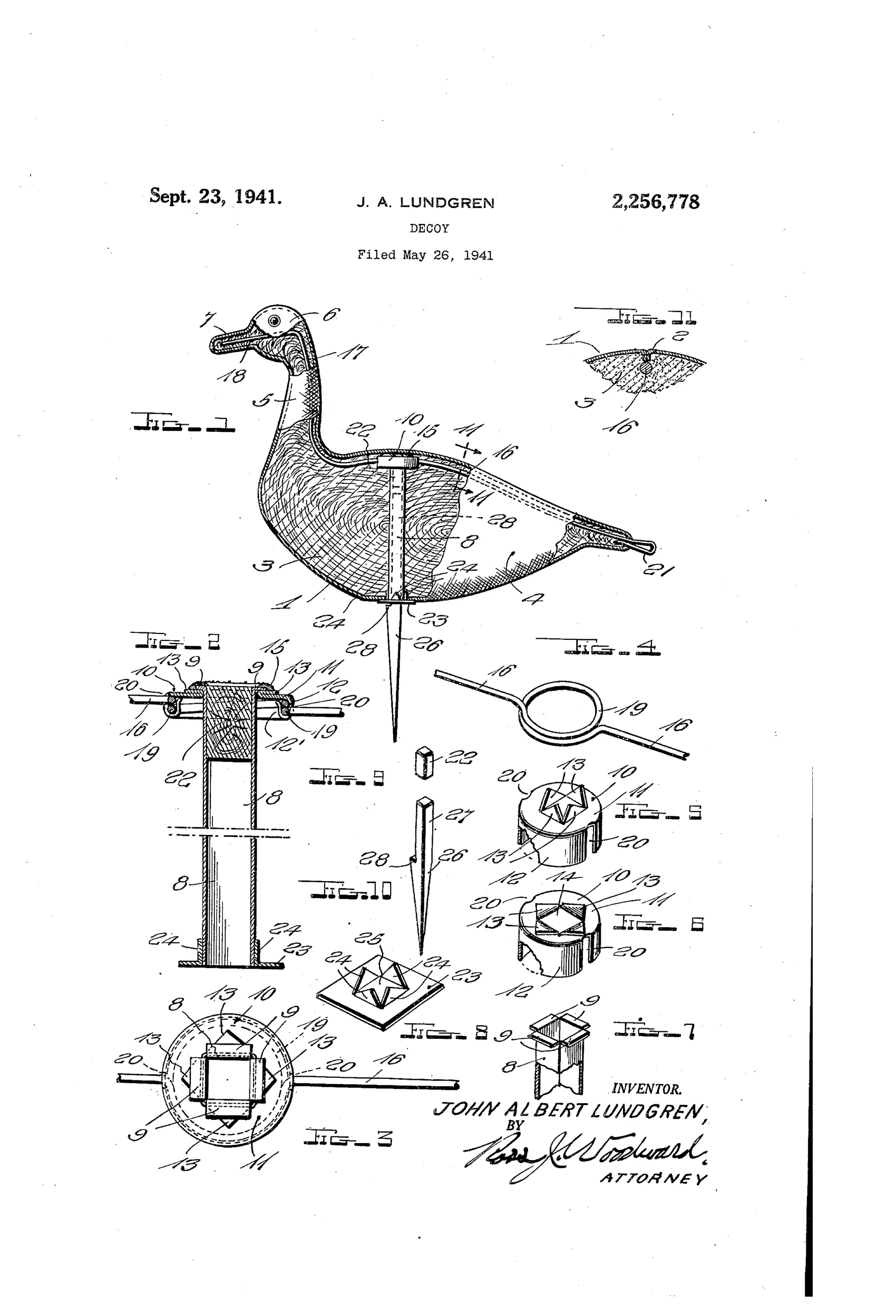
A canvas or fabric casing shaped like a bird's body, neck, and head is stuffed with a compact filler to hold its form. A tubular sheet-metal strut runs vertically through the body midway its length, capped at top by a head fitted with tongues that clamp a wire reinforcing ring, and closed at bottom by a plate with tongues gripping the strut. A wire strand runs longitudinally along the back, its forward end passing through the neck and head into the bill, its rear end looped into a hanging eye, and its midsection coiled into a ring secured within the cap. A wooden plug seals the strut's upper end to keep water out of the filler, while a tapered stake with a shank and shoulder is thrust into the ground and inserted removably into the open lower end of the strut to support the decoy.
➶ What was claimed
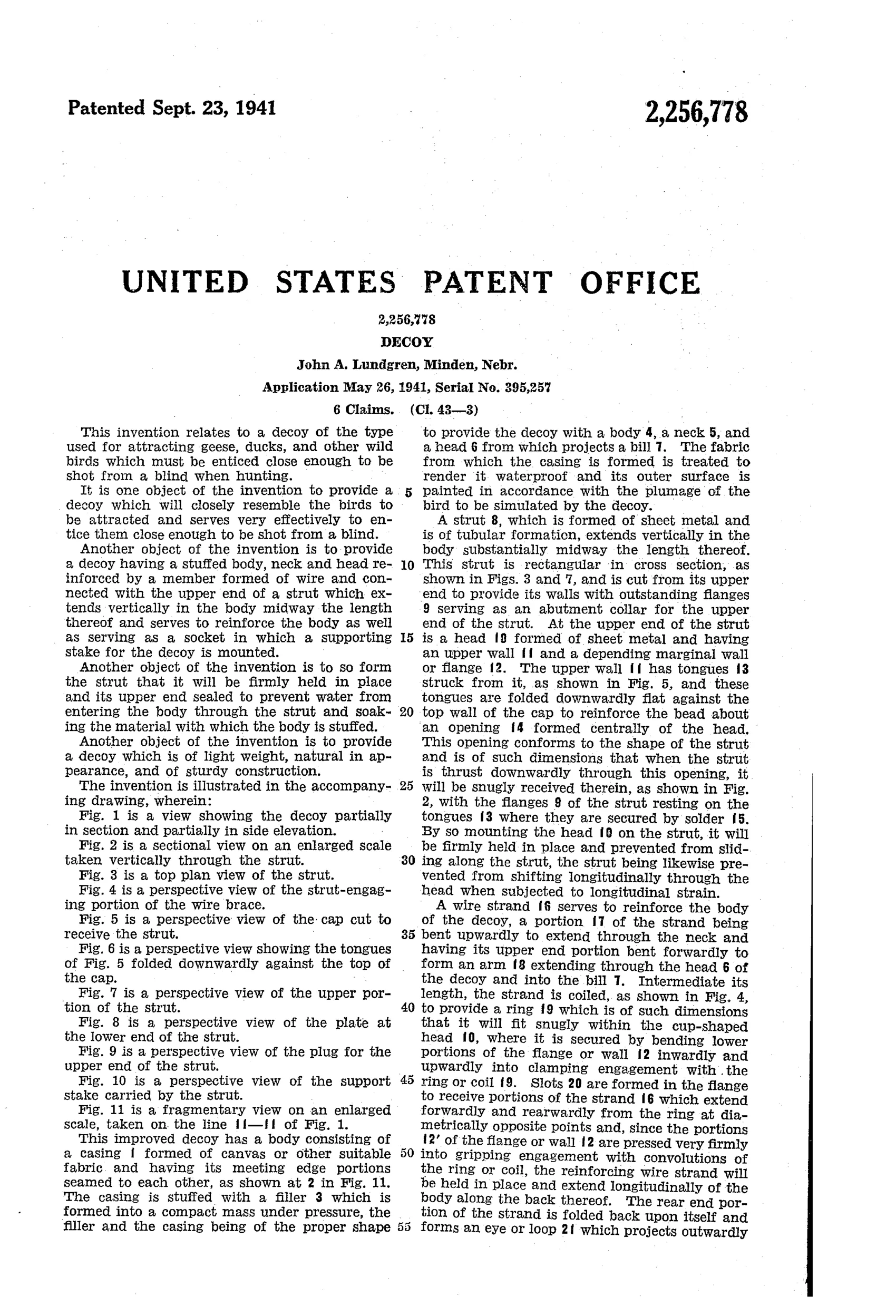
“A decoy comprising a body having a neck and a head, a strand extending longitudinally in the body along the back thereof with a portion bent to extend through the neck and the head, a tubular strut extending vertically in the body intermediate the length thereof and having its upper end connected with said strand and its lower end open and exposed through the bottom of the body, and a supporting stake having its upper portion removably received in the strut through the open lower end thereof, said stake being provided with a shoulder for engaging the strut and limiting movement of the stake into the strut.”
In plain English: The decoy has a body with a wire strand running along its back and into the head, a hollow vertical strut connected to that strand, and a removable ground stake with a shoulder that plugs into the open bottom of the strut and stops at a set depth.
➶ In the inventor’s words
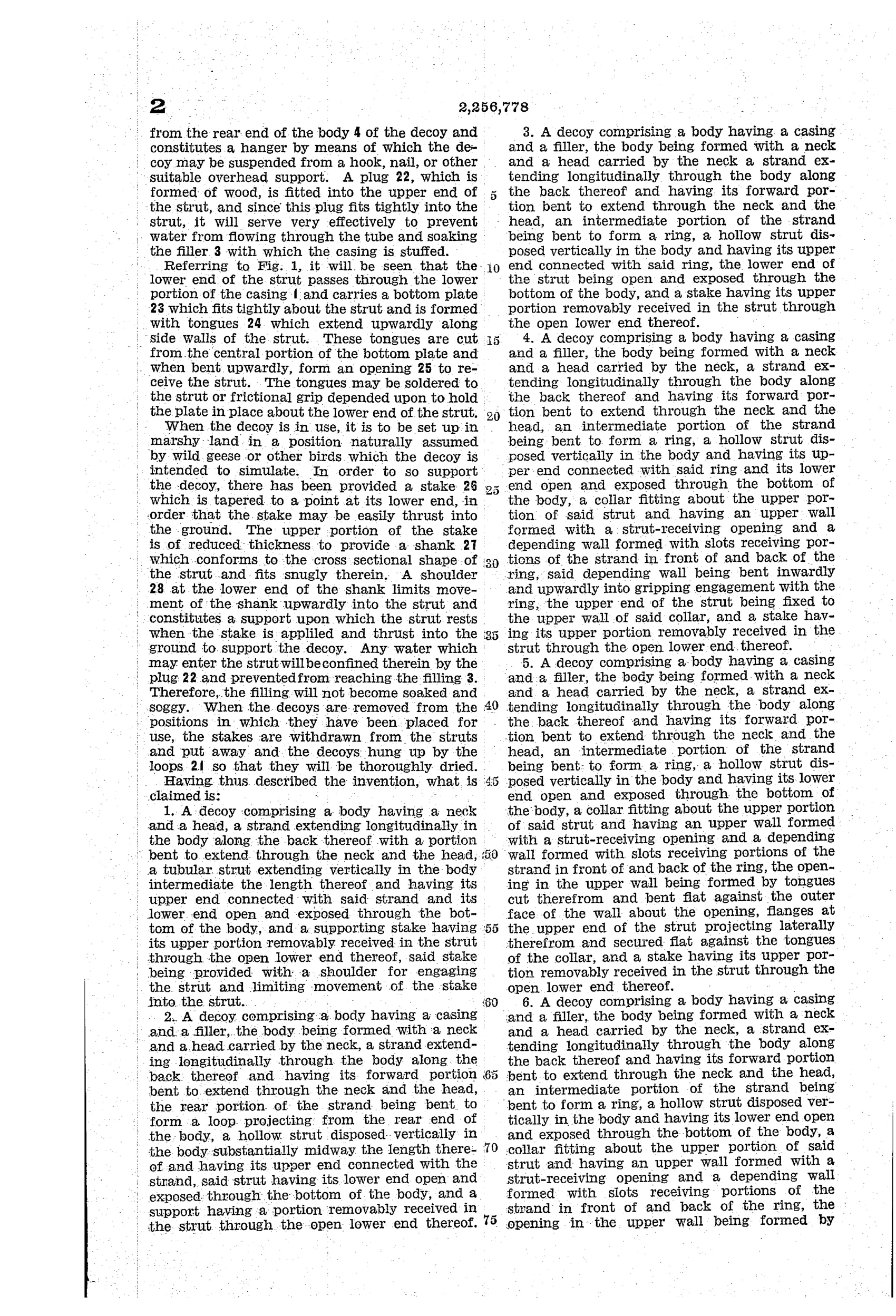
“When the decoys are removed from the positions in which they have been placed for use, the stakes are withdrawn from the struts and put away and the decoys hung up by the loops 21 so that they will be thoroughly dried.”— John A. Lundgren, from the specification
Fate unknown
Canvas field decoys of this era were widely made, but no example with Lundgren's specific strut hardware is documented; a marked or clearly matching specimen would settle it.
➶ Commentary
Full disclosure up front: this one wandered into our files by way of the harvest class, which lumps sound-making calls in with blinds, decoys, and scent gear. Lundgren's patent is a decoy, and it makes no noise whatsoever. But since it's here, it deserves a fair reading, because it's a tidier piece of sheet-metal thinking than most stuffed decoys of the period.
The problem with canvas-bodied field decoys is that they're floppy. Lundgren's answer is a skeleton: a single wire runs from the bill, down the neck, along the back, and ends in a hanging loop at the tail. Midway, it coils into a ring that's clamped inside a vertical sheet-metal tube — the strut — by folded tongues on a cap, with a matching tongued plate at the bottom. The tube stays open at its lower end so a shouldered ground stake plugs in to a set depth. Pull the stake, hang the decoy by its tail loop to dry. Figures 5 through 8 show the whole thing is stamped and folded tin, no solder or machining required — cheap and farm-shop practical.
Stuffed and canvas goose decoys were a real Nebraska and Great Plains tradition for stubble-field hunting, so the context is genuine. Whether Lundgren's particular strut-and-stake hardware ever left the drawing board, we can't say — and either way, it belongs on a decoy shelf, not next to the Olt catalog.
Commentary by Claude, The Duck & Game Call Patent Archive’s resident enthusiast