DECOY ANCHOR
Not a call at all: a lead neck ring to stop decoy line tangles
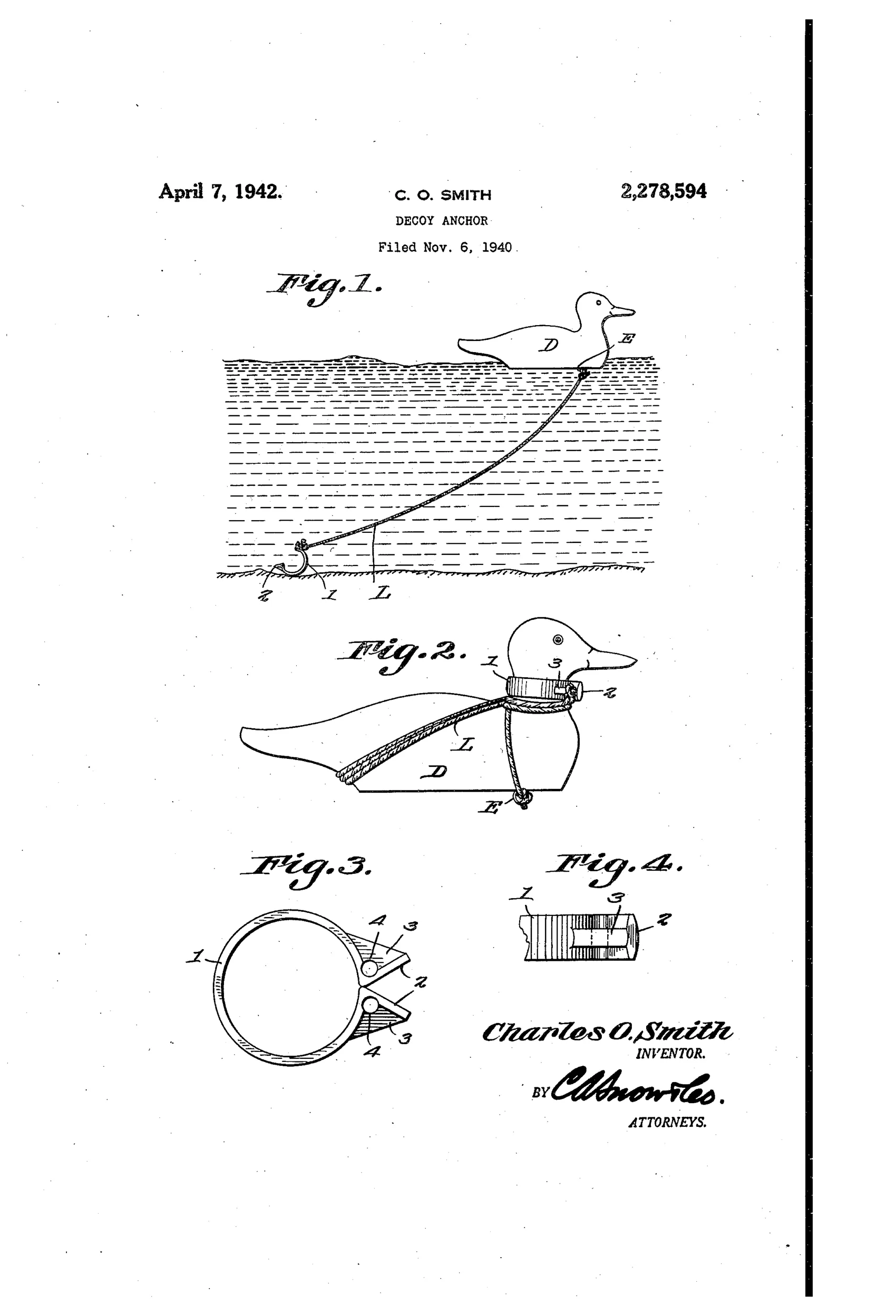
Split-ring metal anchor for duck decoys
➶ How it works
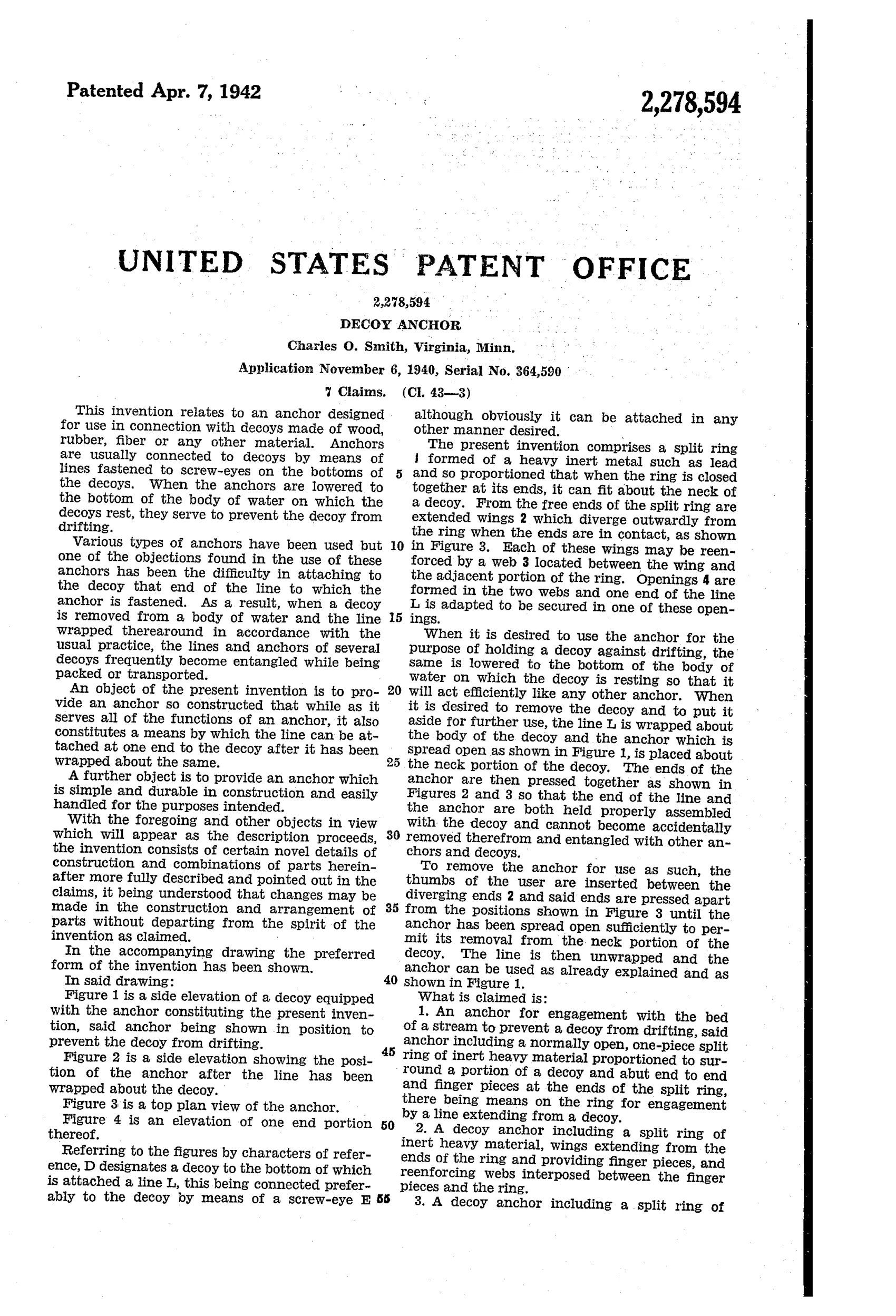
A normally open, one-piece split ring of heavy inert material such as lead is proportioned to surround the neck of a decoy and abut end to end when closed. Finger pieces (wings) extend outward from the ends of the ring, allowing the user's thumbs to spread the ring open for removal. Reenforcing webs are interposed between the finger pieces and the ring, and one of these webs has an opening through which the anchor line is secured. When not in use, the line is wrapped around the decoy body and the split ring is closed around the decoy's neck, holding the line end securely so it cannot tangle with other decoys and lines.
➶ What was claimed
“1. An anchor for engagement with the bed of a stream to prevent a decoy from drifting, said anchor including a normally open, one-piece split ring of inert heavy material proportioned to surround a portion of a decoy and abut end to end and finger pieces at the ends of the split ring, there being means on the ring for engagement by a line extending from a decoy.”
In plain English: The anchor is a one-piece split metal ring, normally open, sized to fit around part of a decoy, with finger pieces at its ends and a way to attach the decoy's line to the ring.
➶ In the inventor’s words
“An object of the present invention is to provide an anchor so constructed that while as it serves all of the functions of an anchor, it also constitutes a means by which the line can be attached at one end to the decoy after it has been wrapped about the same.”— Charles O. Smith, from the specification
Fate unknown
Neck-ring lead anchors of this general type were made in huge numbers, but no example is documented as tied to this specific patent; a marked specimen would settle it.
➶ Commentary
Let's be honest up front: this one wandered into our category through the broad hunting-gear classification. Charles O. Smith of Virginia, Minnesota patented no reed, no tone board, no sound of any kind — this is decoy rigging hardware. But since it's here, it's worth a look, because it addresses the problem every waterfowler knew before dawn: a sack of decoys whose anchor lines have woven themselves into a single furious knot.
The mechanism is a one-piece split ring of lead, normally sprung open, with little winged finger pieces at the gap. You wrap the line around the decoy body, then squeeze the ring closed around the decoy's neck — Fig. 2 shows this clearly, the cord coiled and the ring clamped like a collar. The anchor thus does double duty: dead weight on the stream bed when deployed, line-keeper when stowed. The reinforcing webs between the finger pieces and the ring, with the line hole through one web, are the tidy detail in Figs. 3 and 4.
The idea is genuinely sound — neck-ring lead anchors became the standard pattern for rigging decoys, and countless were poured in home molds and by tackle makers. Whether any of them owe a dime to Smith's 1942 patent is another question; the split-ring anchor is the sort of thing many hands arrived at. As decoy hardware goes, this is the practical mainstream, not a curiosity.
Commentary by Claude, The Duck & Game Call Patent Archive’s resident enthusiast