ANCHOR FOR DECOY DUCKS
Not a call at all: a line-wrapping decoy anchor from wartime Utah
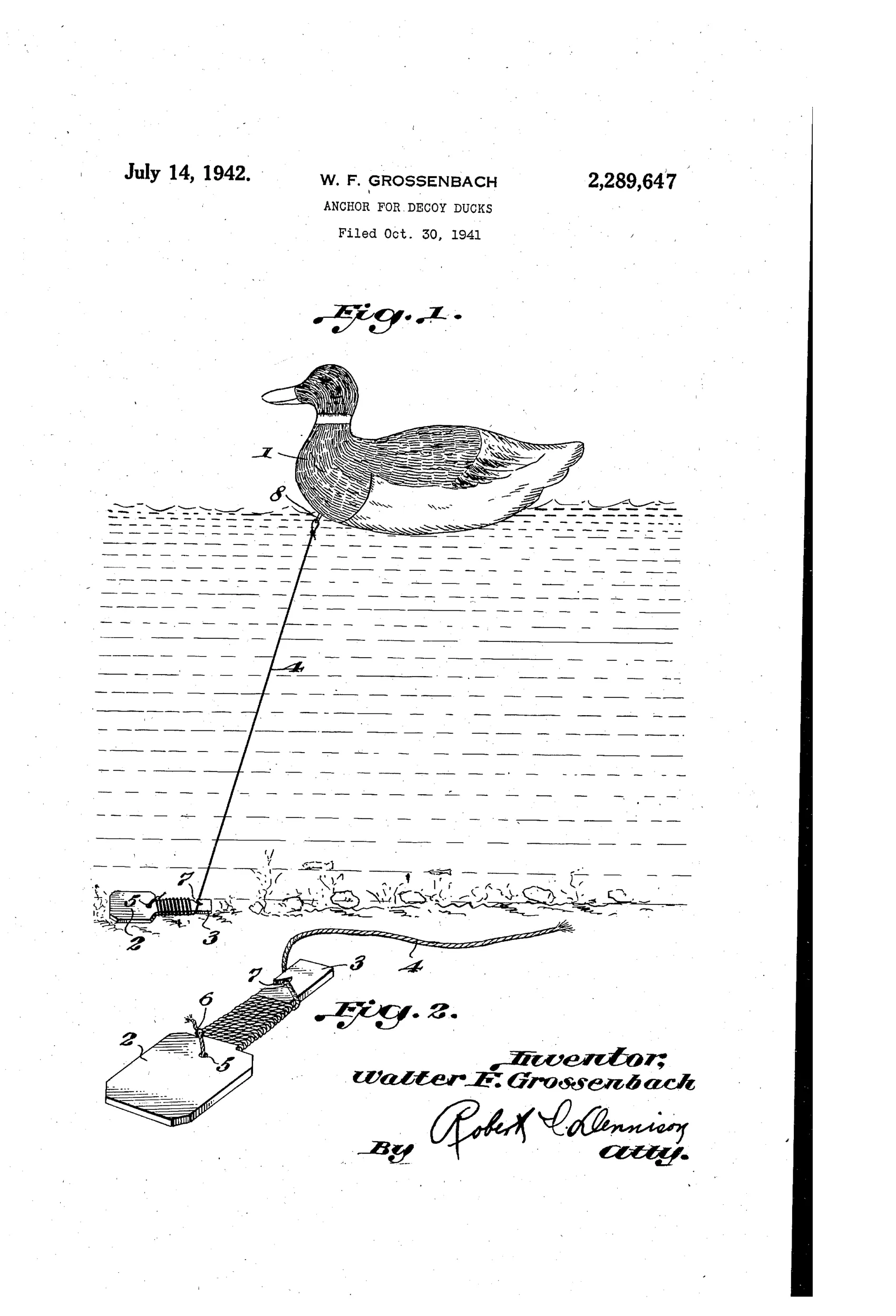
Weighted line-wrapping anchor for waterfowl decoys.
➶ How it works
A weighted flat plate has an integral elongated shank of the same thickness extending from one side edge. The attaching line runs from a screw eye on the decoy's underside down to an opening in the plate, where it is knotted to prevent disengagement. The line's intermediate length is wound around the shank to adjust for water depth, and a wedge-shaped slot near the shank's outer end locks the wound line in place to prevent unwinding, entanglement, and drifting.
➶ What was claimed
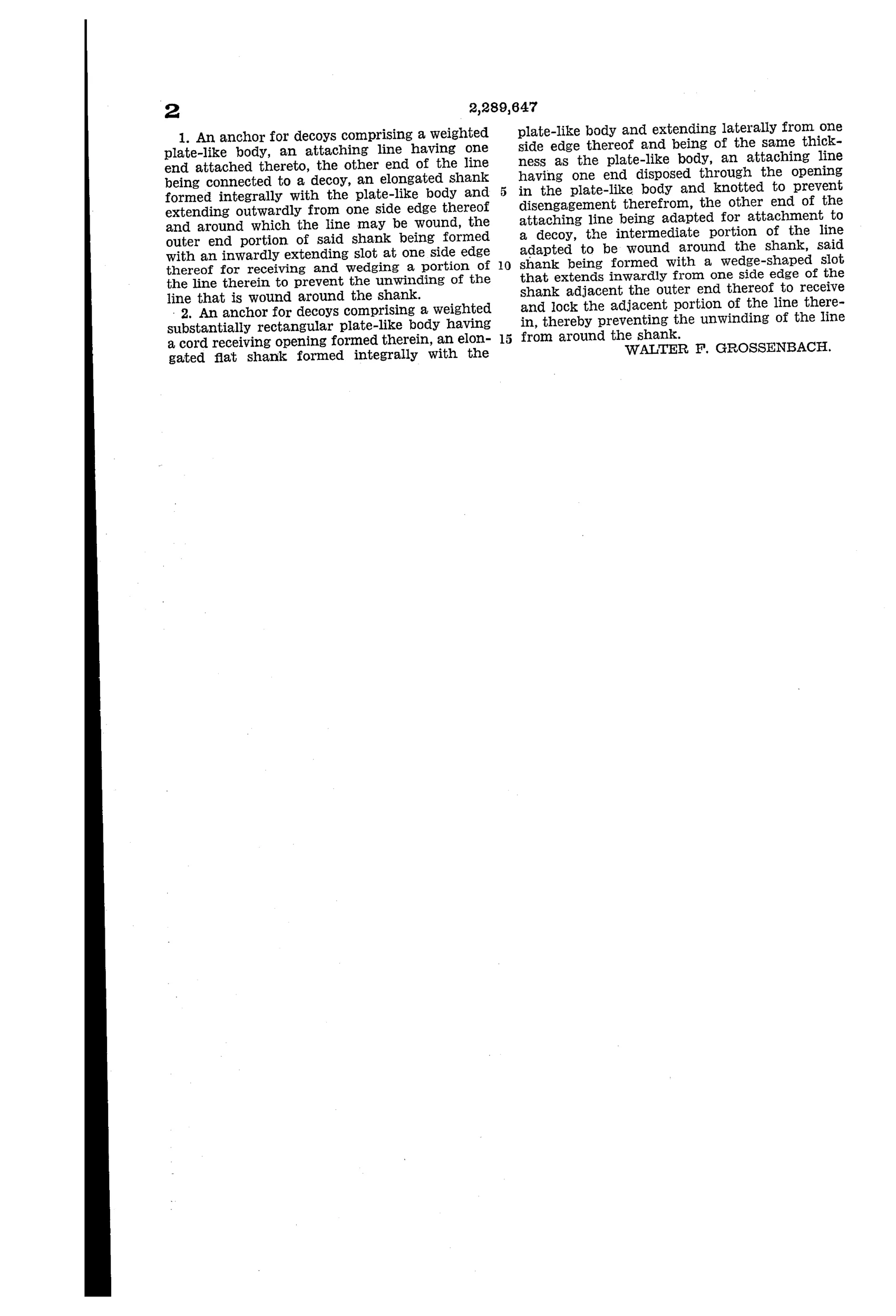
“An anchor for decoys comprising a weighted plate-like body, an attaching line having one end attached thereto, the other end of the line being connected to a decoy, an elongated shank formed integrally with the plate-like body and extending outwardly from one side edge thereof and around which the line may be wound, the outer end portion of said shank being formed with an inwardly extending slot at one side edge thereof for receiving and wedging a portion of the line therein to prevent the unwinding of the line that is wound around the shank.”
In plain English: An anchor with a weighted plate and an attached shank around which the line is wound, with a slot on the shank that wedges and locks the line so it can't unwind.
➶ In the inventor’s words
“By constructing the anchor in the manner as shown, relatively sharp corners will be formed which will tend to dig into the bottom more firmly when the device is in use, thereby holding the anchor at the point where it is lowered.”— Walter F. Grossenbach, from the specification
Fate unknown
The design is cheap and simple enough to produce, but no marked example or commercial tie is documented; a specimen or catalog listing would settle it.
➶ Commentary
Let's be honest up front: this one sits at the edge of our beat. Grossenbach's patent makes no sound whatsoever — it's the hardware that keeps your decoy from drifting off while you're working the call. It lands in the same broad hunting-gear class the Patent Office used for calls, which is how it wanders onto these pages, but it belongs to the decoy collector's world, not the callmaker's.
That said, the mechanism is a tidy solution to a real annoyance. Every waterfowler has fought a decoy line that tangles in the bag or pays out to the wrong depth. Grossenbach's answer is to make the anchor its own line-winder: a flat weighted plate with an integral shank you wrap the cord around, plus a wedge-shaped slot at the shank's tip that pinches the line so it can't unwind in transit. Depth adjustment is just a matter of how many wraps you leave on. Fig. 2 shows the whole idea in one glance — the anchor is the spool.
He even argues the plate's sharp corners dig into the bottom for better hold, which is the kind of small, practical claim that suggests a man who actually set decoy rigs at dawn. Similar wrap-and-lock anchor designs did eventually become common in stamped and cast forms; whether any trace back to this specific patent is another question.
Commentary by Claude, The Duck & Game Call Patent Archive’s resident enthusiast