DECOY
A chemical company's inflatable latex duck — a decoy, not a call, but clever
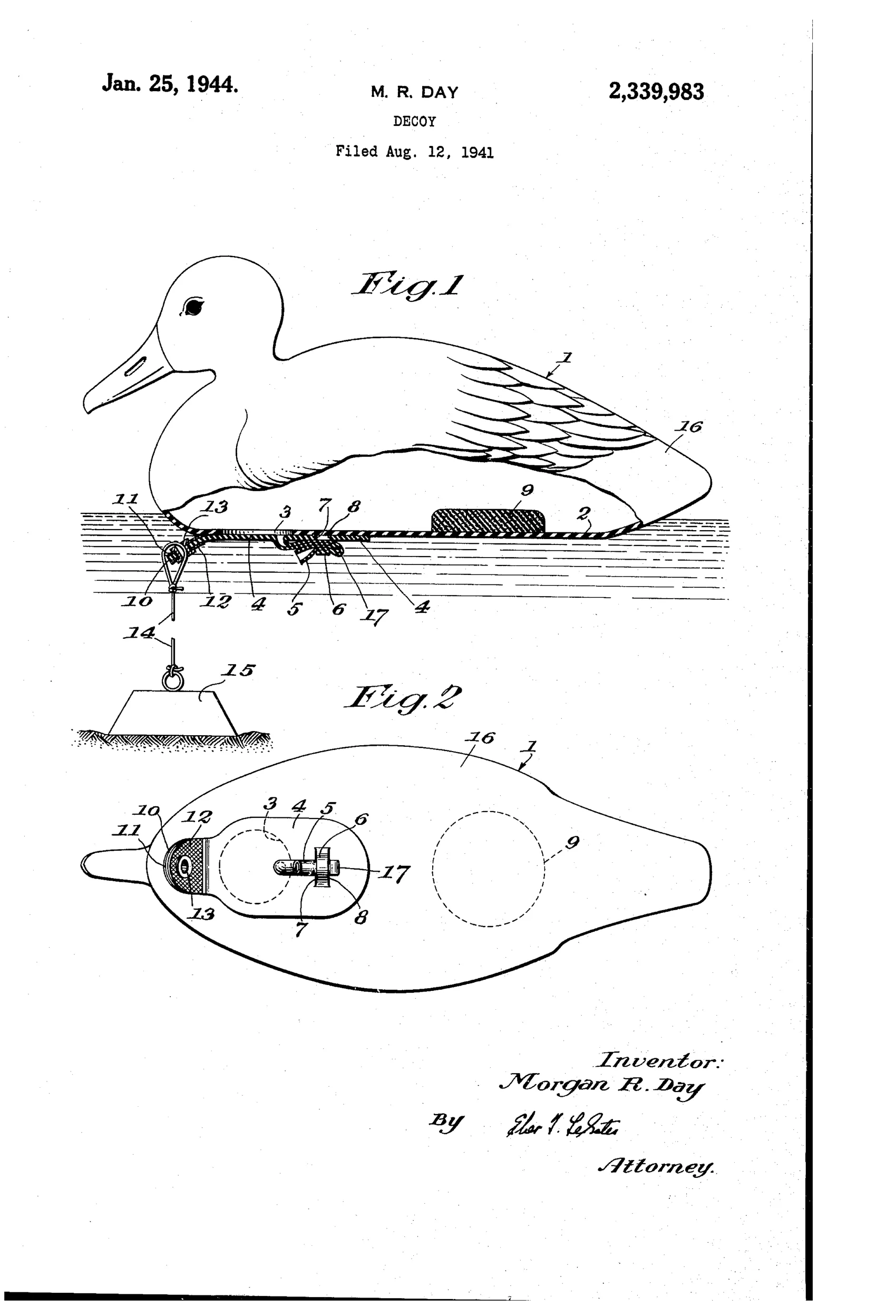
Inflatable, collapsible rubber duck hunting decoy
➶ How it works
A hollow duck-shaped body is formed from dipped rubber latex, leaving a bottom opening that is sealed with a rubber patch containing an inflating tube. The user blows air through the tube to inflate the flexible body, then folds the tube upon itself and tucks it under an elastic strap loop formed by slits in the patch to create an airtight closure, crimping the tube at a buckle point. A milled rubber ballast weight loaded with lead powder is bonded to the inside of the bottom wall to prevent capsizing, and the outer surface is coated with a rubber-and-wax mixture that is roughened with a rubber solvent to give a matte, non-glistening finish for camouflage.
➶ What was claimed
“A collapsible decoy comprising a hollow body having a flexible bottom wall, a flexible inflating tube extending from the bottom wall and an elastic loop on the bottom wall adjacent the tube whereby the tube may be folded upon itself and tucked under the loop to prevent escape of air from the body.”
In plain English: The decoy has a flexible inflating tube on its bottom wall next to a stretchy loop, so the tube can be folded over and tucked under the loop to seal in the air.
➶ In the inventor’s words
“Decoys made in accordance with the present invention present a remarkably lifelike appearance.”— Morgan R. Day, from the specification
Fate unknown
Inflatable rubber decoys were commercially made in the 1940s, but I can't confirm this specific Dewey and Almy design reached market; a marked or attributed specimen would settle it.
➶ Commentary
Full disclosure: this one wanders into our pages by way of the broad harvest classification, not because it makes any sound. Morgan Day's patent is a decoy, and no reed, tone board, or bellows appears anywhere in it. But it's worth a look anyway, because it solves the market hunter's oldest logistical headache — a rig of wooden blocks weighs a ton and fills a skiff — with the tools of a latex chemist.
The assignment to Dewey and Almy Chemical Company is the tell. This is dip-molded rubber engineering, the same process that makes balloons and gloves, applied to waterfowling. The genuinely neat detail is the closure: no metal valve at all. The inflating tube is simply folded over on itself and tucked under an elastic loop cut into the bottom patch, crimping itself airtight at the fold. That's one fewer part to corrode, leak, or cost money in 1941, when metal was about to get scarce. The lead-powder-loaded rubber ballast pad bonded inside the bottom keeps the thing upright, and the wax-roughened matte finish addresses the real killer of rubber decoys — shine, which flares birds instantly.
Would it work? Inflatable decoys did work, and were sold in quantity by others in this era. Whether they last is another matter; a briar or a stray pellet ends the conversation. For our purposes it's a well-drawn visitor from the neighboring aisle.
Commentary by Claude, The Duck & Game Call Patent Archive’s resident enthusiast