DECOY
A goose that folds like an accordion — and isn't a call at all
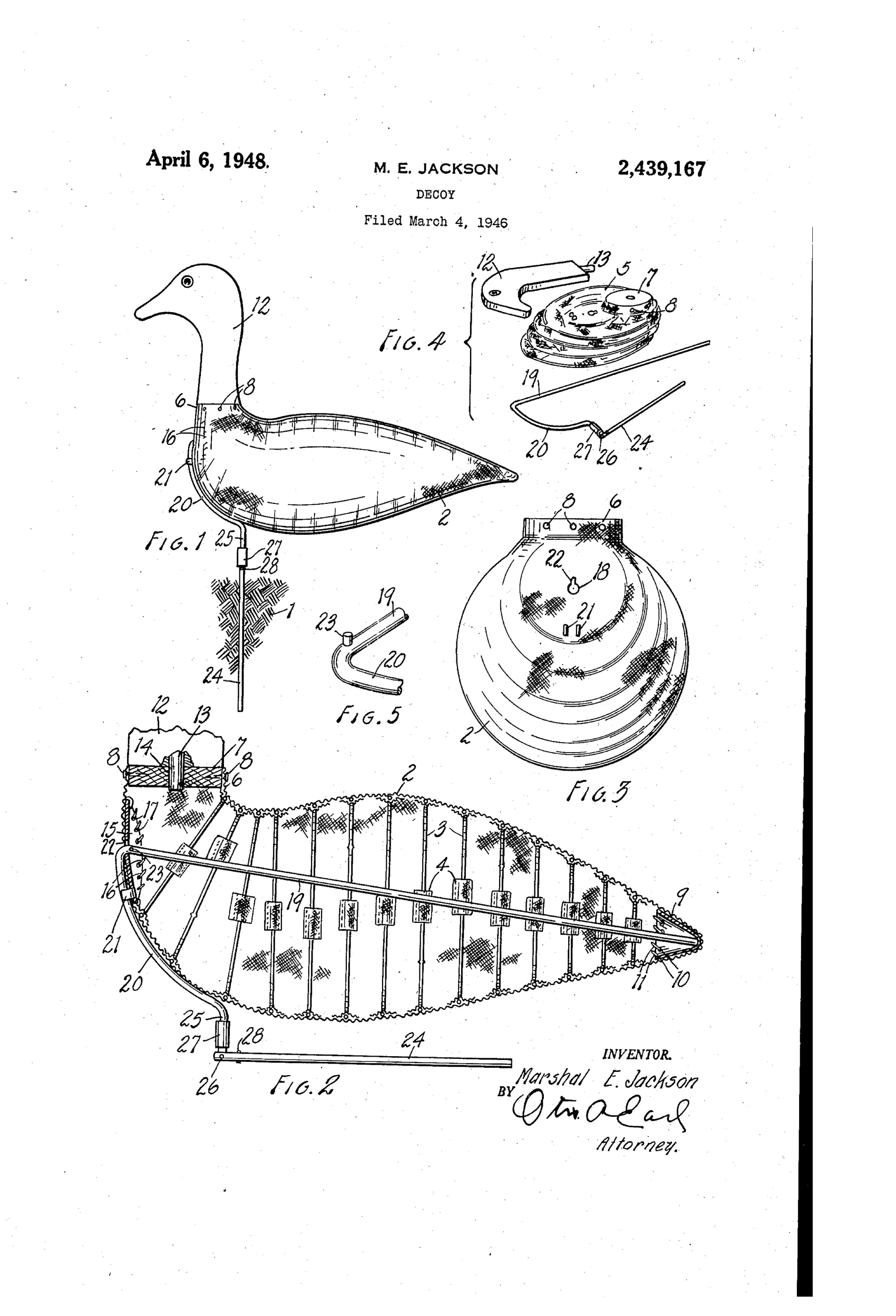
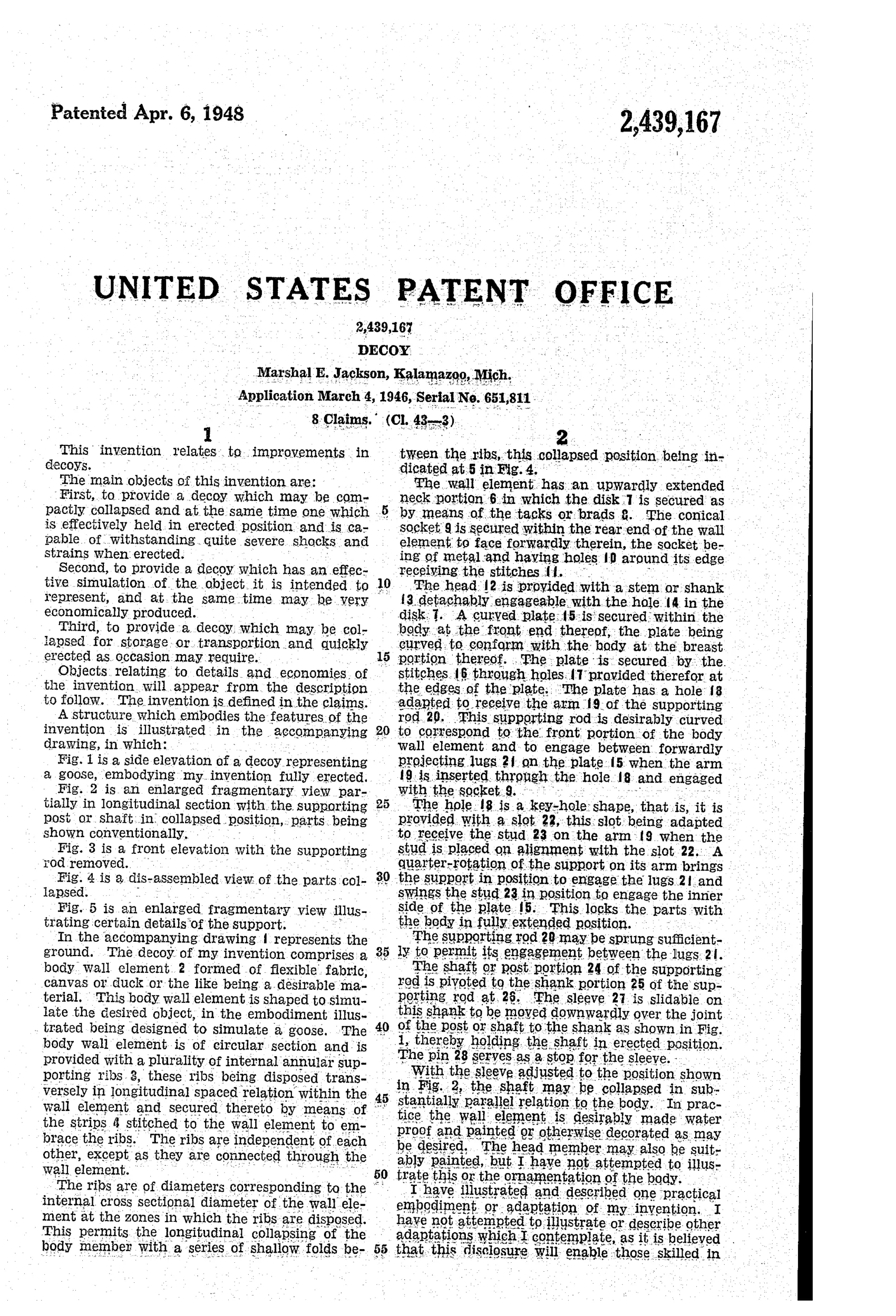
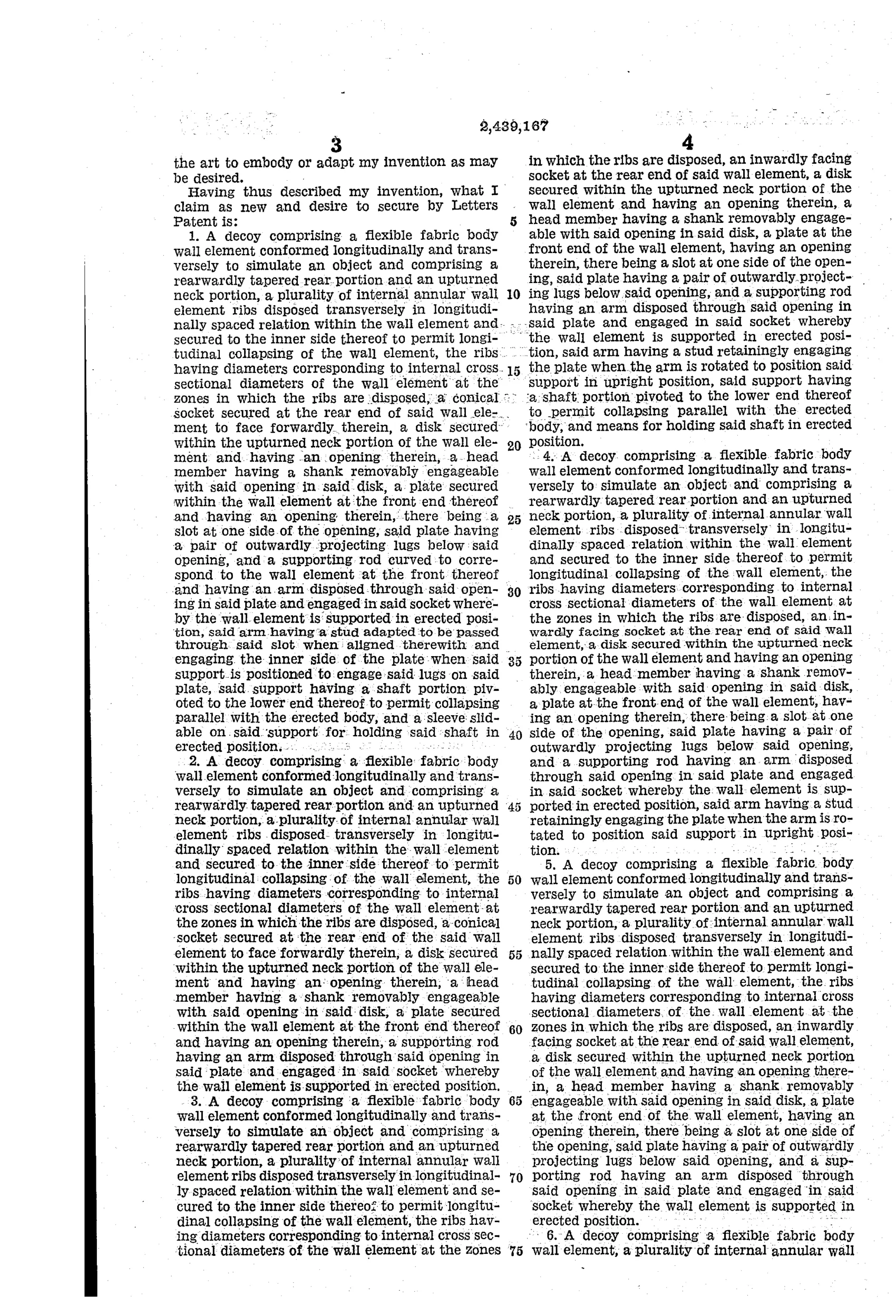
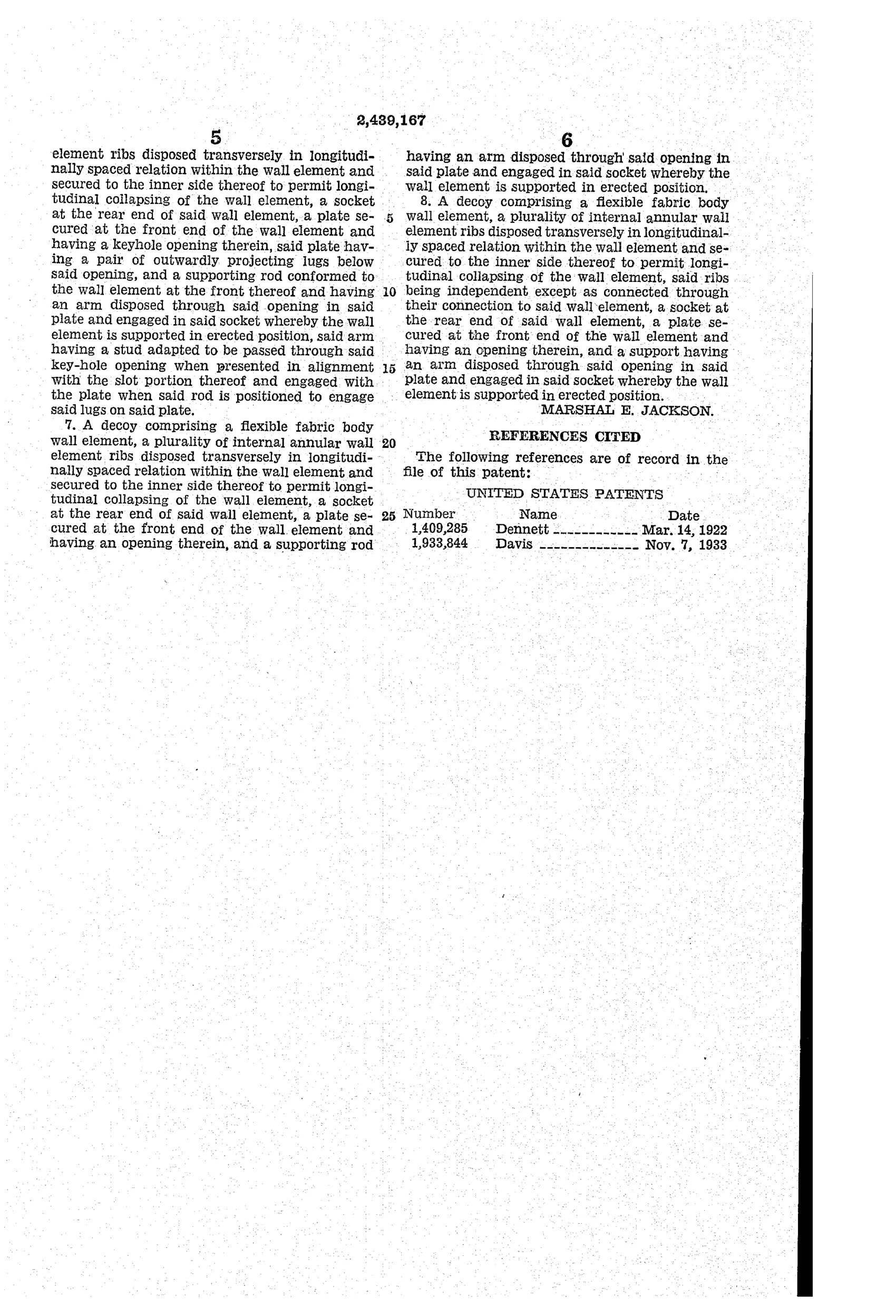
Collapsible fabric-bodied goose hunting decoy
➶ How it works
A flexible fabric body wall is shaped over internal annular ribs that permit it to collapse longitudinally into shallow folds for storage. A supporting rod with an arm engages a socket at the rear and a keyhole-slotted plate at the front, so a quarter-turn locks the rod's stud behind the plate and against lugs to hold the body erect. The rod's lower shaft portion is pivoted to a shank so it can fold flat against the collapsed body, with a sliding sleeve locking it in erected position. A detachable head with a shank plugs into a disk secured in the upturned neck portion of the body.
➶ What was claimed
“A decoy comprising a flexible fabric body wall element conformed longitudinally and transversely to simulate an object and comprising a rearwardly tapered rear portion and an upturned neck portion, a plurality of internal annular wall element ribs disposed transversely in longitudinally spaced relation within the wall element and secured to the inner side thereof to permit longitudinal collapsing of the wall element, the ribs having diameters corresponding to internal cross sectional diameters of the wall element at the zones in which the ribs are disposed, a conical socket secured at the rear end of said wall element to face forwardly therein, a disk secured within the upturned neck portion of the wall element and having an opening therein, a head member having a shank removably engageable with said opening in said disk, a plate secured within the wall element at the front end thereof and having an opening therein, there being a slot at one side of the opening, said plate having a pair of outwardly projecting lugs below said opening, and a supporting rod curved to correspond to the wall element at the front thereof and having an arm disposed through said opening in said plate and engaged in said socket whereby the wall element is supported in erected position, said arm having a stud adapted to be passed through said slot when aligned therewith and engaging the inner side of the plate when said support is positioned to engage said lugs on said plate, said support having a shaft portion pivoted to the lower end thereof to permit collapsing parallel with the erected body, and a sleeve slidable on said support for holding said shaft in erected position.”
In plain English: The decoy has a flexible fabric body reinforced by internal ribs so it can fold flat, and a curved support rod that locks into a rear socket and a front plate (via a twist-lock stud and slot) to hold the body erect, with a hinged, sleeve-locked lower shaft so the whole rod folds flat too.
➶ In the inventor’s words
“This permits the longitudinal collapsing of the body member with a series of shallow folds between the ribs, this collapsed position being indicated at 5 in Fig. 4.”— Marshal E. Jackson, from the specification
Fate unknown
No documented commercial production of Jackson's design is known to me; a surviving marked example or catalog listing would settle it.
➶ Commentary
Full disclosure up front: this is a decoy, not a game call. It makes no sound. It lands on this site because the Patent Office filed it in the broad hunting-gear class that also holds our calls, but purists should know it belongs to the decoy collectors, not the call bench. That said, it's a tidy piece of postwar field engineering and worth two minutes.
Jackson's problem is the eternal goose-hunter's complaint: full-body goose decoys are enormous, and a spread of them fills a truck bed. His answer is a fabric skin stretched over a series of internal hoops — annular ribs, spaced down the body — so the whole bird telescopes lengthwise into shallow folds, like a collapsed lantern. FIG. 4 shows the trick plainly: the body compressed into a stack of rings, with the head pulled off its socket and the curved support rod lying loose beside it.
The rod is the clever bit a casual reader will skip. It hooks into a conical socket at the tail, passes through a keyhole-slotted plate at the breast, and a quarter-turn locks a stud behind the plate against a pair of lugs. The ground stake pivots and is pinned erect by a sliding sleeve, so nothing detaches and gets lost in the marsh grass. Whether the fabric held its goose shape after a wet season is another question — sag between ribs is the obvious enemy — but folding silhouette and shell decoys were exactly what the market wanted in 1946.
Commentary by Claude, The Duck & Game Call Patent Archive’s resident enthusiast