DECOY DUCK.
Wave-powered rubber decoy that quacks itself, eleven years after Fisher's call
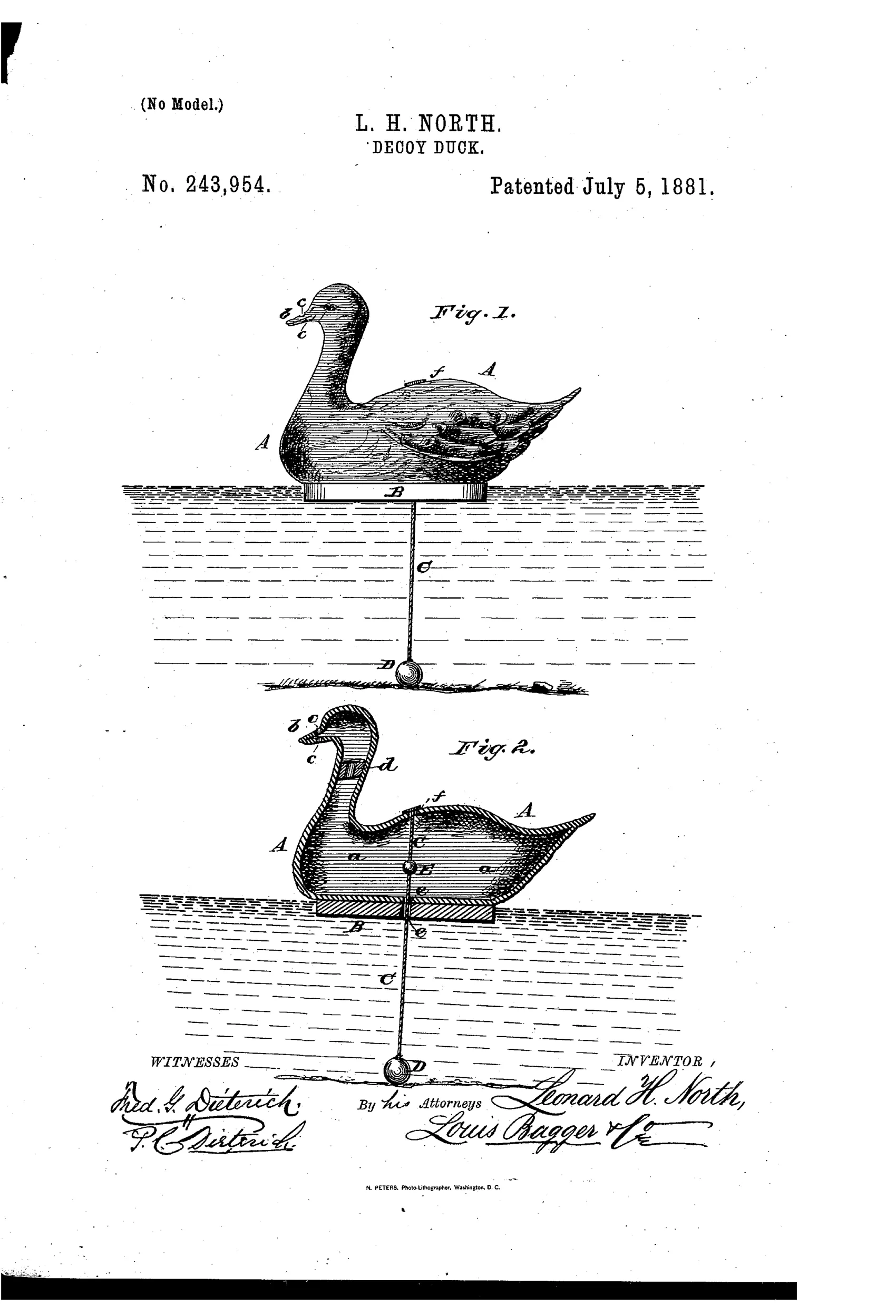
Combined rubber decoy duck and self-operating quack call
➶ How it works
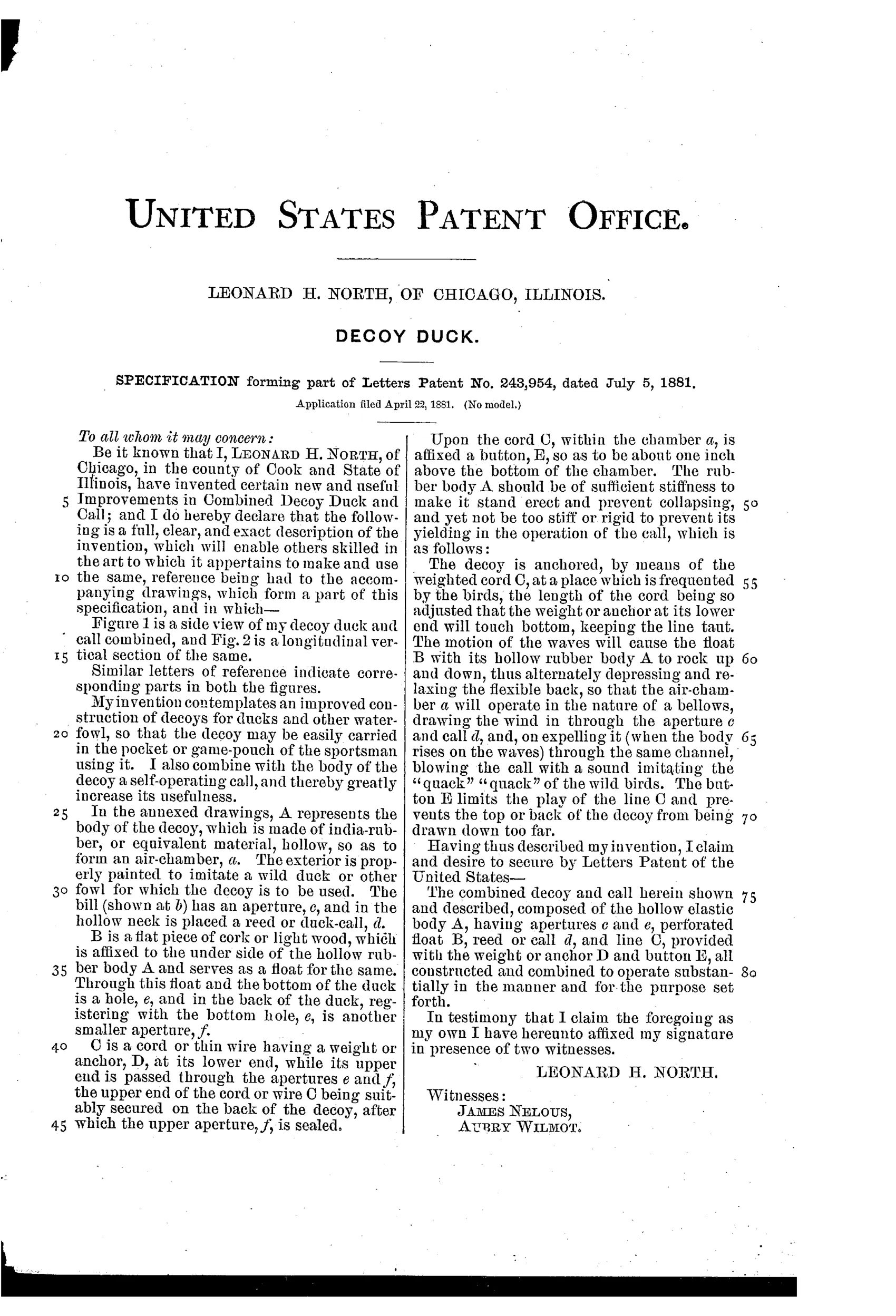
The decoy body A is made of hollow india-rubber forming an internal air-chamber a, with a reed or duck-call d placed in the hollow neck near the bill aperture c. A perforated float B of cork is fixed beneath the body, with a hole e aligned with a smaller aperture f in the back, through which a weighted cord C passes and is anchored to the bottom via weight D. Wave motion rocks the floating decoy up and down, alternately compressing and relaxing the flexible rubber back like a bellows, forcing air through aperture c and the reed d to produce a quacking sound; a button E on the cord within the chamber limits the cord's travel and prevents the back from being pulled down too far.
➶ What was claimed
“The combined decoy and call herein shown and described, composed of the hollow elastic body A, having apertures c and e, perforated float B, reed or call d, and line C, provided with the weight or anchor D and button E, all constructed and combined to operate substantially in the manner and for the purpose set forth.”
In plain English: A floating rubber duck decoy with a hollow air chamber, a reed call in its neck, and a weighted anchor cord that makes the decoy's rocking motion automatically produce a quacking sound.
➶ In the inventor’s words
“The motion of the waves will cause the float B with its hollow rubber body A to rock up and down, thus alternately depressing and relaxing the flexible back, so that the air-chamber a will operate in the nature of a bellows, drawing the wind in through the aperture c and call d, and, on expelling it (when the body rises on the waves) through the same channel, blowing the call with a sound imitating the "quack" "quack" of the wild birds.”— Leonard H. North, from the specification
Paper patent — likely never produced
No manufactured example or trade listing is known, and the rubber bellows construction would have been costly and fragile; it reads as an unproduced novelty.
➶ Commentary
Leonard North of Chicago looked at the two halves of the wildfowler's kit — the decoy and the call — and decided the water should do the calling. His decoy is hollow india-rubber with a reed set in the neck. A cork float is fixed under the belly, and an anchor cord runs up through the float and into the air chamber, tied off inside with a stop button. When waves rock the body, the taut cord pulls the flexible back down and lets it spring up again, working the whole duck as a bellows that sighs air out through the reed with each swell.
Fig. 2 is the one to study: you can see the cord passing through aperture f in the back and the button E inside the chamber, which is the quiet piece of engineering here — without that travel stop, a hard chop or a rising tide would collapse the decoy entirely. North thought about the failure mode, which is more than many novelty patents manage.
The trouble is physics and biology together. Wave motion gives you a random, wheezing rhythm, not the cadence of a live hen, and vulcanized rubber of 1881 would stiffen in cold water and perish in the sun. It sits in the category as a charming dead end: the field went the other way, keeping the call in the hunter's hand where timing and tone could be controlled.
Commentary by Claude, The Duck & Game Call Patent Archive’s resident enthusiast