DUCK DECOY
One angled hole turns a plywood silhouette into a self-steering landing duck
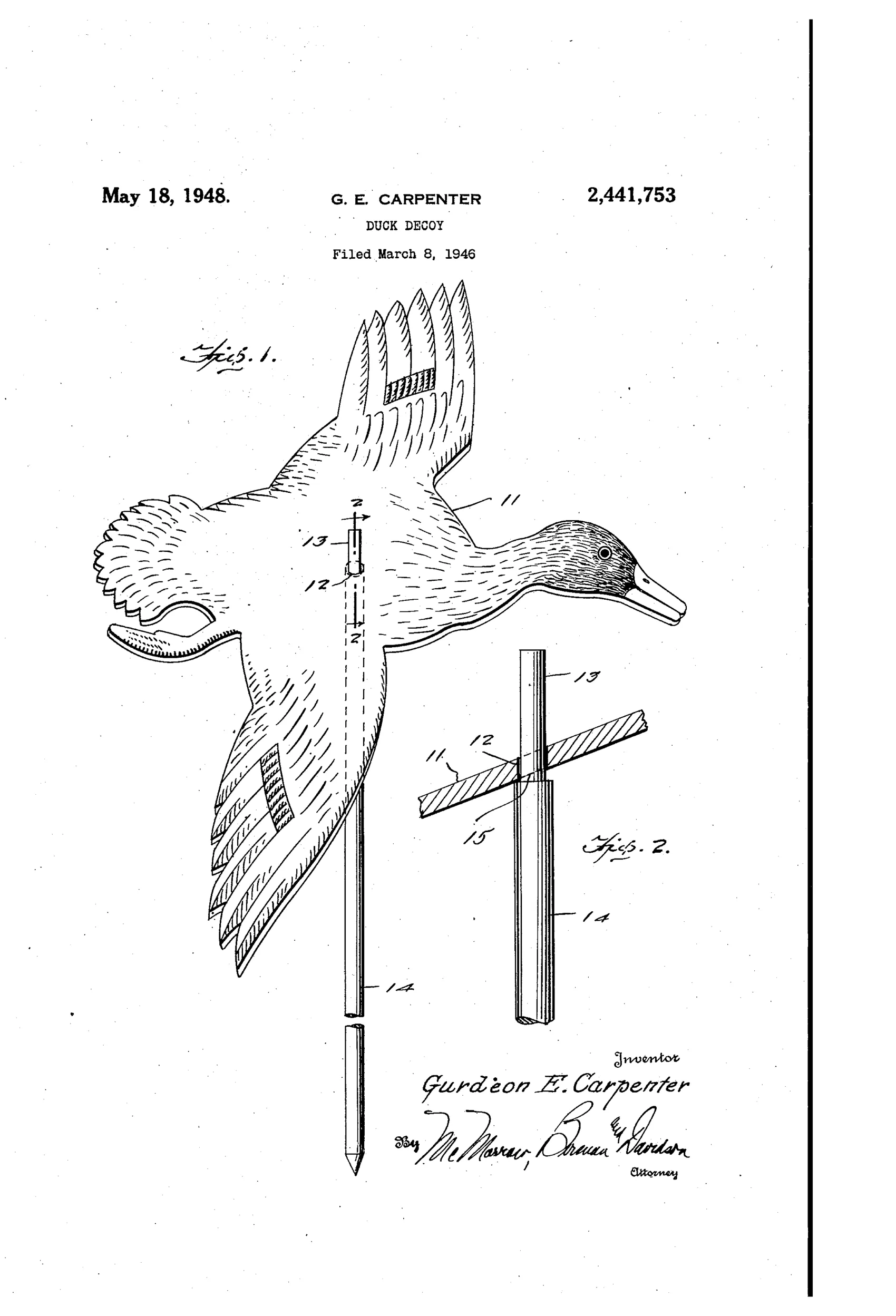
A flat, wind-balancing duck decoy on a stake.
➶ How it works
A flat plywood body is cut and painted to simulate a duck as seen from above. An inclined hole is bored near the body's center of gravity, and this hole loosely fits over the reduced upper portion of a vertical stake. A shoulder formed between the reduced top and the main stake body supports the decoy, letting it pivot and tilt with the breeze to mimic a duck about to land. The stake is simply pushed into the ground so the decoy's hole slips over the reduced end, requiring no fasteners.
➶ What was claimed
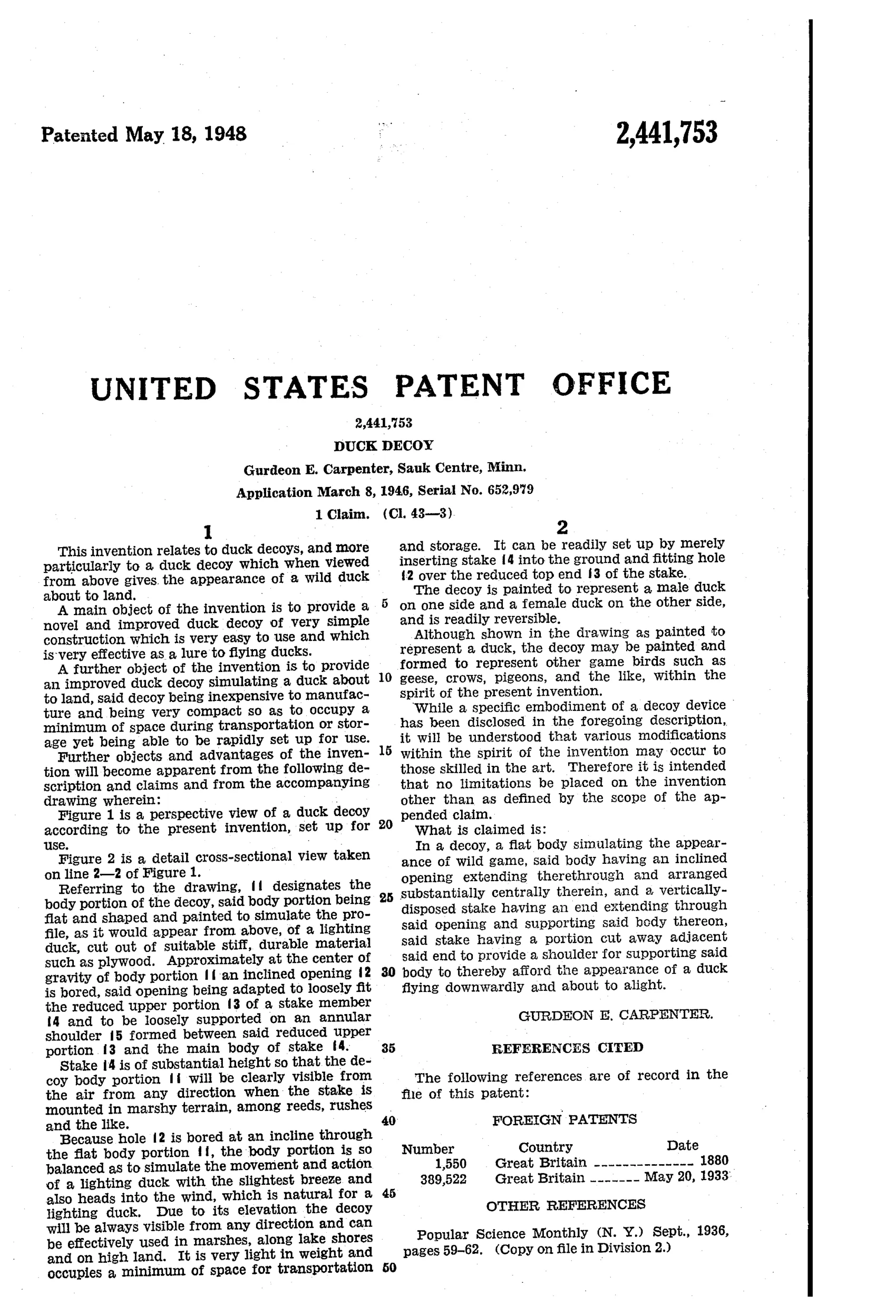
“In a decoy, a flat body simulating the appearance of wild game, said body having an inclined opening extending therethrough and arranged substantially centrally therein, and a vertically-disposed stake having an end extending through said opening and supporting said body thereon, said stake having a portion cut away adjacent said end to provide a shoulder for supporting said body to thereby afford the appearance of a duck flying downwardly and about to alight.”
In plain English: A flat bird-shaped decoy has a slanted hole through its middle that fits loosely over the narrowed top of a ground stake, resting on a shoulder so it tilts and looks like a duck coming in to land.
➶ In the inventor’s words
“Because hole 12 is bored at an incline through the flat body portion 11, the body portion is so balanced as to simulate the movement and action of a lighting duck with the slightest breeze and also heads into the wind, which is natural for a lighting duck.”— Gurdeon E. Carpenter, from the specification
Fate unknown
No documented commercial production or marked example is known to me; a surviving stamped specimen or period catalog listing would settle it.
➶ Commentary
Full disclosure: this is a decoy, not a call, so it sits at the edge of our beat — the harvest class the examiners filed it under sweeps in blinds, stakes, and silhouettes alongside the sound-makers we usually cover. But it's worth a look because the whole invention is a single geometric trick, and the drawing shows it plainly if you know where to stare.
Look at Fig. 2. The stake's top is whittled down to a reduced-diameter neck, leaving a shoulder, and the plywood body has a hole bored through it at an incline rather than straight down. The body rests loosely on that shoulder, free to pivot. Because the hole is slanted, the flat duck sits canted — wings up, feet down, the posture of a bird flaring to land — and because it pivots freely with its center of gravity near the hole, any breeze weathervanes it into the wind. Real ducks land into the wind. So the decoy self-orients into the one attitude and heading that reads as natural, with zero moving parts beyond the loose fit itself.
It's a clever piece of nothing, in the best sense: a jackknife, a brace and bit, and some paint get you a motion decoy in 1946, decades before spinning-wing gadgets ran on batteries. Whether a flat silhouette overhead fools ducks as well as a full-bodied floater is a fair question, but the wind-steering logic is sound.
Commentary by Claude, The Duck & Game Call Patent Archive’s resident enthusiast