ELECTRICAL DUCK DECOY
A relay-driven duck with paddling feet, steered by a wire from the blind
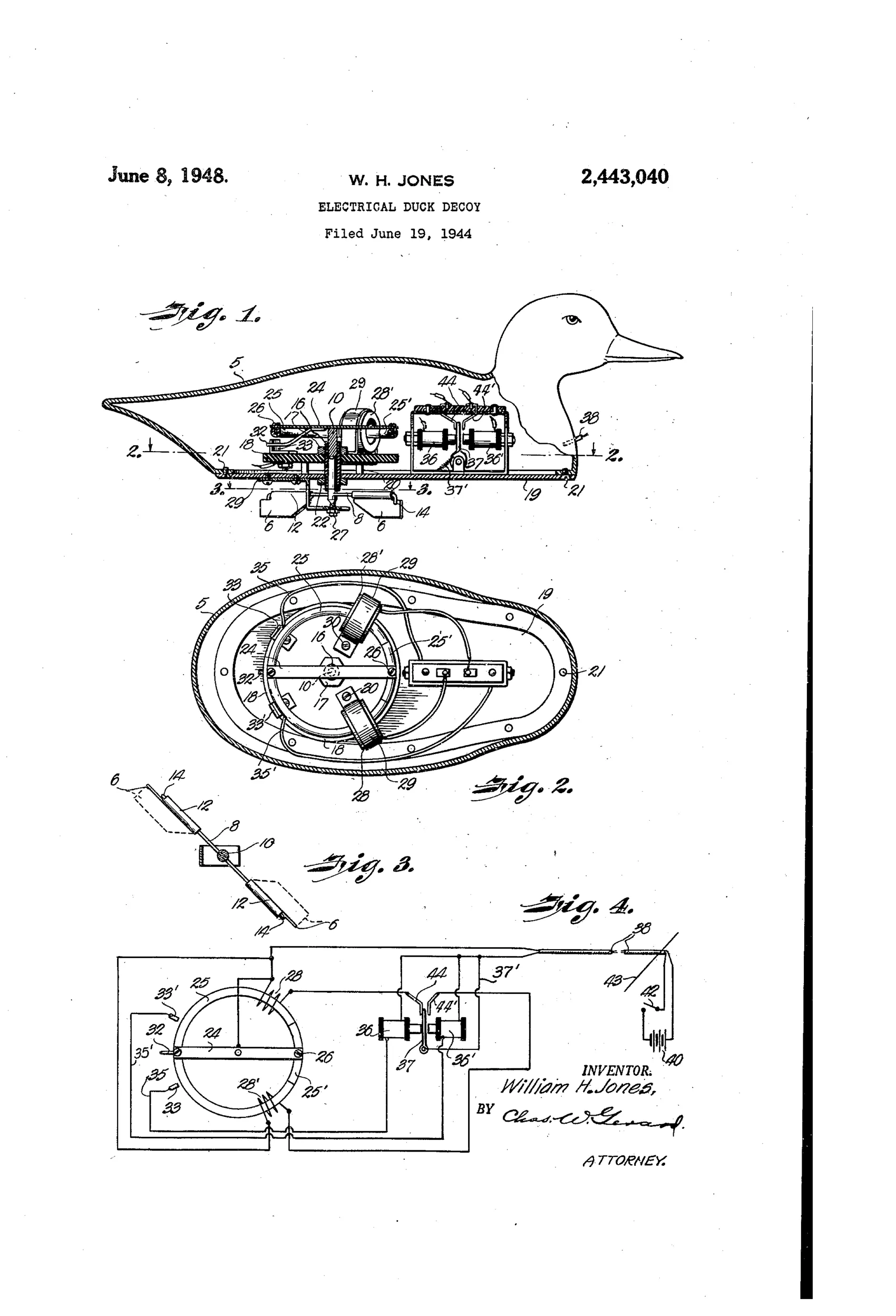
Remote-controlled electric decoy duck with paddling feet
➶ How it works
A pair of pivoting paddle blades are mounted on a rod carried at the bottom of a vertical shaft housed inside the buoyant duck body. The upper end of the shaft supports a solenoid ring with a nonmagnetic section that oscillates between two induction coils mounted on a disk inside the decoy. A spring switch finger on the shaft's crossbar alternately contacts two circuit contacts, energizing relay coils that alternately activate the induction coils, causing the ring and shaft to oscillate. This oscillation swings the paddle blades to simulate paddling motion, with the whole circuit powered by a dry-cell battery and controlled remotely via a leash-like conductor and switch located at the hunting blind.
➶ What was claimed
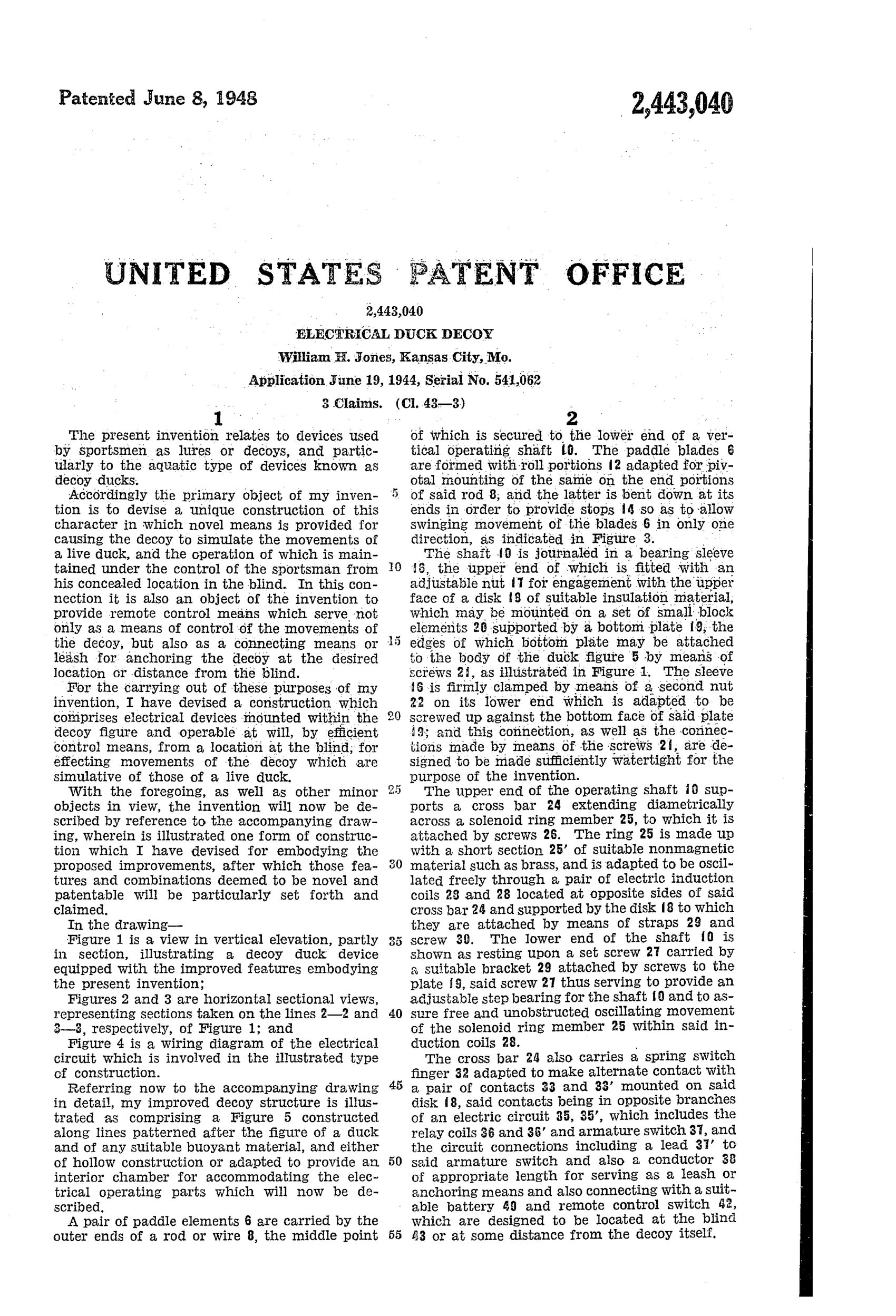
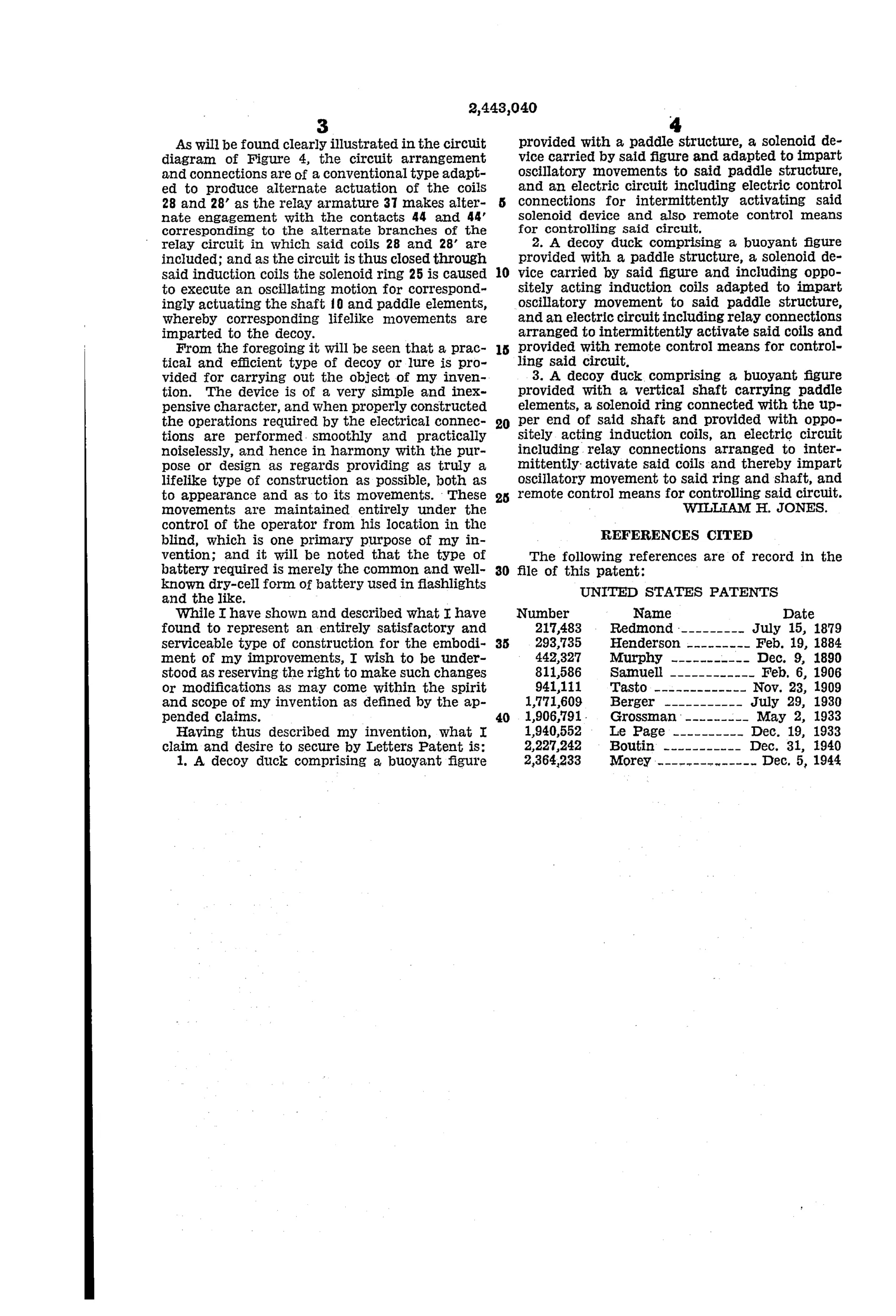
“3. A decoy duck comprising a buoyant figure provided with a vertical shaft carrying paddle elements, a solenoid ring connected with the upper end of said shaft and provided with oppositely acting induction coils, an electric circuit including relay connections arranged to intermittently activate said coils and thereby impart oscillatory movement to said ring and shaft, and remote control means for controlling said circuit.”
In plain English: A floating decoy duck has a shaft with paddles on the bottom and a solenoid ring on top; a relay circuit alternately powers two coils to oscillate the ring and shaft, moving the paddles, all controlled remotely by the hunter.
➶ In the inventor’s words
“These movements are maintained entirely under the control of the operator from his location in the blind, which is one primary purpose of my invention; and it will be noted that the type of battery required is merely the common and well-known dry-cell form of battery used in flashlights and the like.”— William H. Jones, from the specification
Fate unknown
No manufactured example or commercial descendant is documented; a surviving marked decoy or period advertisement would settle it.
➶ Commentary
First, honesty: this is not a call. Jones's patent lives in the broad hunting-gear class alongside our reed calls, but it makes no sound at all — its whole point is motion. It belongs to the parallel obsession of the 1940s wildfowler: dead-still decoy spreads look wrong to circling birds, and hunters kept trying to add ripple and wake without adding suspicion.
Jones's mechanism is more sophisticated than most. Instead of a wind vane or a jerk-string, he builds a genuine electric oscillator inside the body. A vertical shaft carries paddle blades below the waterline; up top, a solenoid ring with a nonmagnetic gap sits between two induction coils. A spring finger on the shaft's crossbar acts as its own commutator, alternately closing two relay circuits so the coils pull the ring back and forth. The paddles swing, the duck kicks, and it all runs off a flashlight dry cell — his own quote makes a point of the humble battery. The remote 'leash' conductor back to the blind means the hunter can start the paddling exactly when birds are working.
The self-interrupting relay is clever, but the failure modes are obvious: contact points in a damp hull, a trailing wire fouling in weeds, and paddle torque that a light float will partly absorb by rotating itself. Wartime filing, 1948 issue, no assignee — it reads like an ingenious garage project that stayed one.
Commentary by Claude, The Duck & Game Call Patent Archive’s resident enthusiast