ART OF MANUFACTURING AQUATIC DECOYS
A decoy, not a call: pulp shell ducks with asphalt-stiffened heads, from Milwaukee
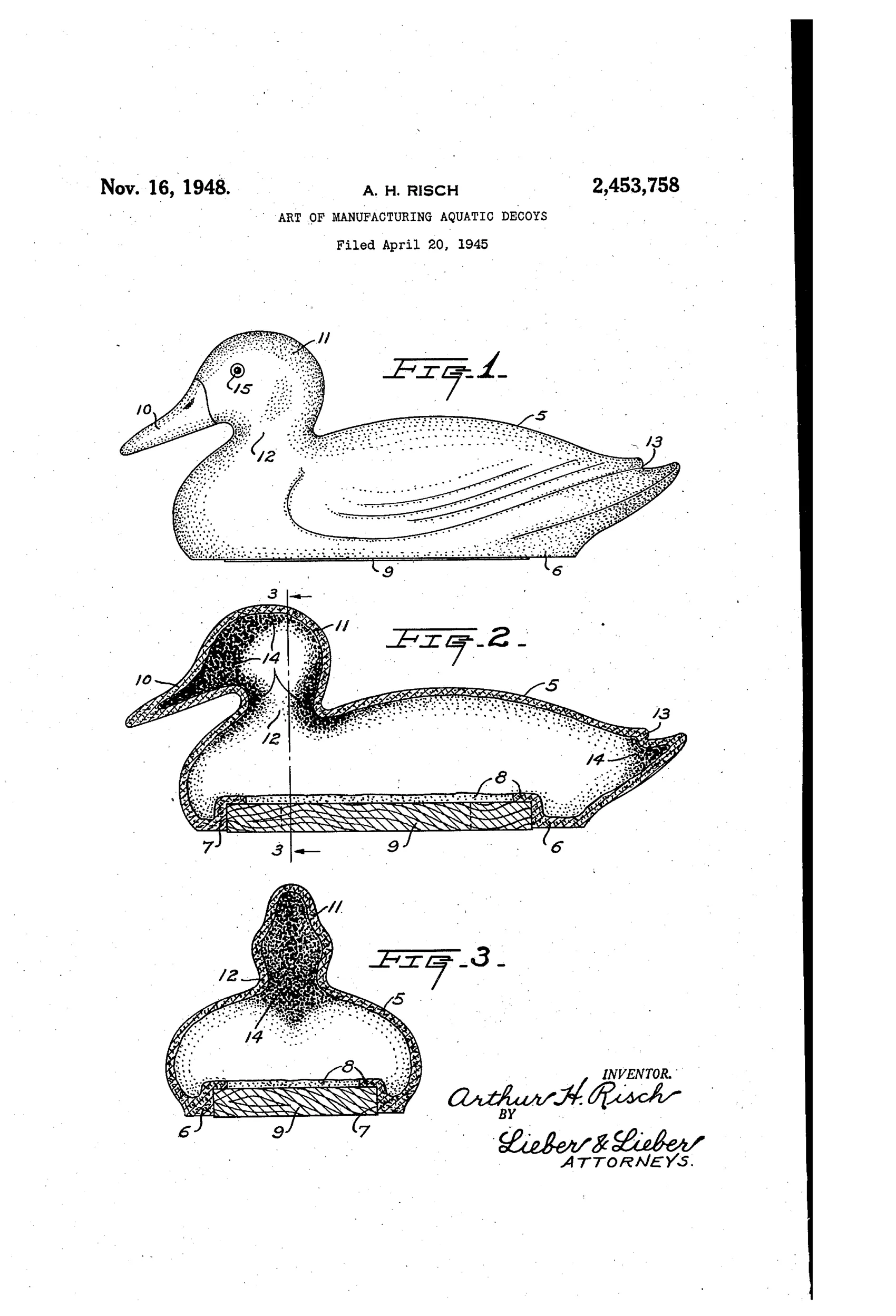
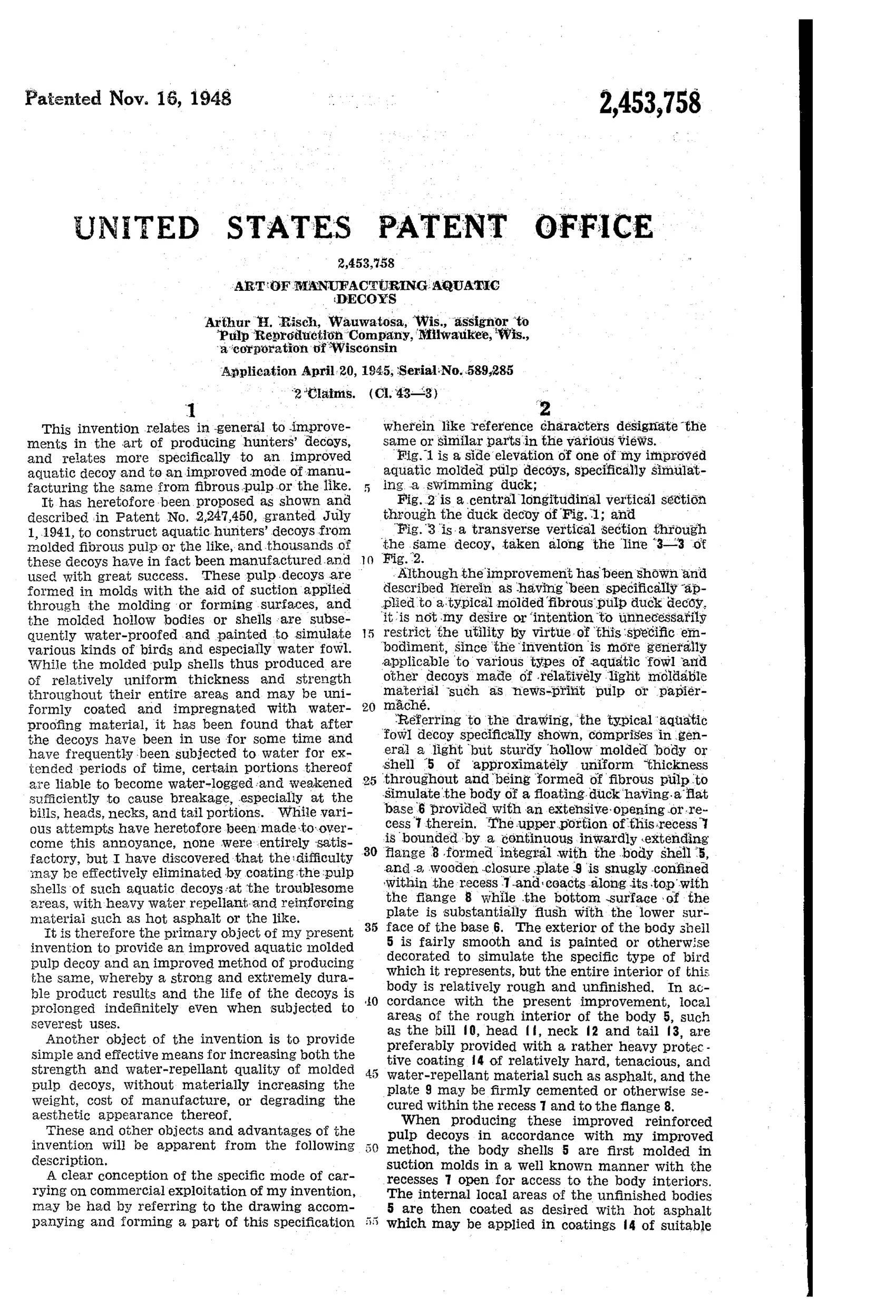
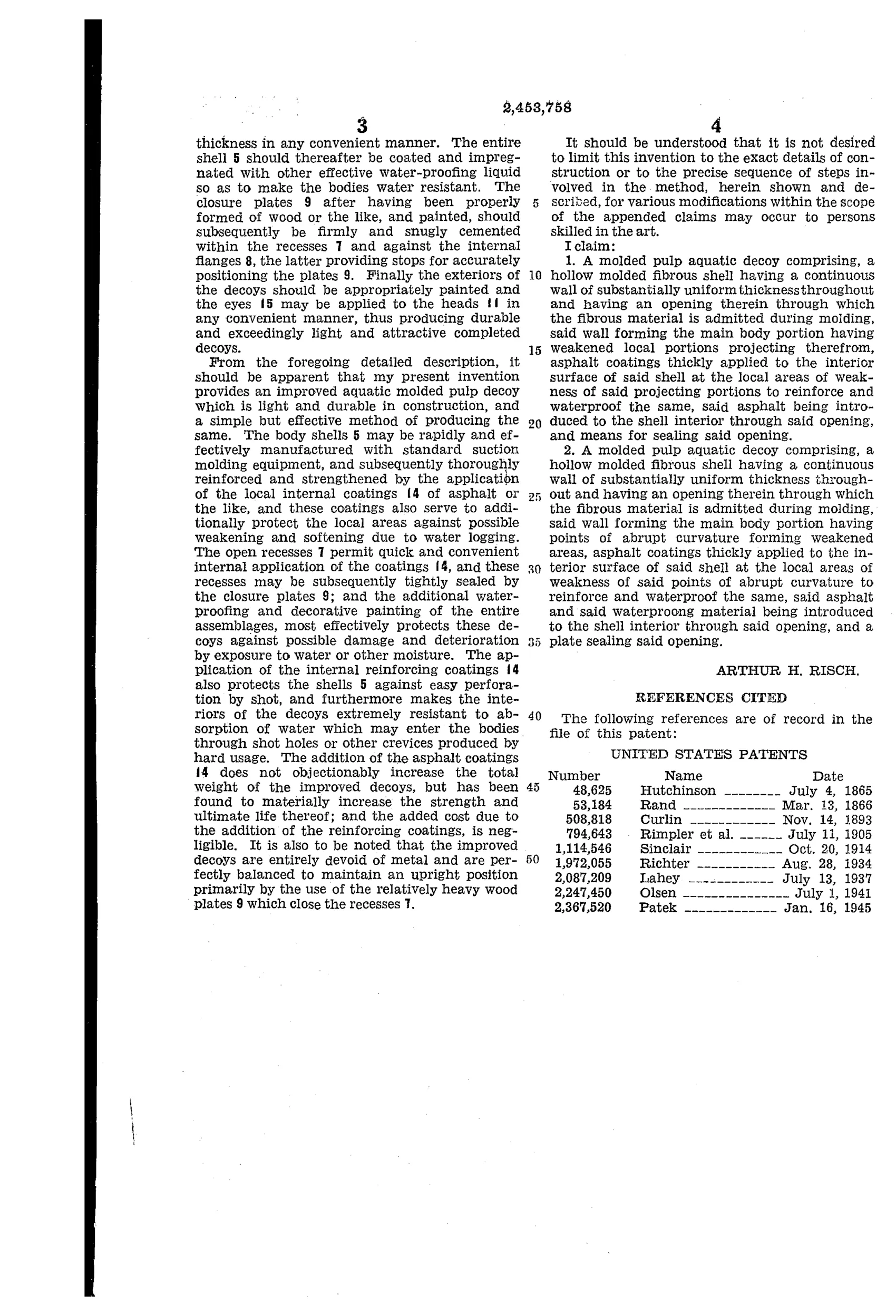
Reinforced molded pulp waterfowl hunting decoy
➶ How it works
A hollow duck decoy body is formed by suction-molding fibrous pulp into a thin, uniformly-walled shell simulating a floating duck. Weak, sharply curved local areas such as the bill, head, neck, and tail are coated on their interior surface with a thick layer of hot asphalt to reinforce and waterproof them. The molded shell has an opening in its flat base, bordered by an internal flange, through which the fibrous material and asphalt are introduced. A wooden closure plate is cemented into this recess against the flange to seal the opening and add ballast for balance.
➶ What was claimed
“A molded pulp aquatic decoy comprising, a hollow molded fibrous shell having a continuous wall of substantially uniform thickness throughout and having an opening therein through which the fibrous material is admitted during molding, said wall forming the main body portion having weakened local portions projecting therefrom, asphalt coatings thickly applied to the interior surface of said shell at the local areas of weakness of said projecting portions to reinforce and waterproof the same, said asphalt being introduced to the shell interior through said opening, and means for sealing said opening.”
In plain English: A hollow pulp decoy shell with thin projecting parts (bill, head, neck, tail) that are internally reinforced and waterproofed with thick asphalt coating applied through a sealable opening in the base.
➶ In the inventor’s words
“I have discovered that the difficulty may be effectively eliminated by coating the pulp shells of such aquatic decoys at the troublesome areas, with heavy water repellant and reinforcing material such as hot asphalt or the like.”— Arthur H. Risch, from the specification
Manufactured and sold
Assigned to an operating Milwaukee pulp-goods manufacturer, and molded-pulp decoys of precisely this construction were mass-produced and survive in quantity.
➶ Commentary
Let's be upfront: this one wandered into our aisle by way of the broad hunting-gear patent class, but it's a decoy, not a call. It makes no sound at all. Still, since it's here, it deserves a fair reading — and it's a genuinely practical piece of manufacturing thinking from the era when molded-pulp decoys were pushing hand-carved cedar birds out of the market.
The problem Risch is solving is visible in Figure 2 if you look at the stippled dark areas around the head, neck, bill, and tail. Suction-molded pulp gives you a nice uniform thin wall — cheap and light — but exactly those sharply curved projections are where a thin fibrous shell is weakest and where water intrusion turns the decoy to mush. His fix is almost crude and all the better for it: slosh hot asphalt inside the shell through the base opening and let it build up thick at the trouble spots, then cement a wooden plate into the flanged recess (items 7, 8, 9 in the sections) to seal the bottom and act as ballast in one stroke.
Assigned to the Pulp Reproduction Company of Milwaukee — a real manufacturer, not a hopeful tinkerer — this reads like a production patent documenting an actual factory process. Milwaukee pulp decoys were made by the crate-load in exactly these years. Fine work; just not our instrument.
Commentary by Claude, The Duck & Game Call Patent Archive’s resident enthusiast