ANIMATED DECOY DUCK
A wave-powered decoy: mercury-weighted neck, ratchet drive, propeller — no call at all
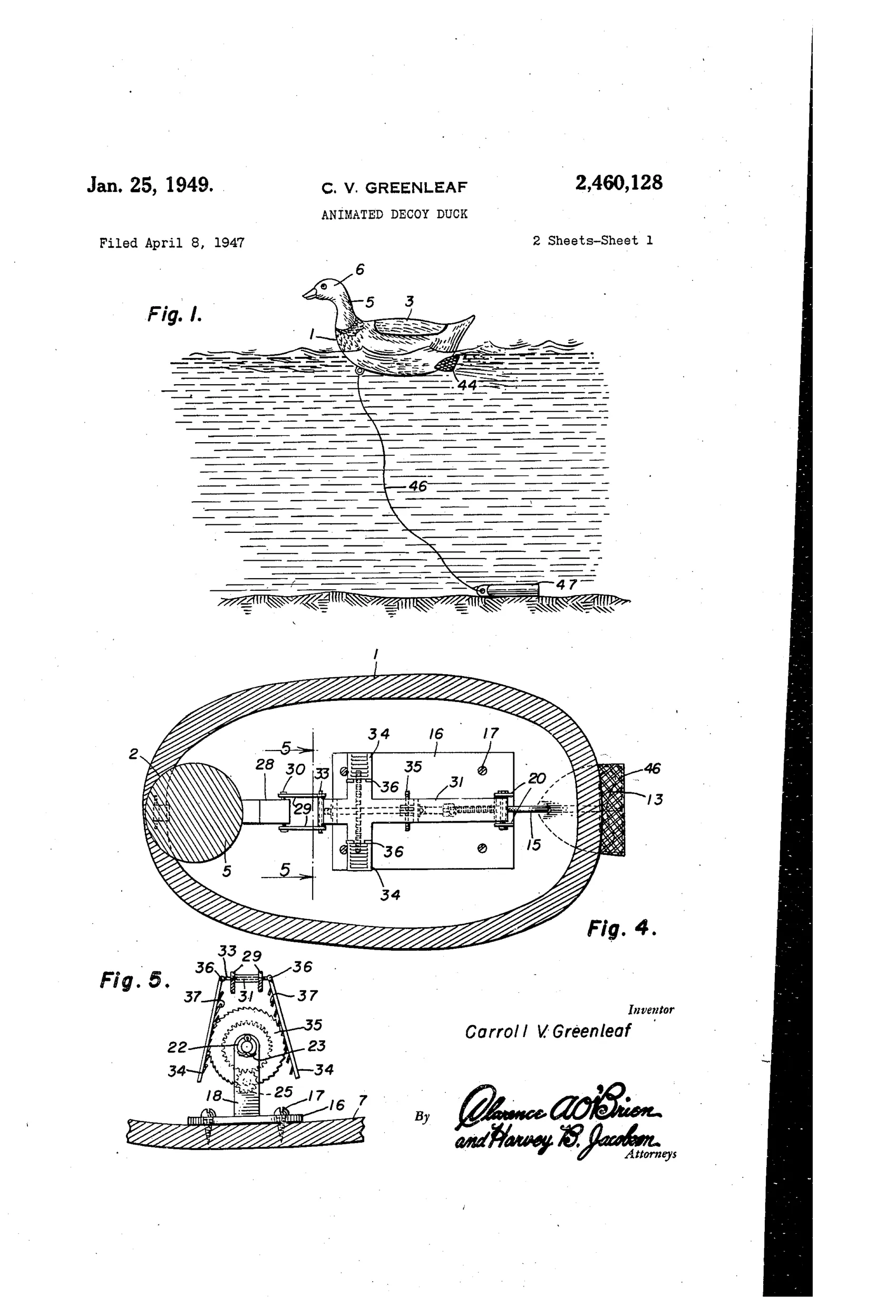
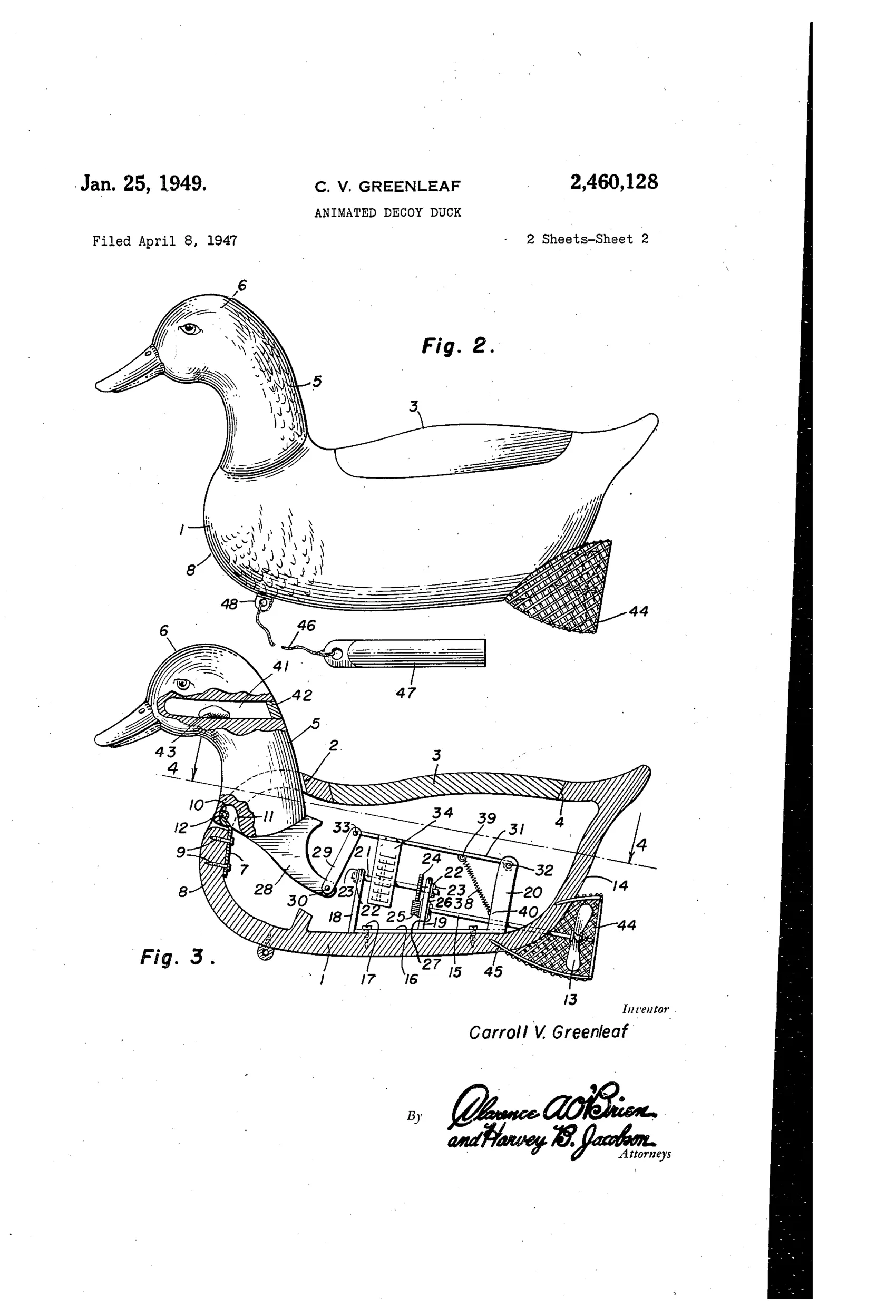
Self-propelled, wave-animated mechanical duck decoy
➶ How it works
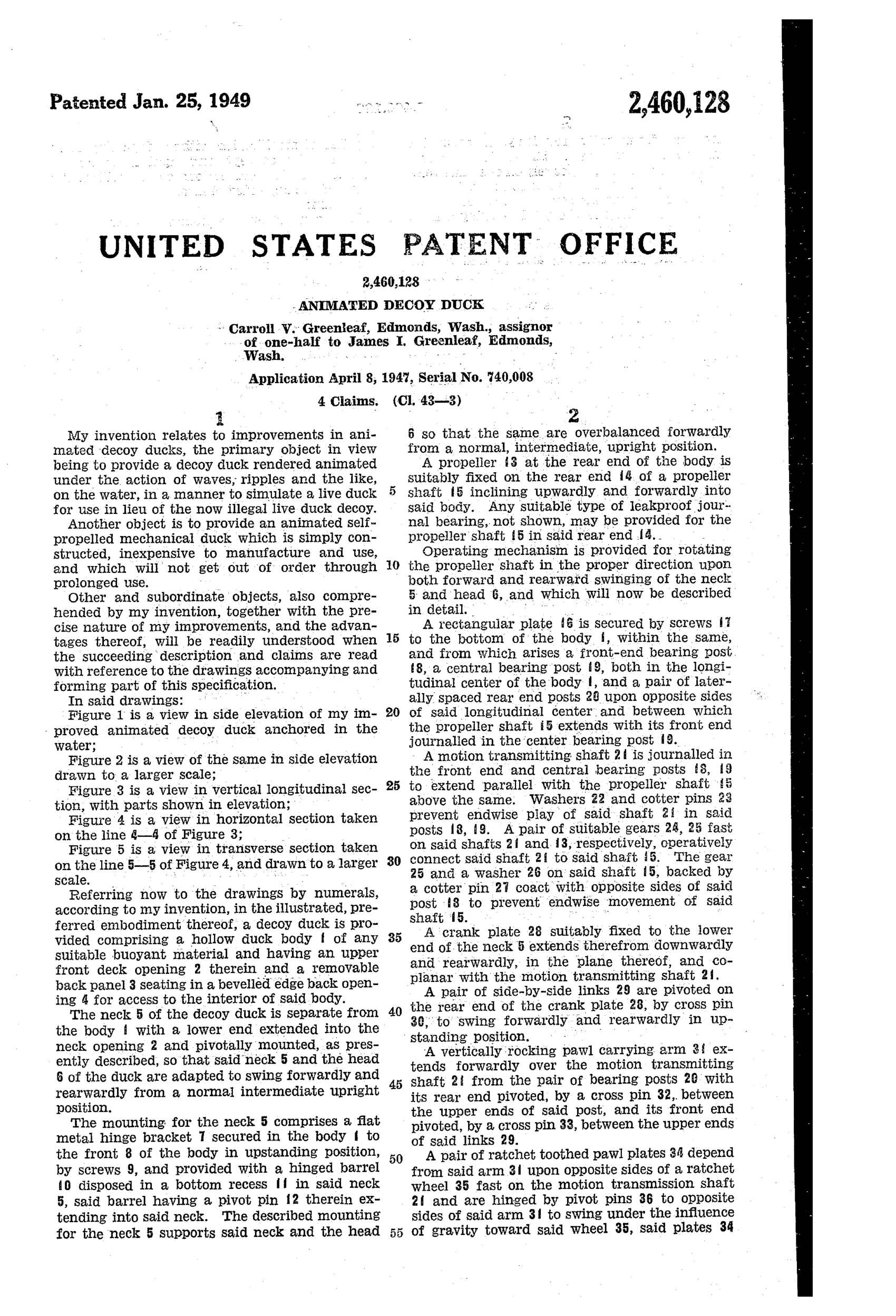
A hollow buoyant duck body houses a pivoted neck and head that swing forward and rearward under the action of waves, ripples, and a gravitating bead of mercury sealed in a bore within the neck, which accelerates the swinging motion. This rocking neck motion drives a crank plate and links that rock a pawl-carrying arm, whose two ratchet-toothed pawl plates alternately engage a ratchet wheel to rotate a motion-transmitting shaft in one direction regardless of swing direction. That shaft turns a pair of gears connected to an inclined propeller shaft, spinning a caged rear propeller so the decoy is drawn forward through the water around its anchor drag, simulating the motion of a live duck. A coil spring counterbalances the neck and head back to a normal upright position between swings.
➶ What was claimed
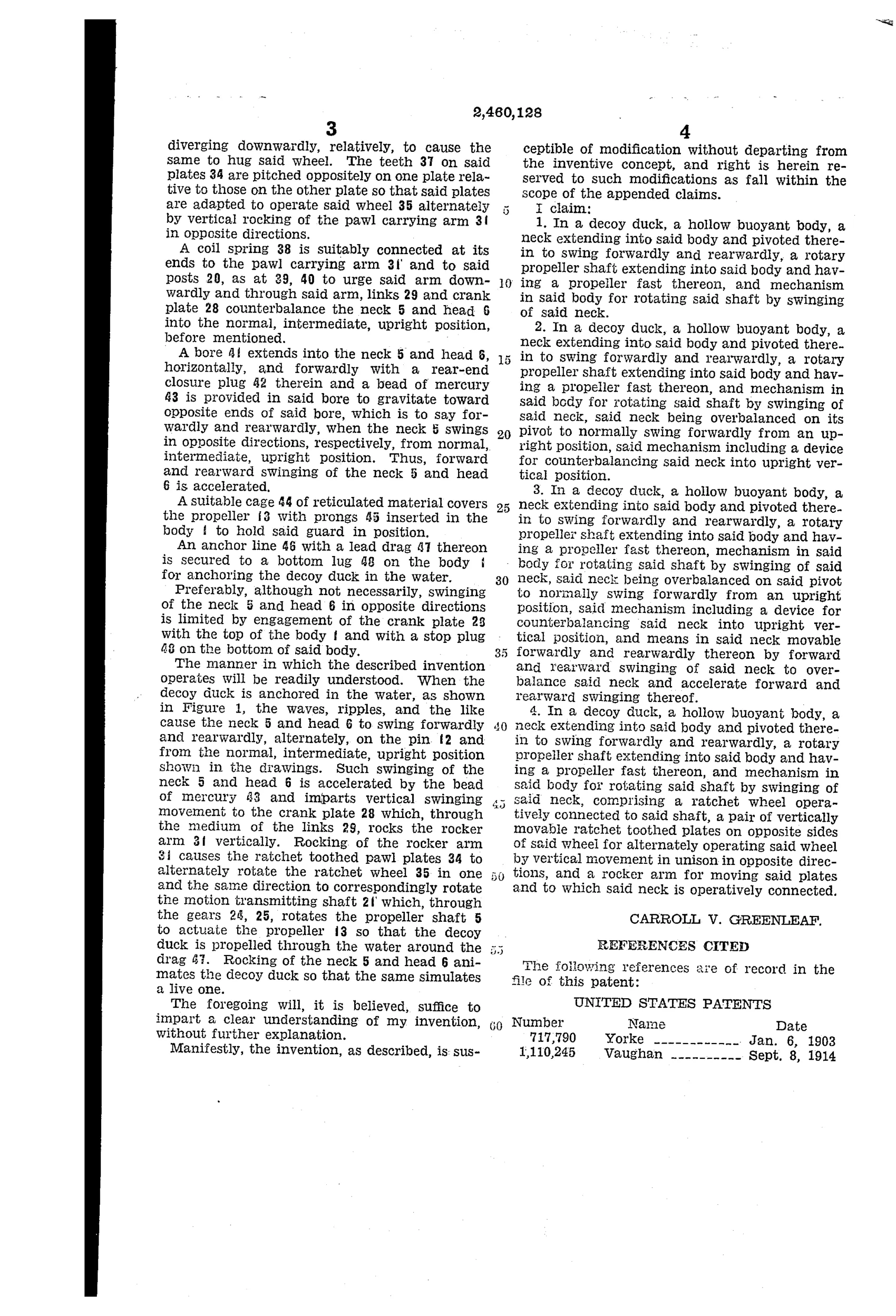
“In a decoy duck, a hollow buoyant body, a neck extending into said body and pivoted therein to swing forwardly and rearwardly, a rotary propeller shaft extending into said body and having a propeller fast thereon, and mechanism in said body for rotating said shaft by swinging of said neck, comprising a ratchet wheel operatively connected to said shaft, a pair of vertically movable ratchet toothed plates on opposite sides of said wheel for alternately operating said wheel by vertical movement in unison in opposite directions, and a rocker arm for moving said plates and to which said neck is operatively connected.”
In plain English: The decoy's swinging neck rocks an arm carrying two ratchet plates that alternately turn a ratchet wheel, which drives a shaft and propeller to push the duck through the water.
➶ In the inventor’s words
“Rocking of the neck 5 and head 6 animates the decoy duck so that the same simulates a live one.”— Carroll V. Greenleaf, from the specification
Paper patent — likely never produced
The wave-energy budget and the multi-stage ratchet-and-gear train make a working commercial version implausible, and no manufactured example is documented.
➶ Commentary
First, honesty: this is not a game call. Greenleaf's patent lives in the broad hunting-gear class alongside our calls, but it makes no sound — it's a decoy that tries to move like a live duck. It earns a look anyway, because it's one of the era's more ambitious attempts to solve the great decoy problem: dead-still blocks on calm water fool nothing.
The mechanism is a small marvel of hopeful engineering. Waves rock the pivoted neck and head, helped along by a bead of mercury sealed in a bore inside the neck — the mercury shifts as the head tips, exaggerating the swing. Figures 4 and 5 show where that motion goes: the neck rocks an arm carrying two ratchet-toothed plates flanking a ratchet wheel, so the wheel turns the same direction whichever way the head swings. That's the same trick as a self-winding watch, applied to a duck. The wheel drives gears and an inclined shaft to a caged propeller at the stern, and the decoy is supposed to swim slow circles around its anchor drag.
The trouble is thermodynamic. The energy in a ripple gently nodding a decoy's head is tiny, and it has to fight a return spring, gear friction, and two pawl sets before any of it reaches the propeller. On the choppy days when it might work, real ducks are already moving. On calm days — when you need animation most — the machine has nothing to eat. A charming dead end, sitting well outside the callmaker's story.
Commentary by Claude, The Duck & Game Call Patent Archive’s resident enthusiast