ANIMATED DECOY AND ACTUATING MECHANISM THEREFOR
One motor shaft bobs the head, flaps the wings, and sculls the tail
Motor-driven animated duck hunting decoy
➶ How it works
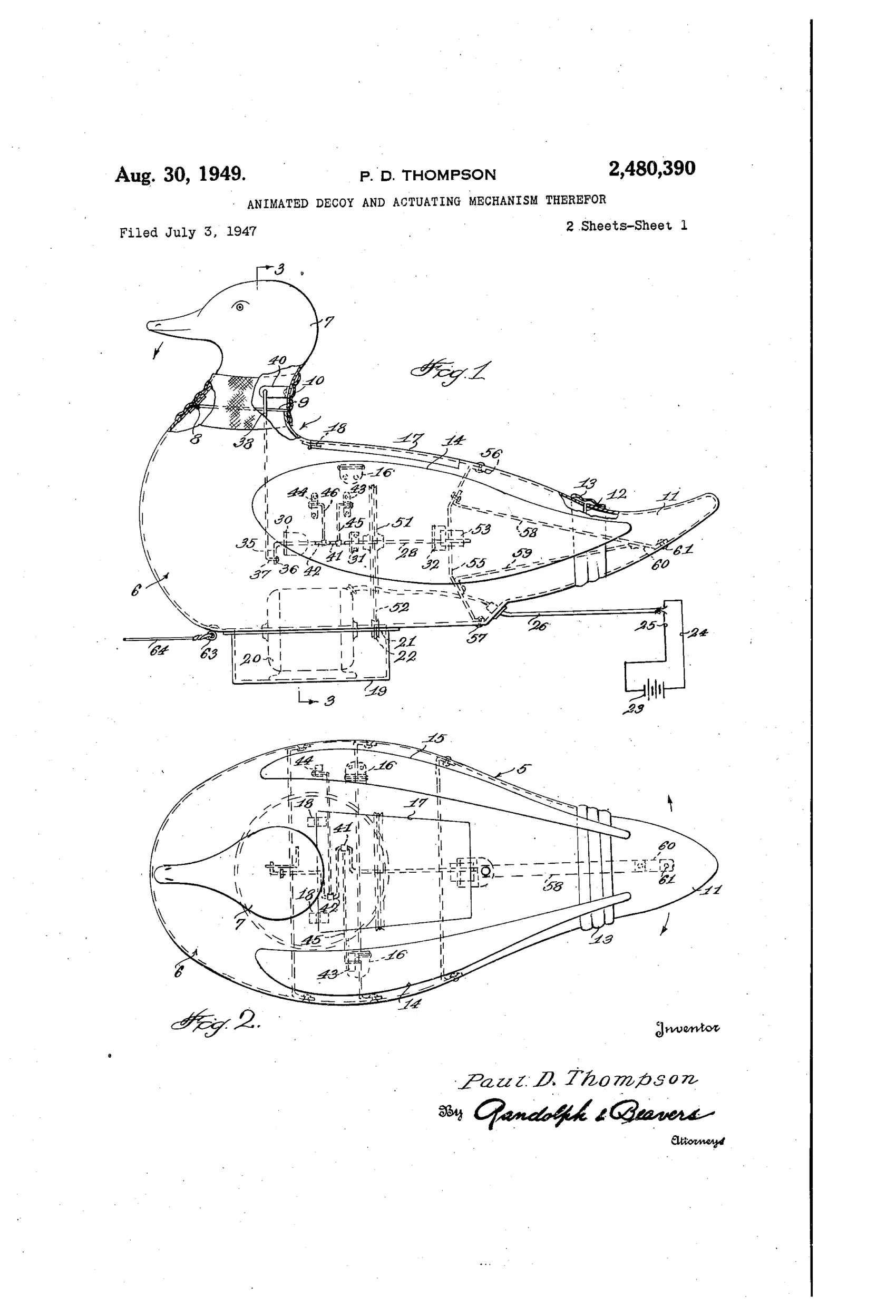
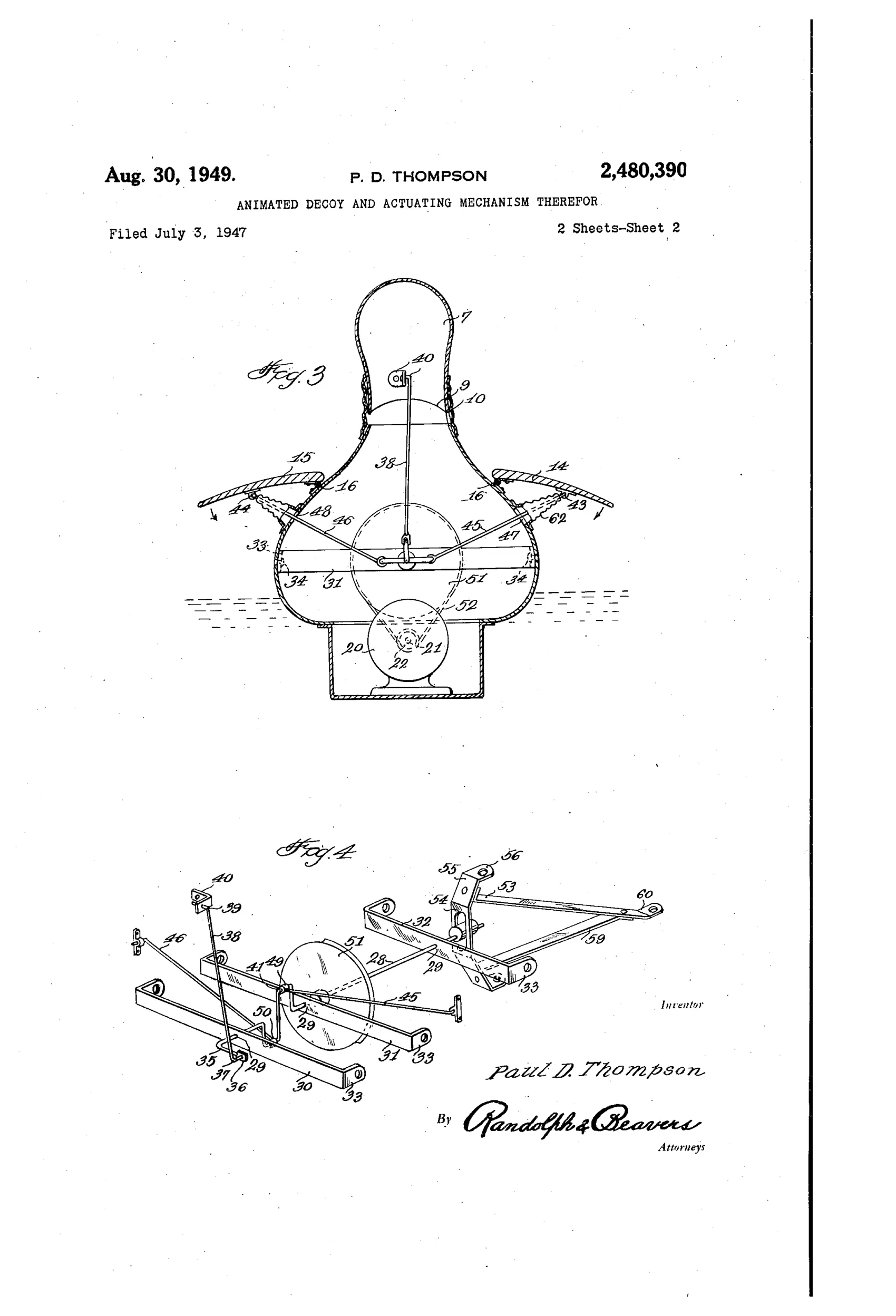
An electric motor inside a hollow buoyant duck-shaped decoy body drives a longitudinal shaft through a belt-and-pulley reduction. The shaft carries a crank that rocks the hinged head via a connecting rod, and two opposed cranks that push connecting rods outward to flap the hinged side wings. A rear eccentric engages a slotted vertical bar with struts joining the tail, causing the tail to swing laterally and scull, which propels the tethered decoy realistically through the water while feeding.
➶ What was claimed
“An animated decoy of the character described, comprising a hollow buoyant decoy body having a head and a tail each flexibly connected thereto and externally disposed wings, hingedly connected adjacent their upper edges to the sides of the body, a driven shaft journalled in the body and longitudinally thereof and provided with a plurality of cranks, connecting rods connecting the head and each of the wings to said cranks for causing a bobbing movement of the head and a flapping movement of the wings, when said shaft is revolved, and eccentric means forming a connection between said shaft and the tail for causing a laterally swinging movement of the tail relatively to the body and in unison with the movement of the head and wings.”
In plain English: A duck-shaped floating decoy with a hinged head, flapping wings, and a swinging tail, all driven simultaneously by cranks and an eccentric on a single motor-driven shaft inside the hollow body.
➶ In the inventor’s words
“This movement of the head, tail and wings will very realistically simulate the action of a duck swimming on the water, and while feeding, and the decoy will be propelled in the water by this sculling movement of the tail.”— Paul D. Thompson, from the specification
Paper patent — likely never produced
The multi-linkage, motor-in-hull construction would have been costly and hard to seal, and no manufactured example or commercial descendant of this specific design is documented.
➶ Commentary
A confession first: this is not a call. Thompson's patent lands in the broad hunting-gear class alongside our calls, but it makes no sound at all — it is a swimming robot duck, and it earns a look on mechanical audacity alone. Everything moves off a single longitudinal shaft. A belt-and-pulley reduction slows the electric motor, a forward crank rocks the hinged head through a connecting rod, two opposed cranks push the side-hinged wing panels outward in alternation, and a rear eccentric drives a slotted bar that swings the tail side to side. That tail is the clever bit: it isn't decoration, it's the propeller. The decoy sculls itself along on a tether like a real bird paddling and feeding.
The Fig. 1 side view is worth slowing down over — the dashed interior shows how much machinery Thompson crammed into a hollow buoyant body, with the battery apparently living outside on the tether line, a sensible dodge on weight and waterproofing.
Would it work? The kinematics are sound; the trouble is 1947 practicalities — sealing a crank-riddled hull against pond water, and cold-morning batteries. Animated decoys are a recurring dream in this class, almost always ending as paper. This is one of the more complete dreams, but a dream still.
Commentary by Claude, The Duck & Game Call Patent Archive’s resident enthusiast