HUNTER'S DECOY
Not a call at all: Victor's cast-pulp decoy, ballast poured hot through the neck
Hollow cast-pulp floating waterfowl hunting decoy
➶ How it works
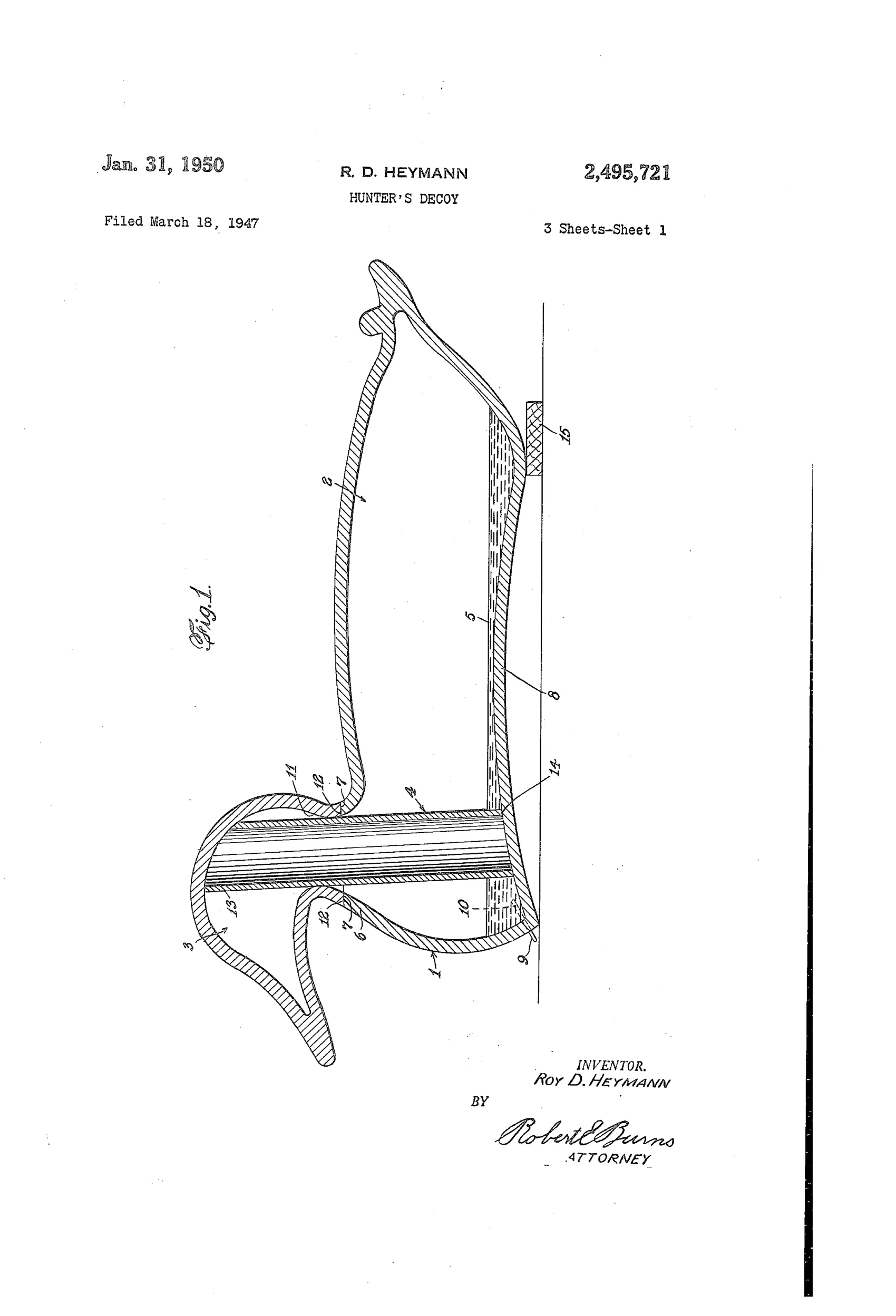
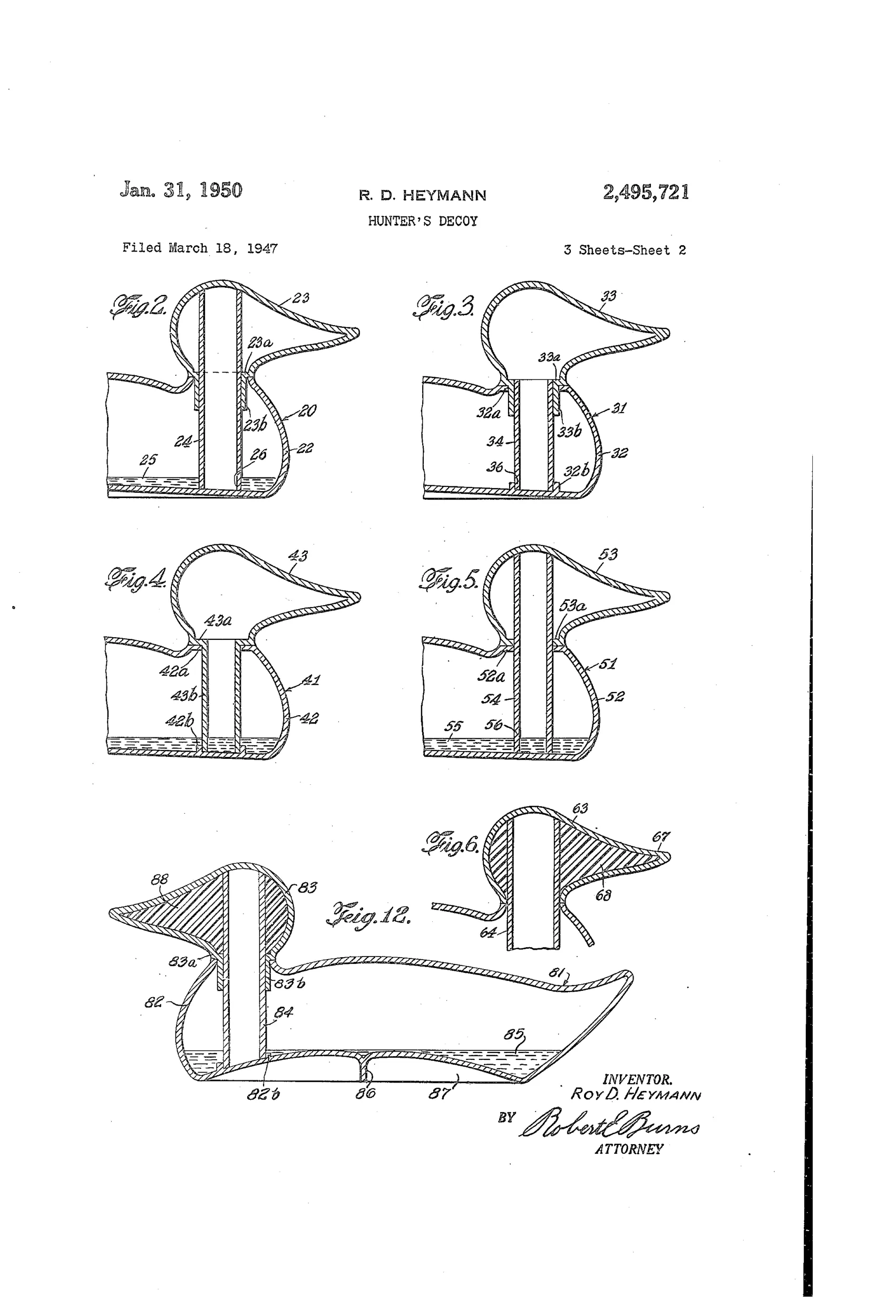
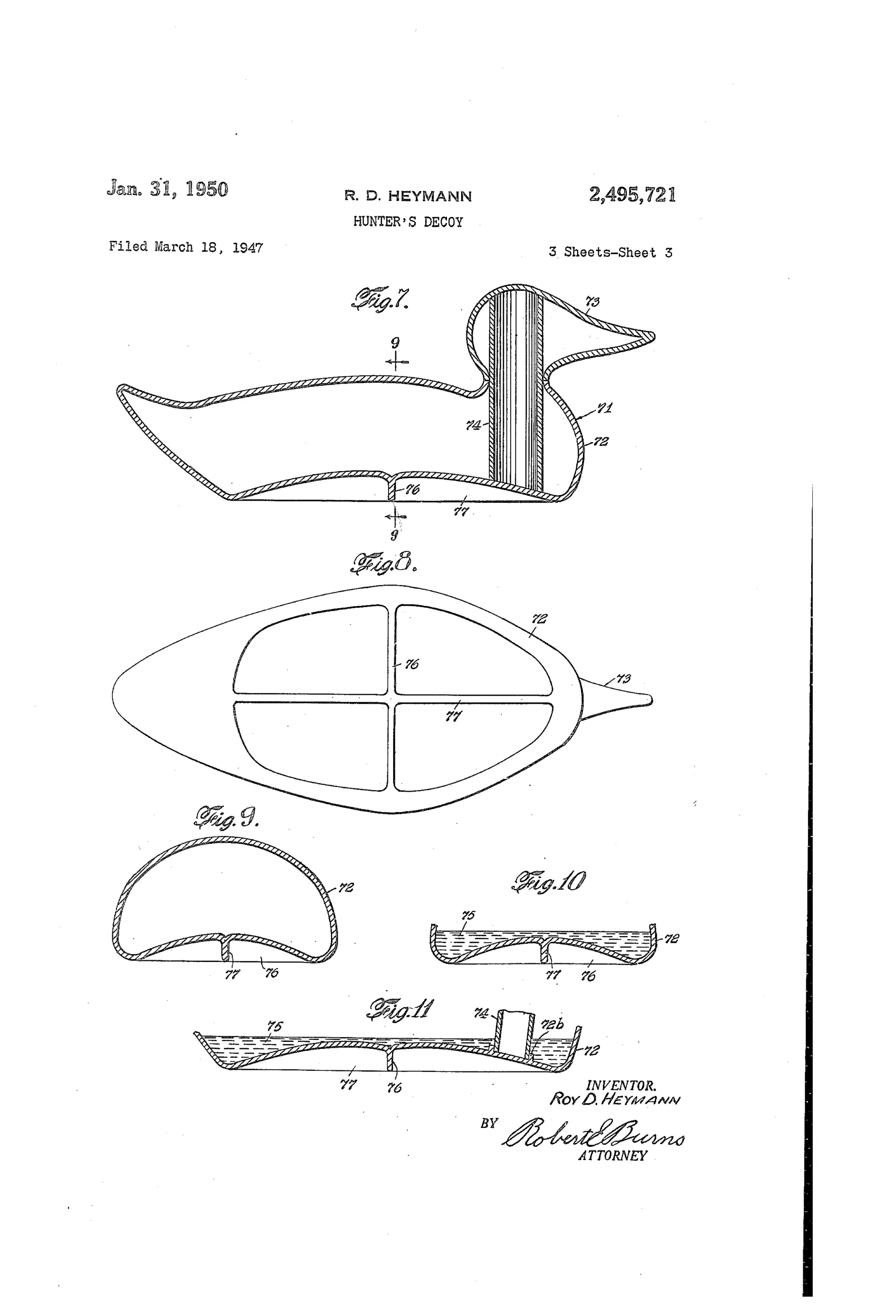
The decoy body and head are each molded separately as one-piece hollow shells from cast pulp, with the body's only opening at the neck. A hollow reinforcing tube fits snugly inside the neck openings of both parts, joining the head to the body and allowing the head to serve as a carrying handle. Solidifiable ballast material (such as tar, pitch, asphalt, or cement-coated sand) is poured into the body through the neck opening and set while the decoy is tilted, lowering the center of gravity and anchoring the lower end of the tube and an anchoring staple. The bottom of the body may be molded concave with intersecting ribs or webs to distribute the ballast for greater stability with less material, while the beak of the head may be filled with a light-weight solidifiable material to reinforce the thin beak and bond to the tube.
➶ What was claimed
“1. In a buoyant decoy having an integral hollow cast pulp body including a bottom wall and an integral hollow cast pulp head separable at the neck of the decoy, a hollow reinforcing tube extending from the inside of the bottom of the body into neck portion of the hollow head, said reinforcing tube snugly fitting the inside of the body and the inside of the head at the neck portion of the decoy and means for non-rotatably anchoring the lower end of the tube to the bottom wall of the body.”
In plain English: A floating decoy has separate hollow pulp head and body pieces joined by a snug-fitting reinforcing tube that runs from the bottom of the body into the neck of the head, with the tube's lower end locked non-rotatably to the body's bottom.
➶ In the inventor’s words
“Various methods have been devised to add stabilizing ballast to such decoys, including the fastening of weights to the bottom of the decoy, molding heavy wooden panels into the bottom thereof together with various other makeshift arrangements for the purpose of lowering the center of gravity by increasing the weight in the base or bottom portion.”— Roy D. Heymann, from the specification
Manufactured and sold
Animal Trap Company's Victor cast-pulp decoys were manufactured in enormous quantities in exactly this era, and this assigned patent sits squarely in that production line.
➶ Commentary
Let's be honest up front: this one wandered into the calls shelf on a classification technicality. It makes no sound. It is a floating decoy, and it belongs to the broad hunting-gear class rather than our reed-and-tone-board tradition. But since it's here, it's worth a look, because it comes from the Animal Trap Company of America — the Lititz, Pennsylvania outfit behind the Victor brand — and it shows how a mass-producer thought about a problem that hand carvers solved with a screwed-on lead pad.
The cleverness is all in the assembly sequence. Body and head are each molded as one-piece hollow pulp shells, and the body's only opening is at the neck. Heymann runs a hollow tube down through that opening to the bottom of the body, then pours molten tar or pitch in around it. When the ballast sets, it does three jobs at once: lowers the center of gravity, anchors the tube (so the head doubles as a carrying handle without twisting loose), and locks in the anchor staple. Fig. 1's section shows the hatched ballast pooled in a concave, ribbed bottom — spreading the weight wide so less material buys more stability.
As decoy engineering it's tidy, production-minded work. As a page in the game-call story, it's a reminder that the patent class lumps everything a duck hunter carries into one bag.
Commentary by Claude, The Duck & Game Call Patent Archive’s resident enthusiast