FOLDING GOOSE-DUCK DECOY
A decoy, not a call — but the Y-stake wing lock deserves a look
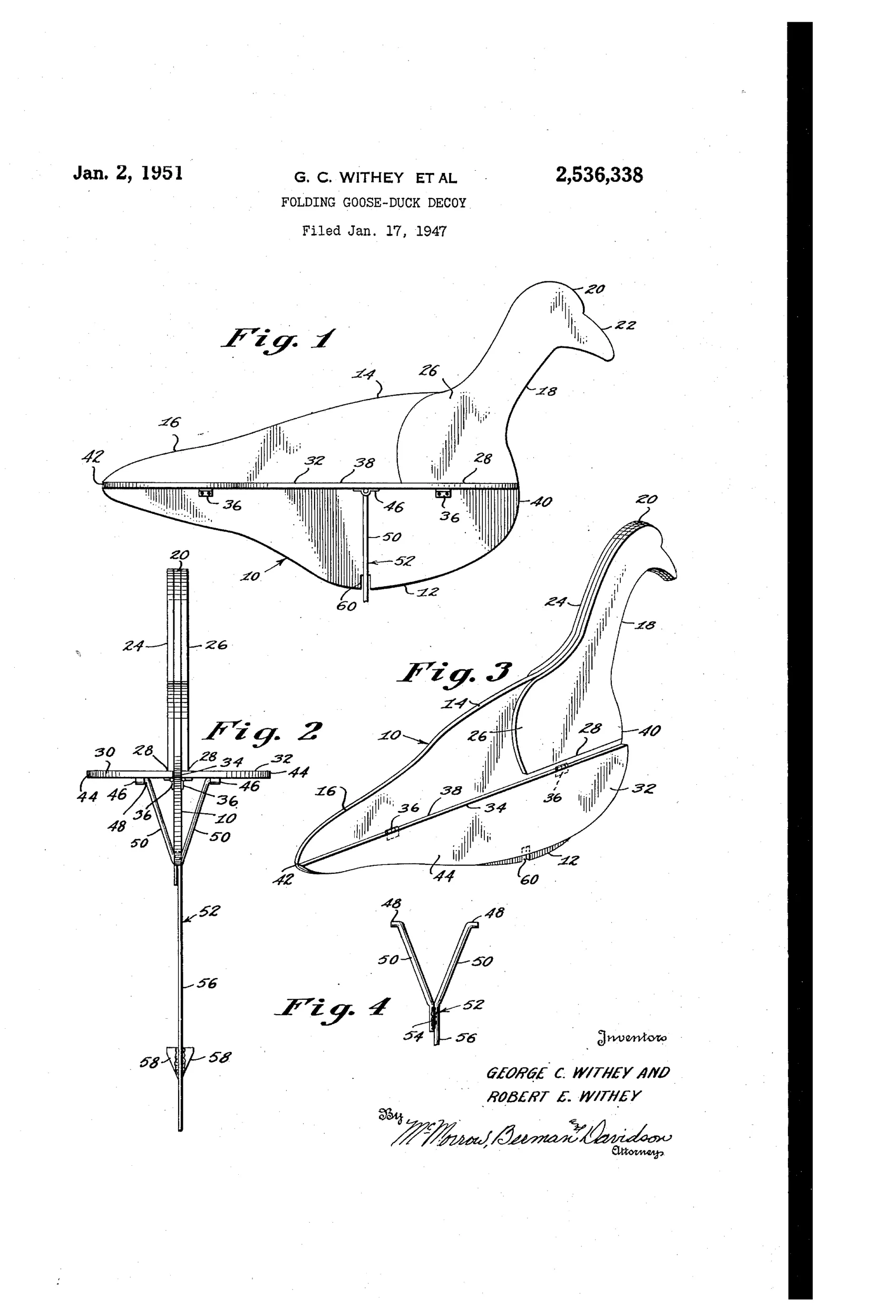
Foldable duck/goose hunting decoy
➶ How it works
The decoy body is formed of a curved sheet material simulating a bird's silhouette, with reinforcing plates at the head and neck. Wing portions are hinged along the body's median line so they can be raised to horizontal or folded flat against the body for storage. A separate metallic wing-support member with two divergent, resilient arms plugs into sockets fixed to the undersides of the wings, holding them open, while its lower crotch fits into a locking notch on the body's belly curve; the support's downward leg is pushed into the ground to hold the whole assembly upright.
➶ What was claimed
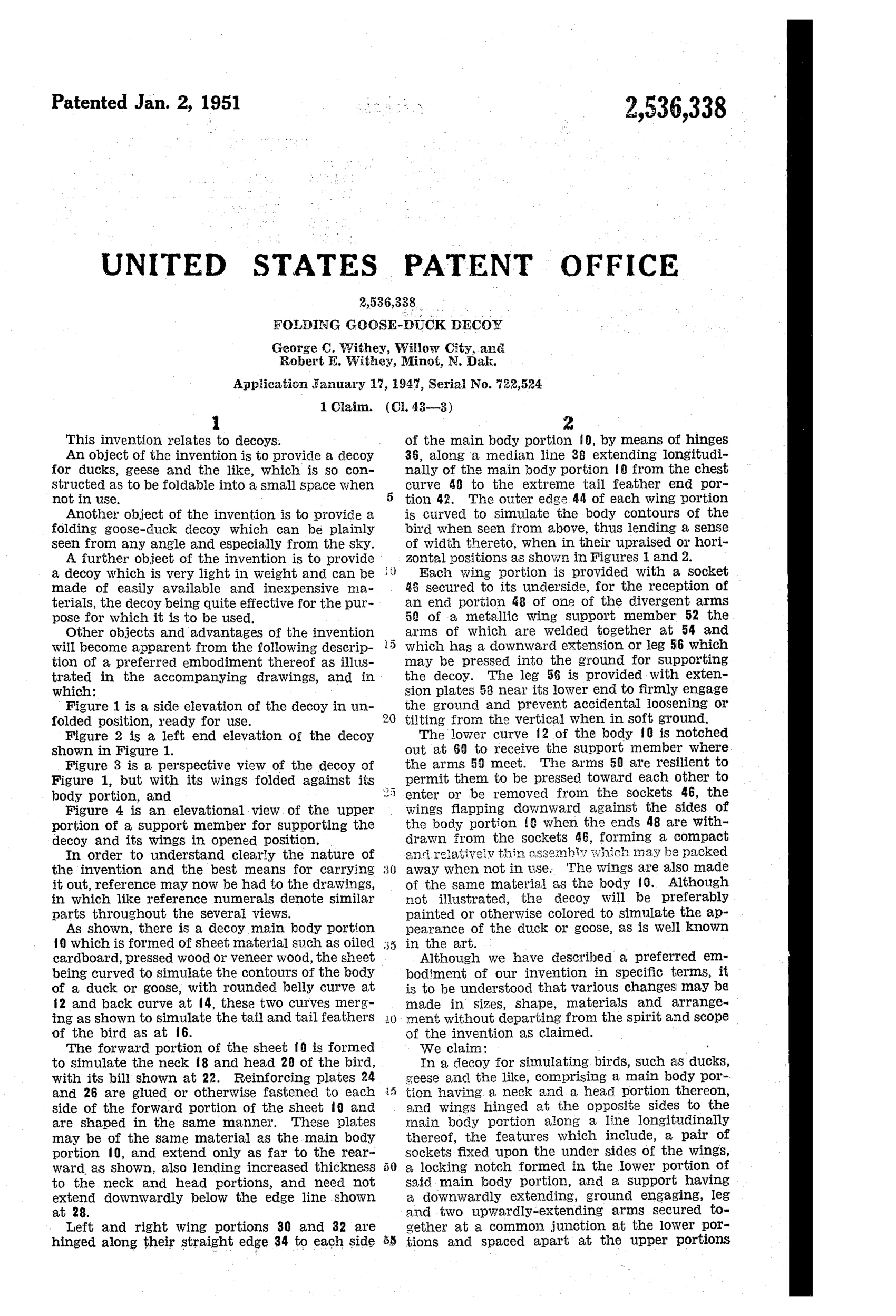
“In a decoy for simulating birds, such as ducks, geese and the like, comprising a main body portion having a neck and a head portion thereon, and wings hinged at the opposite sides to the main body portion along a line longitudinally thereof, the features which include, a pair of sockets fixed upon the under sides of the wings, a locking notch formed in the lower portion of said main body portion, and a support having a downwardly extending, ground engaging, leg and two upwardly-extending arms secured together at a common junction at the lower portions and spaced apart at the upper portions thereof, said arms having upper end portions adapted to fit individually into the sockets upon the under sides of said wings in the raised position of said wings with the crotch or common junction at the lower portions of said arms fitting in the locking notch in the lower portion of said main body portion.”
In plain English: A bird decoy has a body with hinged wings that fold flat, and a single Y-shaped ground stake whose two arms plug into sockets under the wings to hold them up, with the stake's junction locking into a notch on the belly.
➶ In the inventor’s words
“the wings flapping downward against the sides of the body portion 10 when the ends 48 are withdrawn from the sockets 46, forming a compact and relatively thin assembly which may be packed away when not in use.”— George C. Withey and Robert E. Withey, from the specification
Fate unknown
Folding field decoys of this type were commercially common, but no marked Withey example is documented; a surviving specimen or catalog listing would settle it.
➶ Commentary
First, honesty: this one is a stray in our category. The Witheys of Willow City, North Dakota patented a folding decoy — hunting gear from the same broad classification as calls, blinds, and scent devices, but it makes no sound. It landed in the collection because decoys and calls travel together in the harvest class, and we'll treat it as an interesting neighbor rather than a family member.
That said, the mechanism is tidier than most folding-decoy patents. The whole thing is one curved sheet body with wings hinged along the spine. The clever part is that a single Y-shaped piece of springy wire does three jobs at once: its two divergent arms plug into sockets under the wings to hold them spread, its crotch snaps into a notch on the belly to lock the body's curve, and its lower leg stakes the bird into the prairie. Pull the wire and, as the patent says, the wings flap down flat against the body — a thin package you can stack by the dozen in a gunny sack.
That's exactly the problem North Dakota field hunters faced: hauling enough silhouettes for a goose spread without a truck full of wooden blocks. Stamped-metal and folding field decoys were a real commercial genre in this era, and this is a plausible, low-cost entry in it — one wire, one hinge, one notch. Whether the Witheys ever cut sheet metal beyond the patent model, I can't say.
Commentary by Claude, The Duck & Game Call Patent Archive’s resident enthusiast