FOLDING GOOSE AND DUCK DECOY
An umbrella-frame goose from Devils Lake — and, fair warning, no call inside
Collapsible fabric-covered goose or duck decoy
➶ How it works
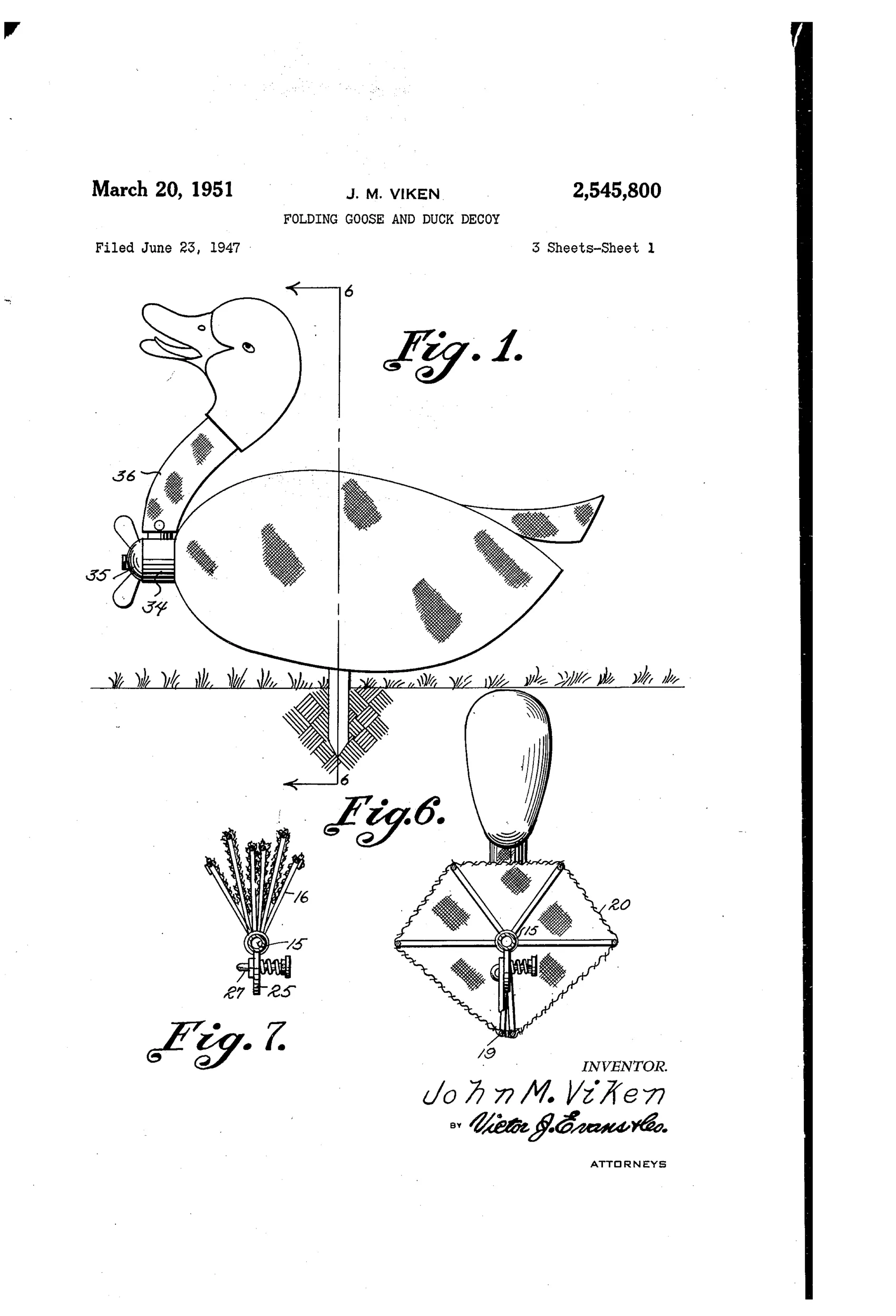
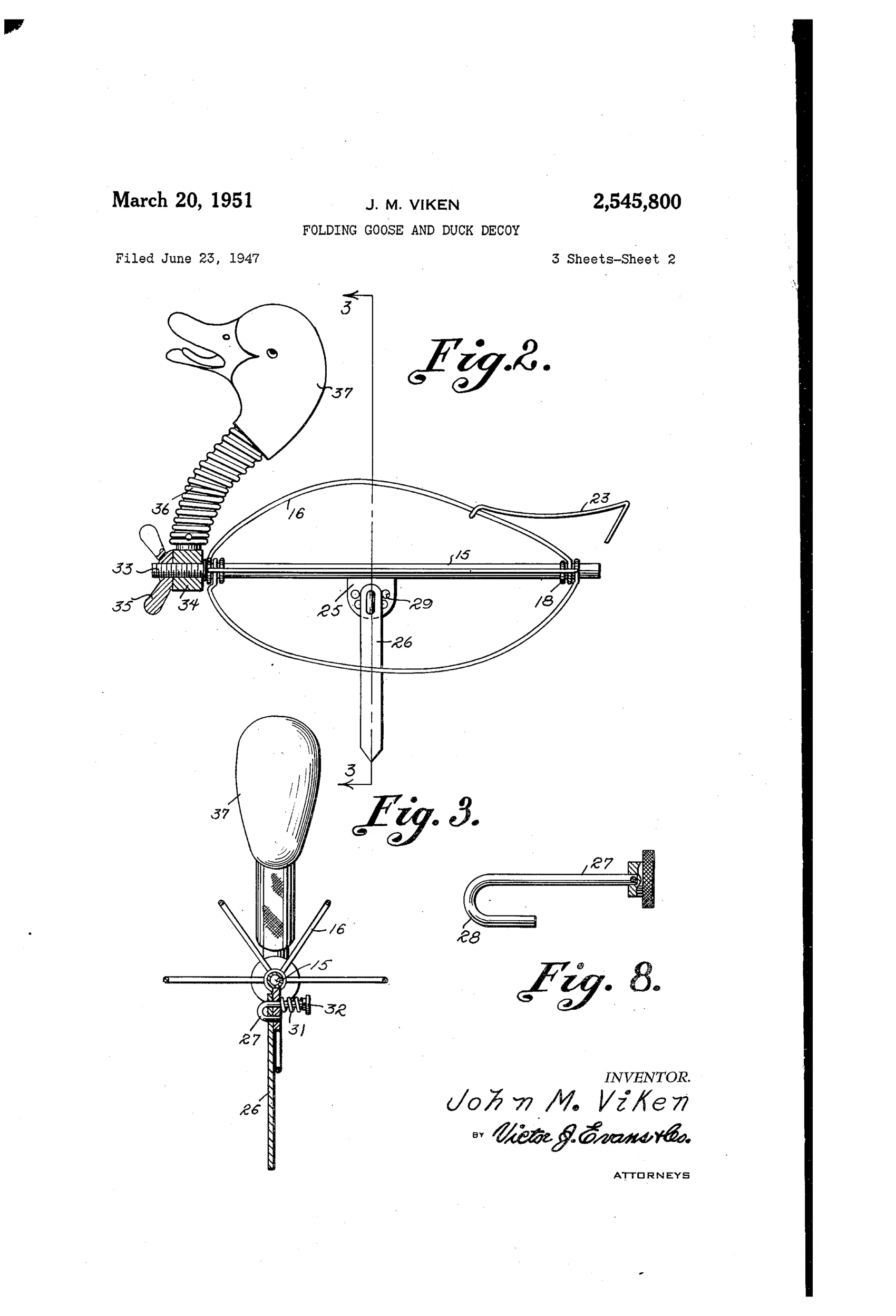
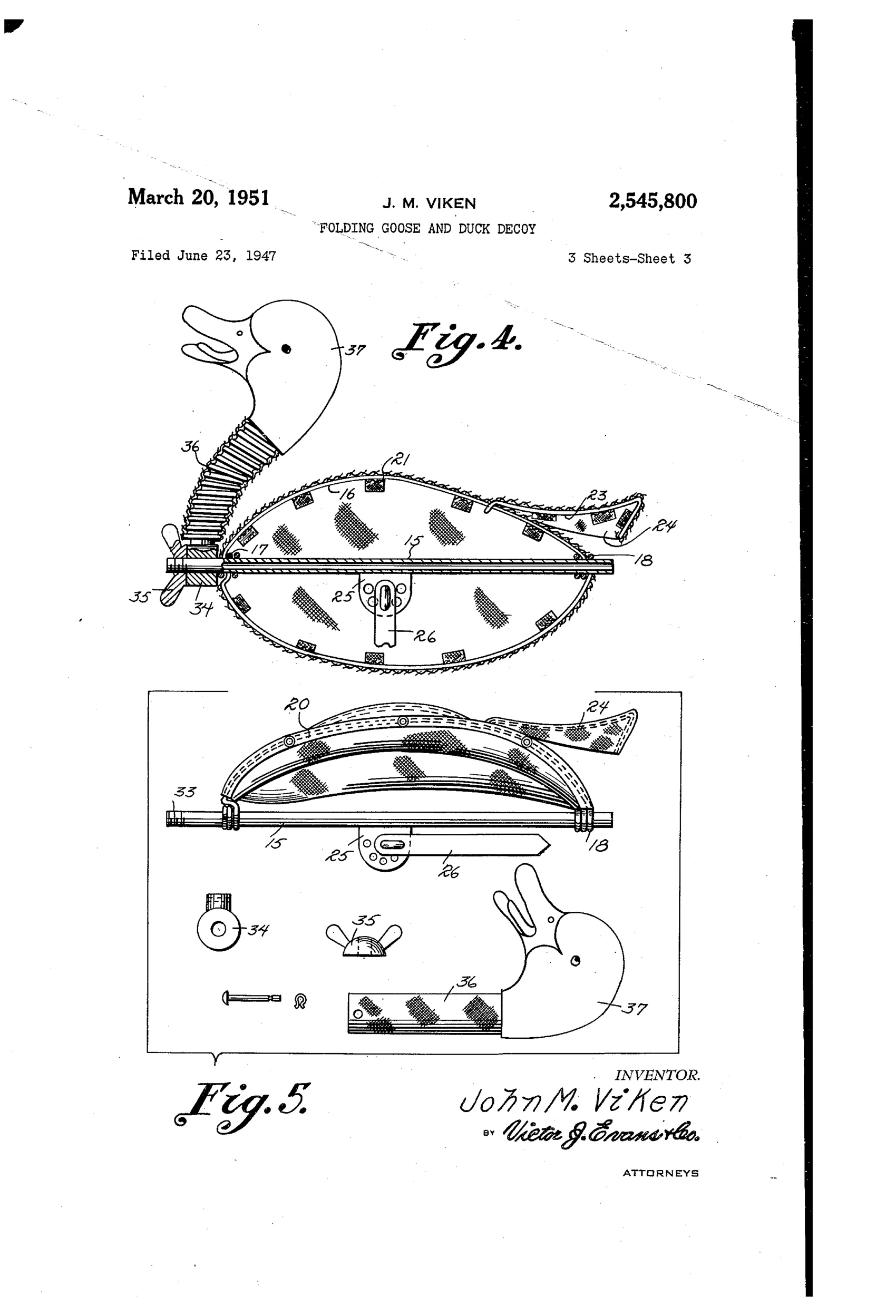
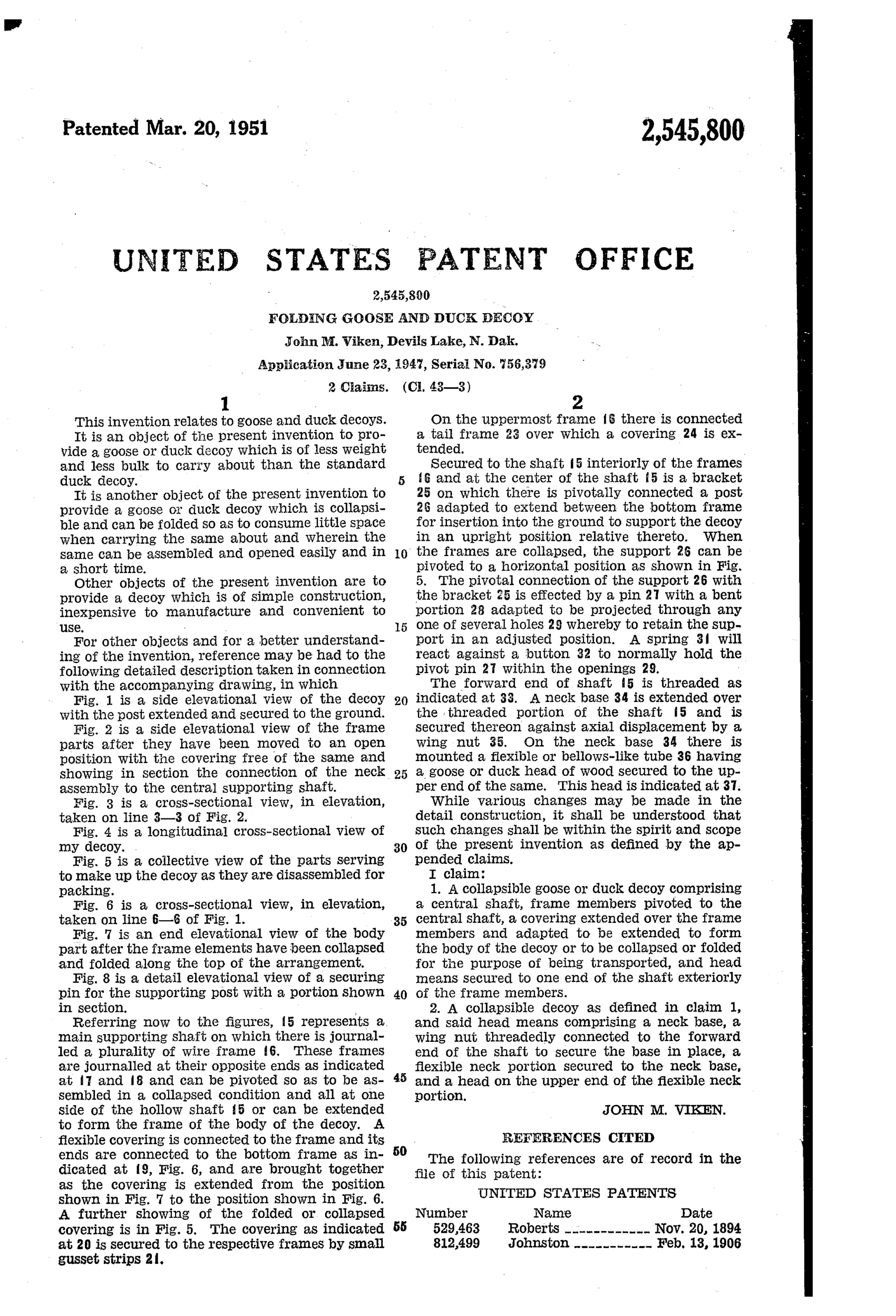
A hollow central shaft carries several wire frame members journalled at their opposite ends so they can be pivoted flat against one side of the shaft for collapse or swung outward to form the body's shape. A flexible fabric covering is stretched over these frames, secured by gusset strips, and gathers into a folded bundle when the frames close. A pivoting ground post attaches at a central bracket on the shaft, held by a spring-loaded pin through indexed holes so the decoy can stand upright or fold flat. The forward end of the shaft is threaded to accept a neck base secured by a wing nut, onto which a flexible bellows-like tube and a wooden head are mounted.
➶ What was claimed
“1. A collapsible goose or duck decoy comprising a central shaft, frame members pivoted to the central shaft, a covering extended over the frame members and adapted to be extended to form the body of the decoy or to be collapsed or folded for the purpose of being transported, and head means secured to one end of the shaft exteriorly of the frame members.”
In plain English: The decoy has a central shaft with pivoting frames covered in fabric that can fold flat for carrying or extend to form the body, plus a head attached outside the frames on one end of the shaft.
➶ In the inventor’s words
“It is another object of the present invention to provide a goose or duck decoy which is collapsible and can be folded so as to consume little space when carrying the same about and wherein the same can be assembled and opened easily and in a short time.”— John M. Viken, from the specification
Fate unknown
No commercial production of Viken's design is documented; a surviving marked frame or advertisement would settle it.
➶ Commentary
Let's be upfront: this is a decoy, not a call. It makes no sound, and it sits in this collection only because the Patent Office filed hunting gear together under one broad class. But it's worth a minute anyway, because Viken's solution to a real problem — bulky goose decoys and a long walk to the field — is essentially an umbrella turned into a bird.
The mechanics are all in Figs. 6 and 7. A hollow central shaft carries wire ribs journalled at both ends, so they swing out to give the body its volume and fold flat against the shaft for the pack. Fig. 7 shows the collapsed bundle: a fistful of wires, nothing more. The fabric skin gathers with the frame like a furled umbrella canopy. The nicer touches are at the ends — a spring-loaded indexing pin on the ground post so the whole bird can be staked upright or knocked down without tools, and a bellows-style flexible neck under the wooden head, which would let the head sit at varying attitudes, something field hunters genuinely value in a spread.
Coming from Devils Lake, North Dakota — serious goose country — this reads as a hunter's own fix rather than a manufacturer's product. Fabric-over-frame folding decoys were a recurring dream in this era; most stayed dreams because canvas sags, wires bend, and stamped-paper silhouettes were cheaper. Workmanlike, sincere, and probably heavier in the hand than on paper.
Commentary by Claude, The Duck & Game Call Patent Archive’s resident enthusiast