CANVAS SEAT
No reed, no barrel: a strap-on tree seat that wandered into our category
Fold-out canvas hunting seat that straps to a tree
➶ How it works
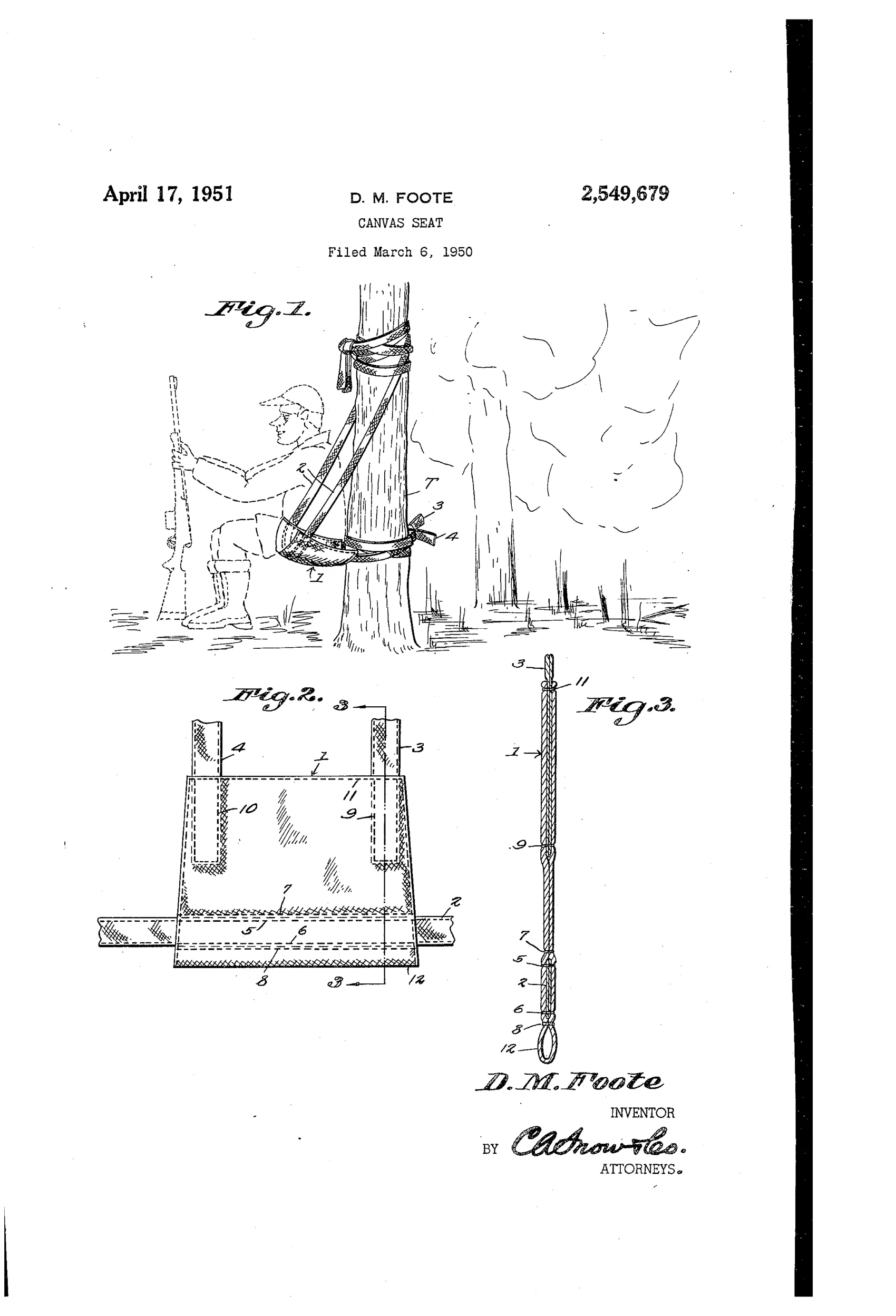
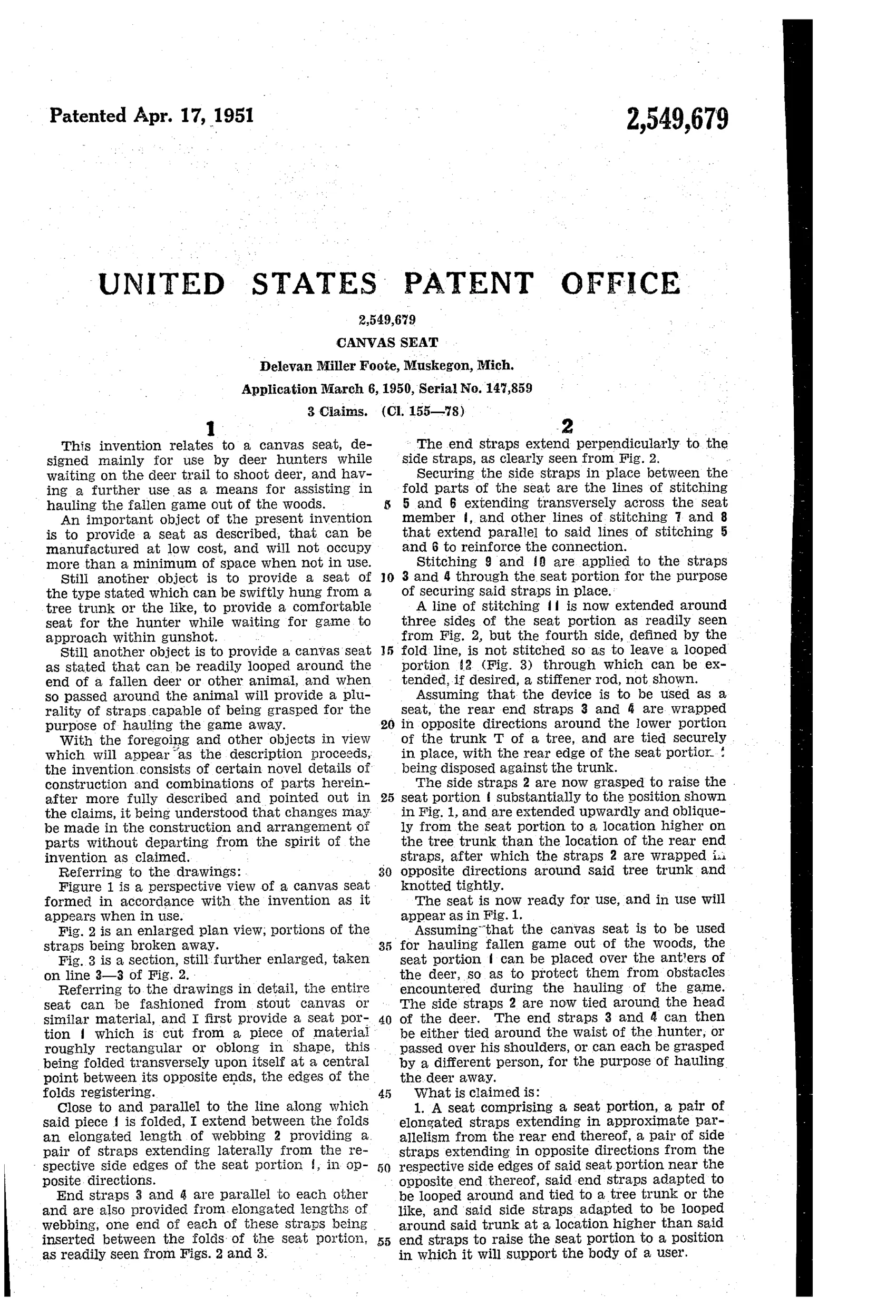
A rectangular canvas seat portion is folded transversely upon itself and stitched, with a length of webbing sandwiched between the folds near the fold line to form side straps extending laterally in opposite directions. Separate end straps of webbing are inserted between the folds near the rear edge and stitched in place, extending perpendicular to the side straps. In use the rear end straps are wrapped in opposite directions around a tree trunk and tied against the trunk, then the side straps are raised and wrapped around the trunk at a higher point and knotted, suspending the seat portion to support a seated hunter. The same straps can alternatively be looped around a deer's antlers and head, with the end straps tied around the hunter's waist or shoulders, to help haul fallen game out of the woods.
➶ What was claimed
“A seat comprising a seat portion, a pair of elongated straps extending in approximate parallelism from the rear end thereof, a pair of side straps extending in opposite directions from the respective side edges of said seat portion near the opposite end thereof, said end straps adapted to be looped around and tied to a tree trunk or the like, and said side straps adapted to be looped around said trunk at a location higher than said end straps to raise the seat portion to a position in which it will support the body of a user.”
In plain English: A canvas seat with rear straps tied low around a tree trunk and side straps tied higher up the same trunk, so the fabric hammocks out to support a seated person.
➶ In the inventor’s words
“Still another object is to provide a canvas seat as stated that can be readily looped around the end of a fallen deer or other animal, and when so passed around the animal will provide a plurality of straps capable of being grasped for the purpose of hauling the game away.”— Delevan Miller Foote, from the specification
Fate unknown
Simple sewn canvas goods like this were cheap to produce, but no marked commercial example tied to Foote is documented; a labeled specimen or catalog listing would settle it.
➶ Commentary
Full disclosure: this one makes no sound at all. Foote's 1951 patent is a canvas tree seat, filed into the broad hunting-gear class that also sweeps up blinds, decoys, and scent rigs — the same drawer where duck calls happen to live. It's a good reminder that the classification system cares about hunting, not about acoustics, and collectors browsing the class have to sift accordingly.
Taken on its own terms, it's a tidy piece of soft-goods engineering. The whole trick is in the stitching: the canvas is folded on itself and the webbing straps are sandwiched between the folds before sewing, so the load runs through the fabric layers rather than hanging on a few stitches at an edge. Rear straps tie low around the trunk, side straps tie higher, and the canvas hammocks out under the sitter — Fig. 1 shows the geometry plainly, with the hunter's weight pulling the upper straps into tension. It is, in embryo, the modern tree-stand seat and lounge sling.
The best part is the second use buried in the objects clause: loop the same straps around a downed deer's antlers and drag it out by the webbing. A seat on the way in, a harness on the way out — that dual-purpose thrift is very much of its era, when a Michigan deer hunter carried everything on his back.
Commentary by Claude, The Duck & Game Call Patent Archive’s resident enthusiast