MECHANICAL WILD FOWL DECOY
A motor, a screw, and a swinging weight teach a wooden duck to dive
A motorized diving mechanism for a duck decoy
➶ How it works
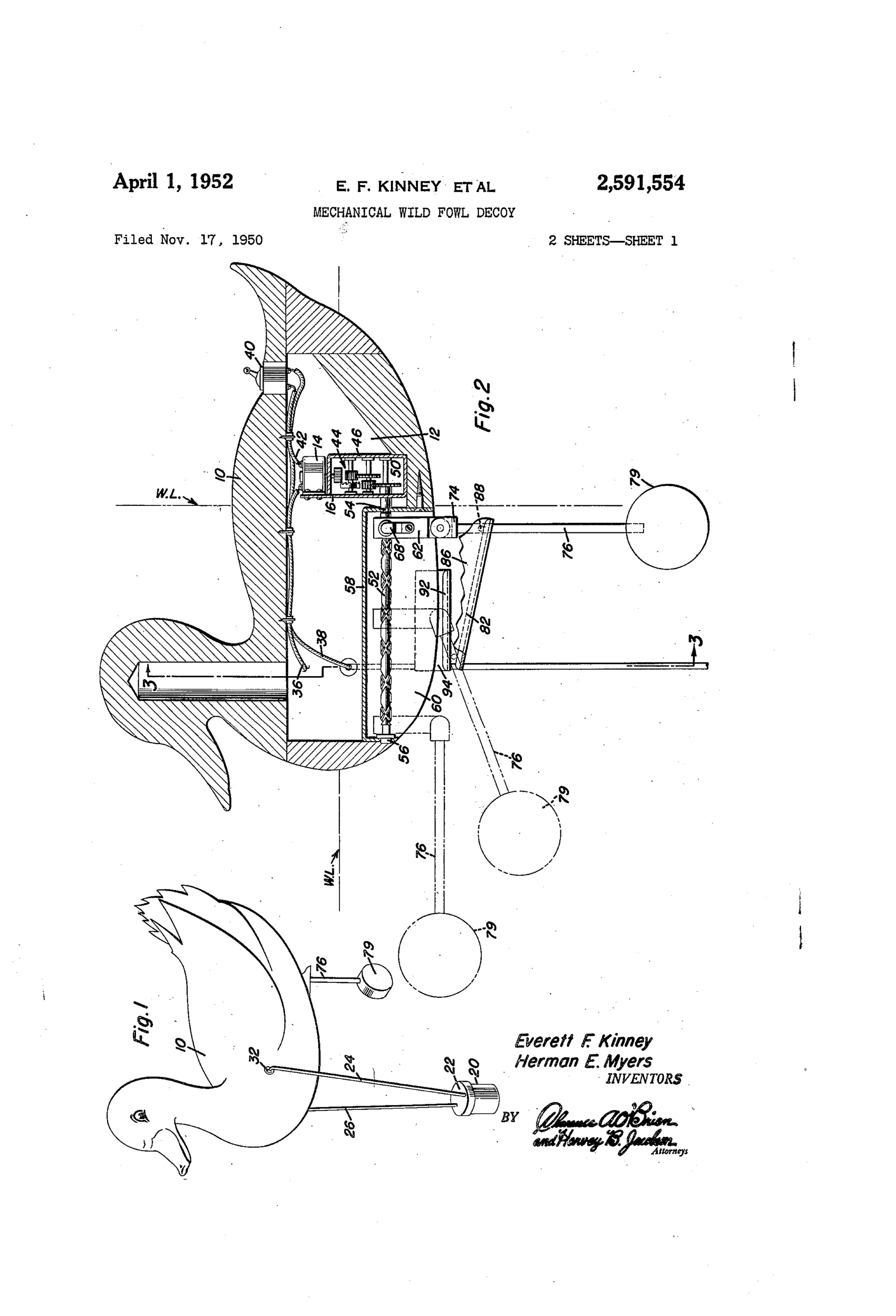
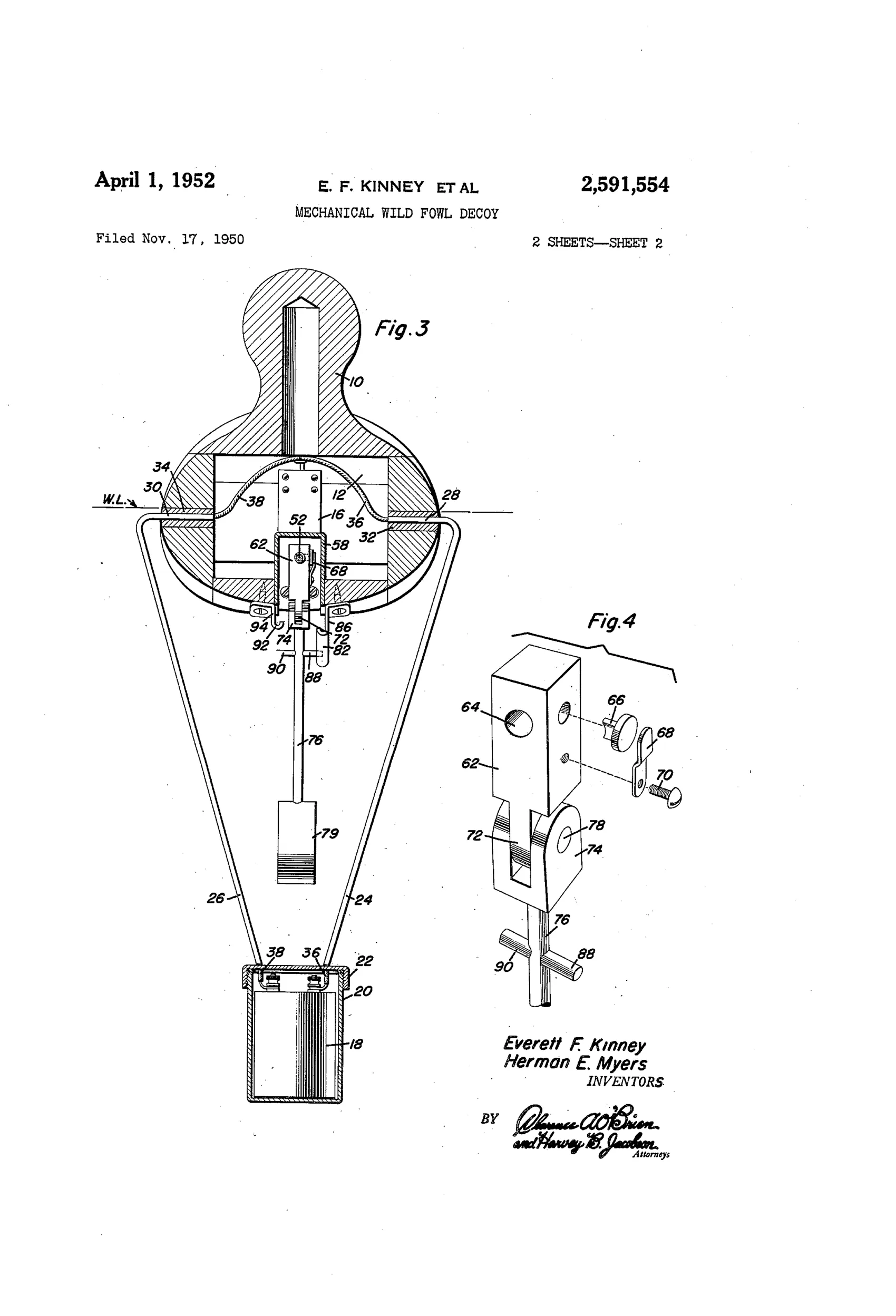
An electric motor inside the buoyant decoy body drives a double-threaded screw through a gear transmission, moving a traveling block back and forth along the screw. A pendulous weighted arm hangs from the block, and its guide pin follows an inclined cam track fixed to the body, lifting the weight and shifting the decoy's center of gravity forward to simulate a diving motion. As the block reaches the forward limit, the arm's pin drops from an upper horizontal track onto the lower inclined track, and when moving rearward the reverse occurs, causing the weight to descend and the body to return to a horizontal floating position, repeating the dive cycle indefinitely while the screw rotates.
➶ What was claimed
“7. In a decoy having a decoy body, a motor carried by said body, a double threaded screw driven thereby, a traveling block engaging said screw, a pendulous arm pivotally carried by said block and having a weight secured thereto whereby when said block is moved axially of said screw and on said screw the center of gravity of said body is shifted, means connected to said body and operatively connected with said arm for lifting said pendulous arm so that the weight is carried to an elevated position, and means for holding said weight in the elevated condition until said block reaches a predetermined place on said screw.”
In plain English: A duck decoy with a motor-driven double-threaded screw that moves a block carrying a weighted, pivoting arm, which is lifted and held elevated by a cam mechanism to shift the decoy's balance and simulate diving until the block reaches a set point on the screw.
➶ In the inventor’s words
“An object of this invention is to provide an improved decoy capable by means of structure carried thereby, to preform a series of operations, the series consisting of diving motions made possible by shifting the center of gravity of the decoy to the front thereof and then moving it rearwardly and then again shifting it to the front and then again moving it rearwardly, this operation being continued indefinitely.”— Everett F. Kinney and Herman E. Myers, from the specification
Fate unknown
No commercial version or surviving example is documented; a built specimen or period advertisement would settle it.
➶ Commentary
Full disclosure up front: this is a decoy, not a call. It makes no sound at all — it sits in our files because the harvest class sweeps up everything a duck hunter drags to the marsh. But it earns a look anyway, because Kinney and Myers of Cambria, Wisconsin were chasing the same prey the callmakers were: convincing a wary bird that a fake one is alive.
Their answer is entirely mechanical and rather elegant. An electric motor inside the hollow body turns a double-threaded screw — the kind that reverses a traveling block automatically at each end, no clutch or switch needed. Hanging from that block is a weighted pendulum arm whose pin rides a cam track: as the block runs forward, the incline lifts the weight, the center of gravity lurches ahead, and the decoy tips nose-down like a dabbling duck. At the end of travel the pin drops off the upper track, the weight falls, and the bird bobs back upright. Fig. 2 is the one to study — the whole choreography of screw, block, and cam is laid out in section.
Would it work? Physically, yes; shifting ballast will tip a float. The trouble is everything else: batteries and a motor in a wet, freezing marsh, circa 1950. It's a lovely dead end that anticipates today's motorized spinner decoys by half a century.
Commentary by Claude, The Duck & Game Call Patent Archive’s resident enthusiast