HUNTER'S BELT
Spring-steel loops that clamp shotgun shells one way, dead duck necks the other
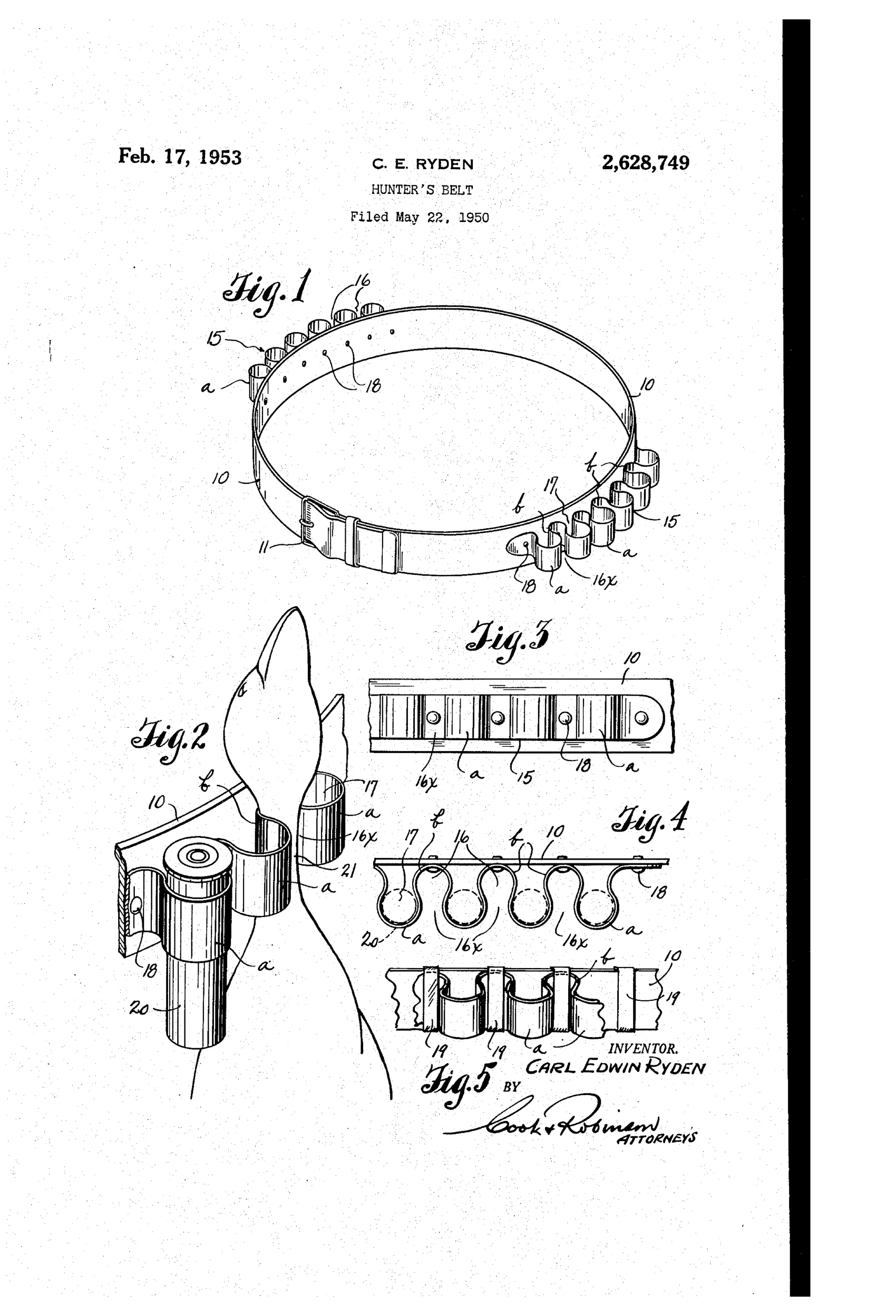
Combination hunter's belt for fowl and cartridges
➶ How it works
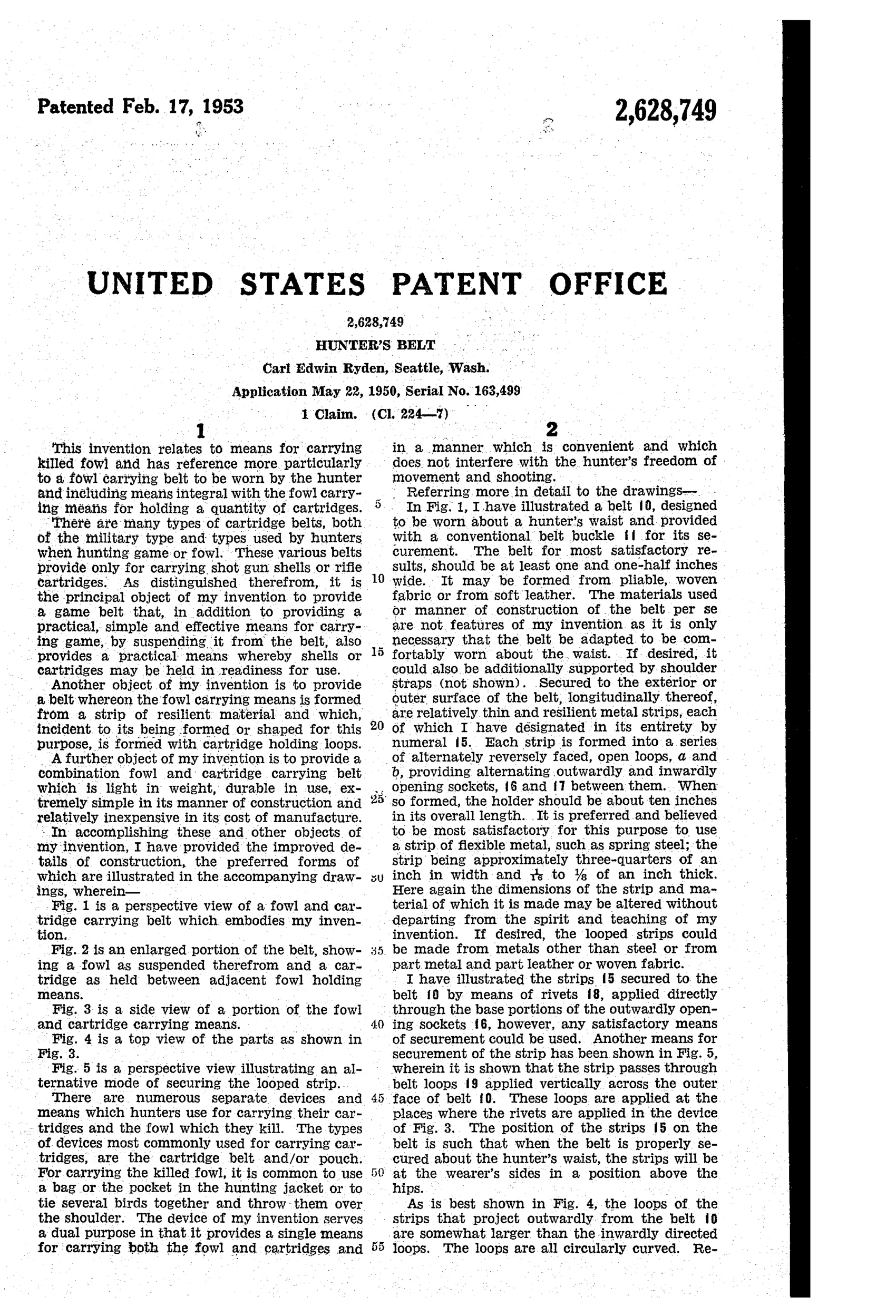
A resilient metal strip is formed into a series of alternately reversely-faced curved loops, riveted or looped along the outer face of a flexible waist belt. The loops facing outward form larger sockets sized to grip and hold shotgun or rifle cartridges. The loops facing inward form smaller, restricted-entrance sockets that receive and clamp the neck of killed fowl, suspending the bird from the belt. The spring steel's resiliency lets each pocket flex open to admit an object then close to grip it securely.
➶ What was claimed
“A cartridge and game holding means comprising a flat flexible belt adapted to be fastened and worn about the waist of the wearer, and a strip of resilient metal extending longitudinally along the outer face of the belt and on at least one side of the wearer, the metal strip being formed into a succession of curved and reentrant curved loops providing a series of resilient oppositely opening transverse pockets to grip and hold articles therein, a number of the pockets opening inwardly toward the belt and the rest of the pockets being between each inwardly opening pocket and opening outwardly away from the belt, each loop having a circular portion of more than one hundred and eighty degrees in extent and being provided with a restricted entrance to each pocket, the inwardly opening pockets being larger in area than the outwardly opening pockets, the inwardly opening pockets receiving and holding cartridges while the outwardly opening pockets receive and hold game, the metal strip being secured to the belt at each end and at the base of each outwardly opening pocket so that the resiliency of each respective pocket is relied upon to securely hold the cartridge and game placed therein.”
In plain English: A waist belt fitted with a springy metal strip bent into alternating loops, where the larger inward-facing pockets grip cartridges and the smaller outward-facing pockets clamp and hold the necks of killed birds by spring tension.
➶ In the inventor’s words
“The device of my invention serves a dual purpose in that it provides a single means for carrying both the fowl and cartridges and in a manner which is convenient and which does not interfere with the hunter's freedom of movement and shooting.”— Carl Edwin Ryden, from the specification
Fate unknown
No manufactured example or maker is documented; a marked belt or period catalog listing would settle it.
➶ Commentary
Let's be upfront: this is not a call. Ryden's belt makes no sound at all — it lives in the broad harvest class alongside blinds and decoys, the gear that surrounds duck calling without being it. But it earns a look for one genuinely tidy piece of thinking: a single strip of spring steel bent into alternating loops, so that every other pocket opens outward and every other one opens inward. One size of pocket grips a cartridge; the other, with a restricted mouth, snaps around the neck of a downed bird and holds it hanging from your hip.
The drawing rewards a close read. Fig. 2 shows the duck suspended head-up by the neck, wedged past the loop's constriction, while a shell sits in the adjacent socket — the whole trick is that the loops exceed 180 degrees of arc, so the metal has to flex open to admit anything and then springs shut to keep it. The strip is riveted only at the ends and at the base of the outward loops, deliberately leaving each pocket free to work as its own spring. Fig. 5 shows a cheaper alternative where the strip threads through slots in the belt.
Would it work? Probably, for a walking upland or jump-shooter with two or three birds. A limit of mallards swinging from your waist by spring clips is another matter. It reads as a clever solo answer to a problem the game strap already solved more cheaply.
Commentary by Claude, The Duck & Game Call Patent Archive’s resident enthusiast