COLLAPSIBLE DECOY
A folding goose decoy on our doorstep — not a call, but worth the detour
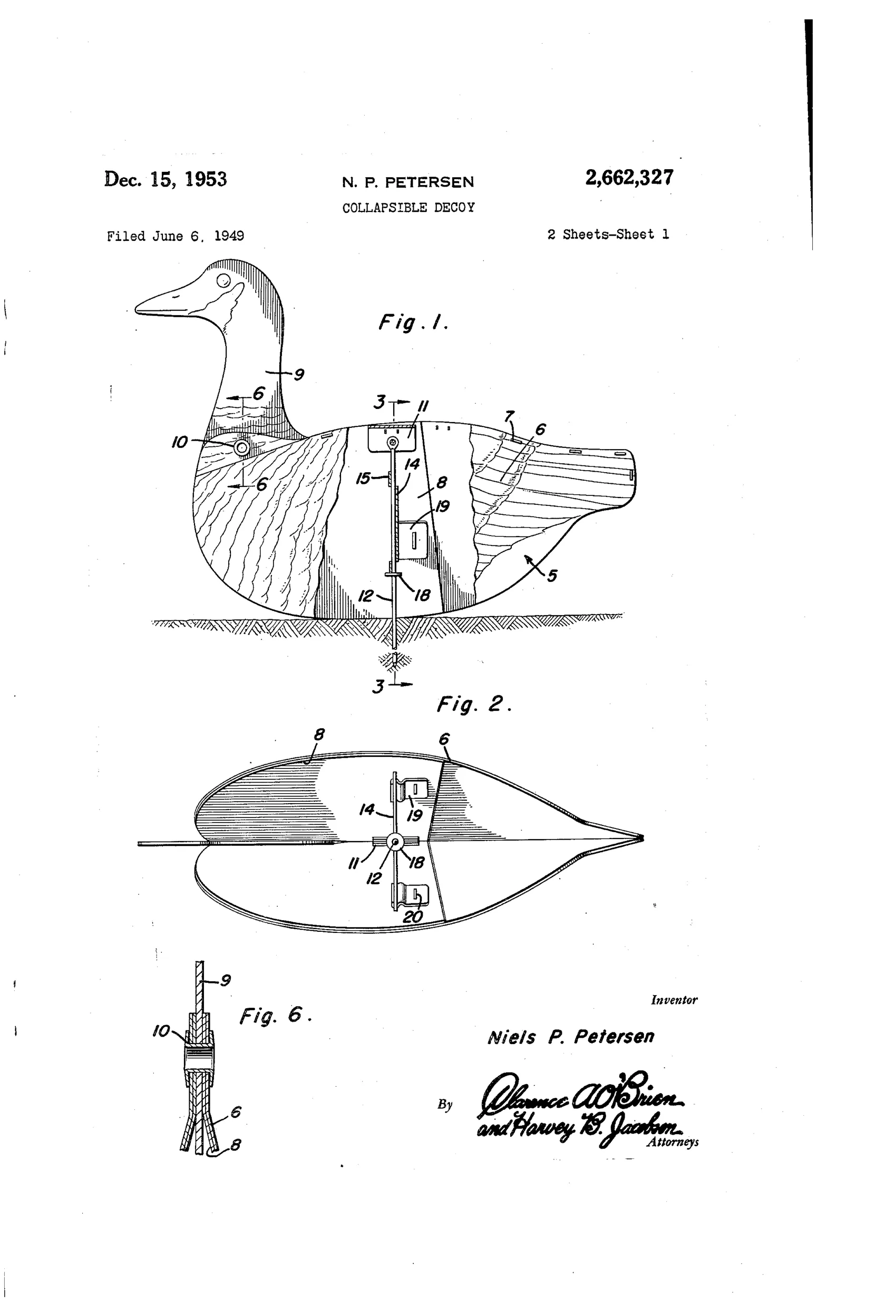
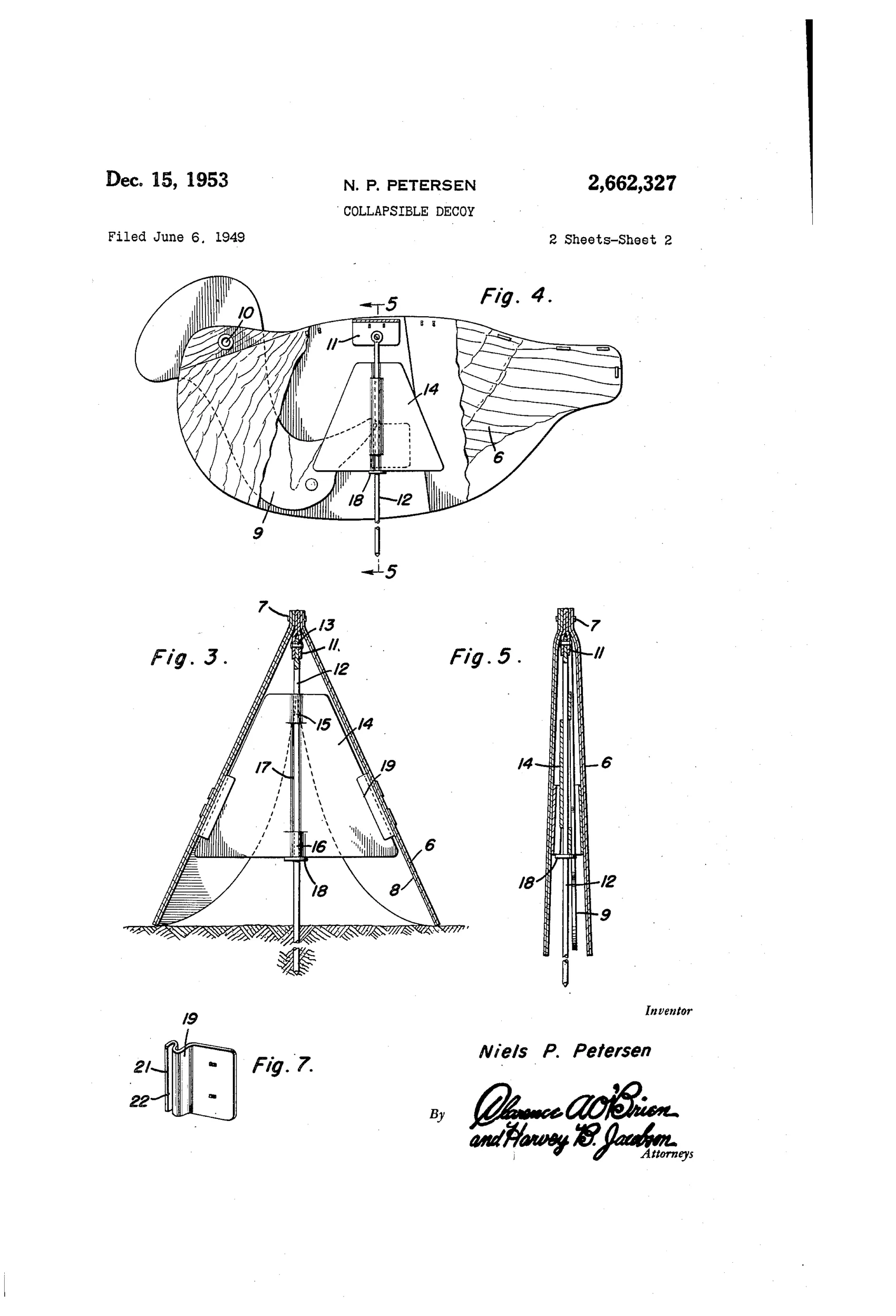
Collapsible goose decoy with folding sides
➶ How it works
The decoy body has two flexible sides joined at their upper edges, which can swing inward and outward like a hinge. A stake passes down through the body and pivots on an inverted U-shaped hanger, allowing it to swing between an upright anchoring position and a folded position along the body. A triangular spreader plate rotates on the stake and, when turned crosswise, its edges snap into resilient catches on the inside of each side panel, locking the sides apart in an open, lifelike shape. Turning the spreader lengthwise releases the catches so the sides can be folded flat against each other and the neck folded down for storage.
➶ What was claimed
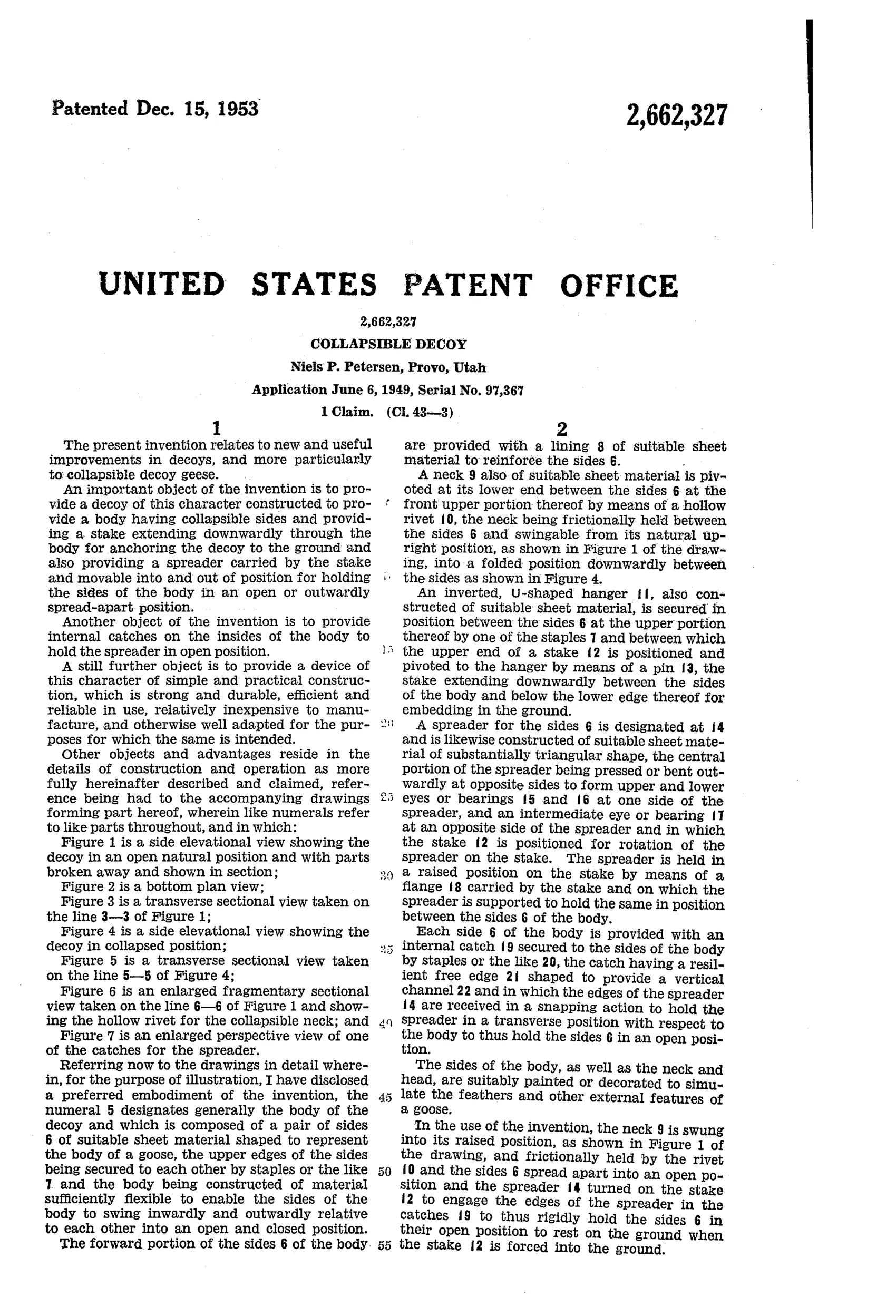
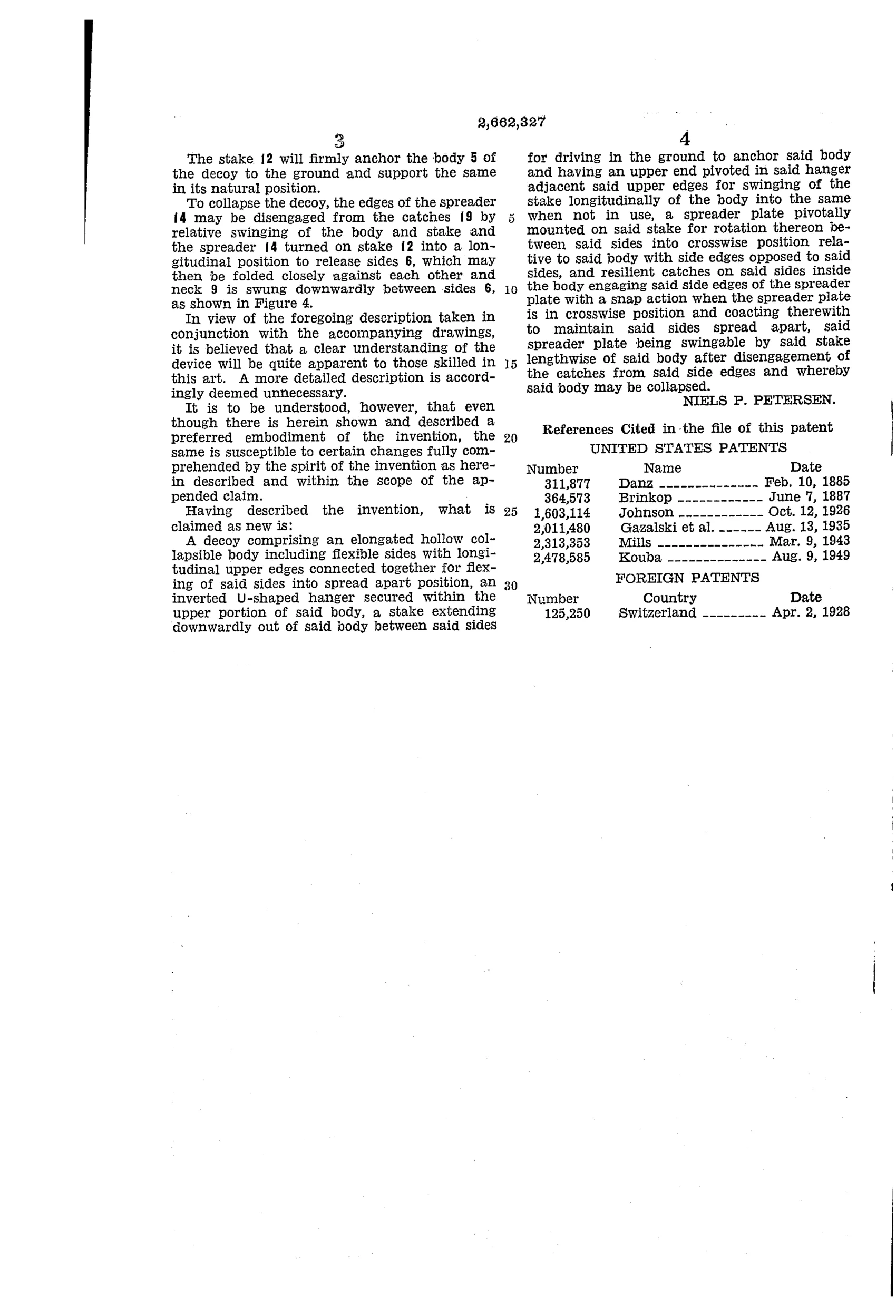
“A decoy comprising an elongated hollow collapsible body including flexible sides with longitudinal upper edges connected together for flexing of said sides into spread apart position, an inverted U-shaped hanger secured within the upper portion of said body, a stake extending downwardly out of said body between said sides for driving in the ground to anchor said body and having an upper end pivoted in said hanger adjacent said upper edges for swinging of the stake longitudinally of the body into the same when not in use, a spreader plate pivotally mounted on said stake for rotation thereon between said sides into crosswise position relative to said body with side edges opposed to said sides, and resilient catches on said sides inside the body engaging said side edges of the spreader plate with a snap action when the spreader plate is in crosswise position and coacting therewith to maintain said sides spread apart, said spreader plate being swingable by said stake lengthwise of said body after disengagement of the catches from said side edges and whereby said body may be collapsed.”
In plain English: The decoy has a flexible folding body held open by a rotating triangular spreader that snaps into internal catches on the sides, all mounted on a ground stake that also lets the whole thing fold flat for storage.
➶ In the inventor’s words
“An important object of the invention is to provide a decoy of this character constructed to provide a body having collapsible sides and providing a stake extending downwardly through the body for anchoring the decoy to the ground and also providing a spreader carried by the stake and movable into and out of position for holding the sides of the body in an open or outwardly spread-apart position.”— Niels P. Petersen, from the specification
Fate unknown
No documented production or marked example is known to me; a surviving specimen or period catalog listing would settle it.
➶ Commentary
Full disclosure up front: this is not a game call. Petersen's patent makes no sound at all — it's a stake-mounted collapsible decoy, and it lands on this site only because the Patent Office files decoys, blinds, and calls into the same broad hunting-gear class. So consider this a neighborly visit rather than a category entry.
That said, the mechanism is tidy. The body is two flexible side panels joined along the back like a tent, and the whole trick lives on the ground stake. The stake pivots in an inverted-U hanger at the spine, and carries a triangular spreader plate that rotates on it. Turn the plate crosswise and its edges snap into spring catches inside each panel — the body pops open into a rounded goose. Turn it lengthwise, the catches release, the stake folds along the body, the neck folds down on its hollow-rivet hinge (Fig. 6), and the whole bird packs flat. One part does three jobs: anchor, spreader pivot, and folding spine.
The problem field decoys were chasing in 1949 was exactly this — a hunter hauling four dozen full-body geese across a stubble field needs them to weigh nothing and stack. Silhouettes and shell decoys ultimately won that fight commercially; a snap-catch spreader is more parts than a stamped shell. But as a mechanical answer to the bulk problem, it's an honest, well-drawn one.
Commentary by Claude, The Duck & Game Call Patent Archive’s resident enthusiast