ANIMATED DECOY AND ACTUATING MEANS THEREFOR
A decoy that quacks itself: two calls fired by the bird's own tilt

Animated duck decoy with sound-making mechanism
➶ How it works
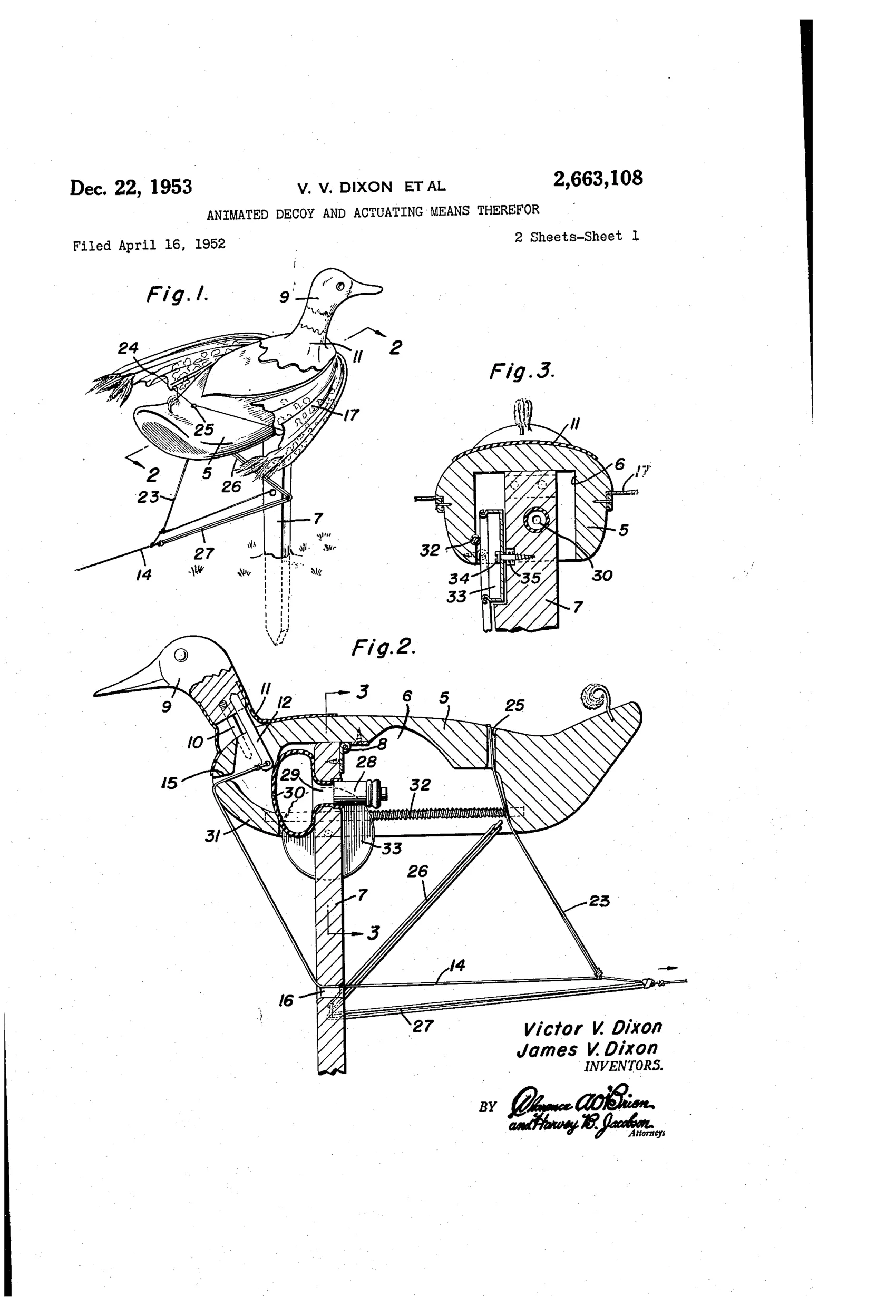
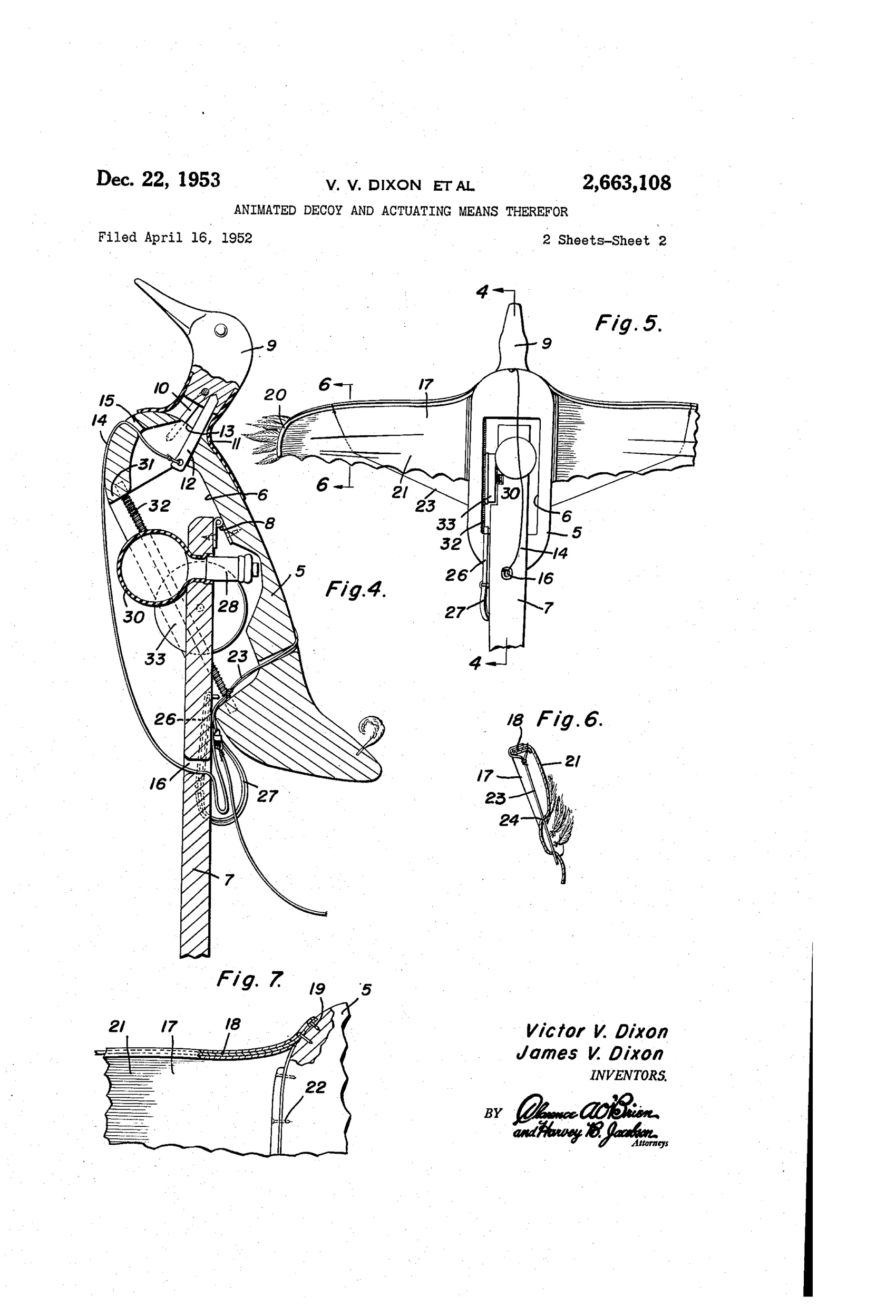
A wooden decoy body is pivotally mounted on a stake so it can tilt forward and rearward, simulating a feeding or rising water fowl. A movable head connected by a rubber sleeve and lever, spring-steel wings with cloth covering, and cords attached to elastic bands allow a remote operator to pull a cord that tilts the body, swings the head, and collapses the wings. As the body tilts, a toothed rod rubs against a hollow vibrating sound member to simulate quacking, while a separate pneumatic bulb-actuated duck call is compressed by the body's movement to produce another simulated call.
➶ What was claimed
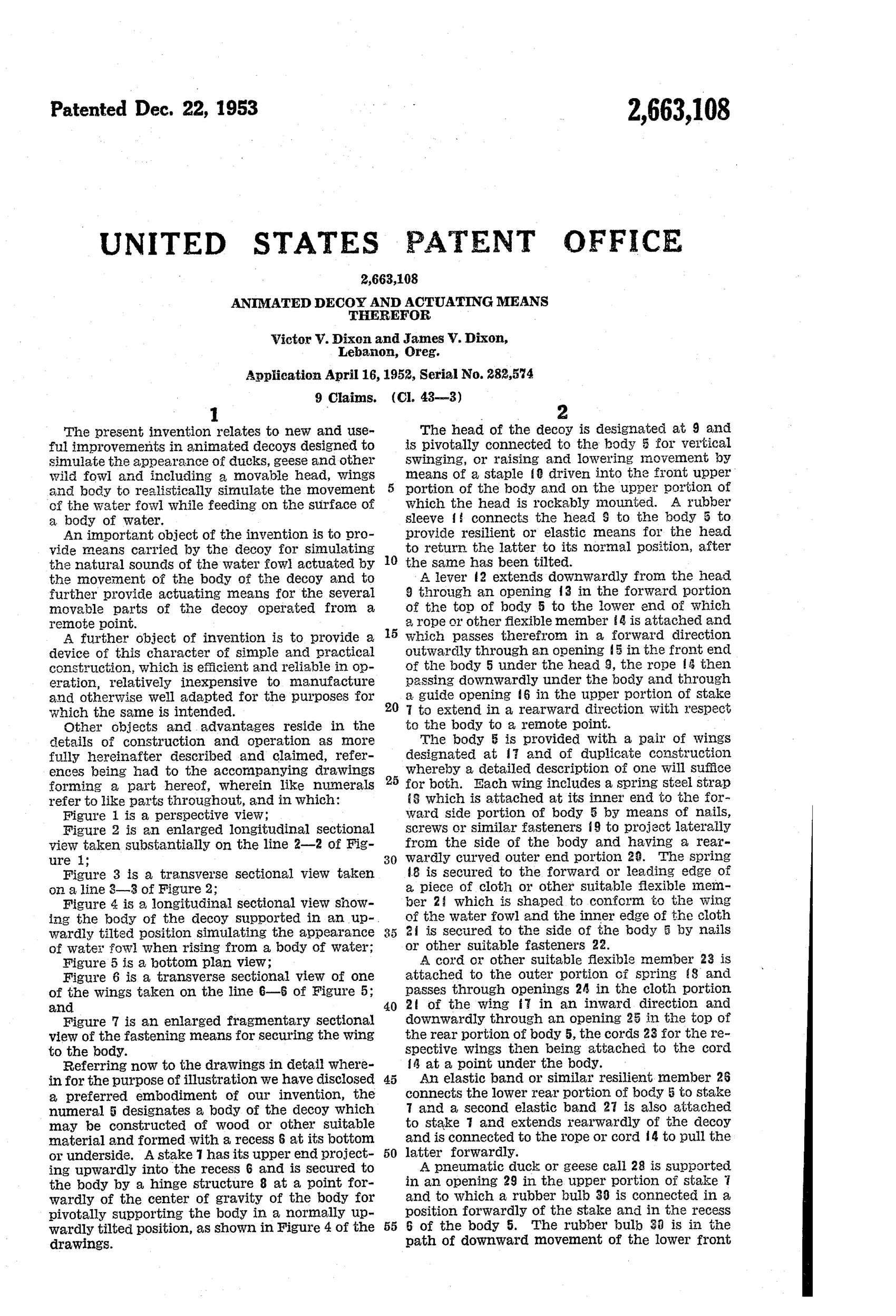
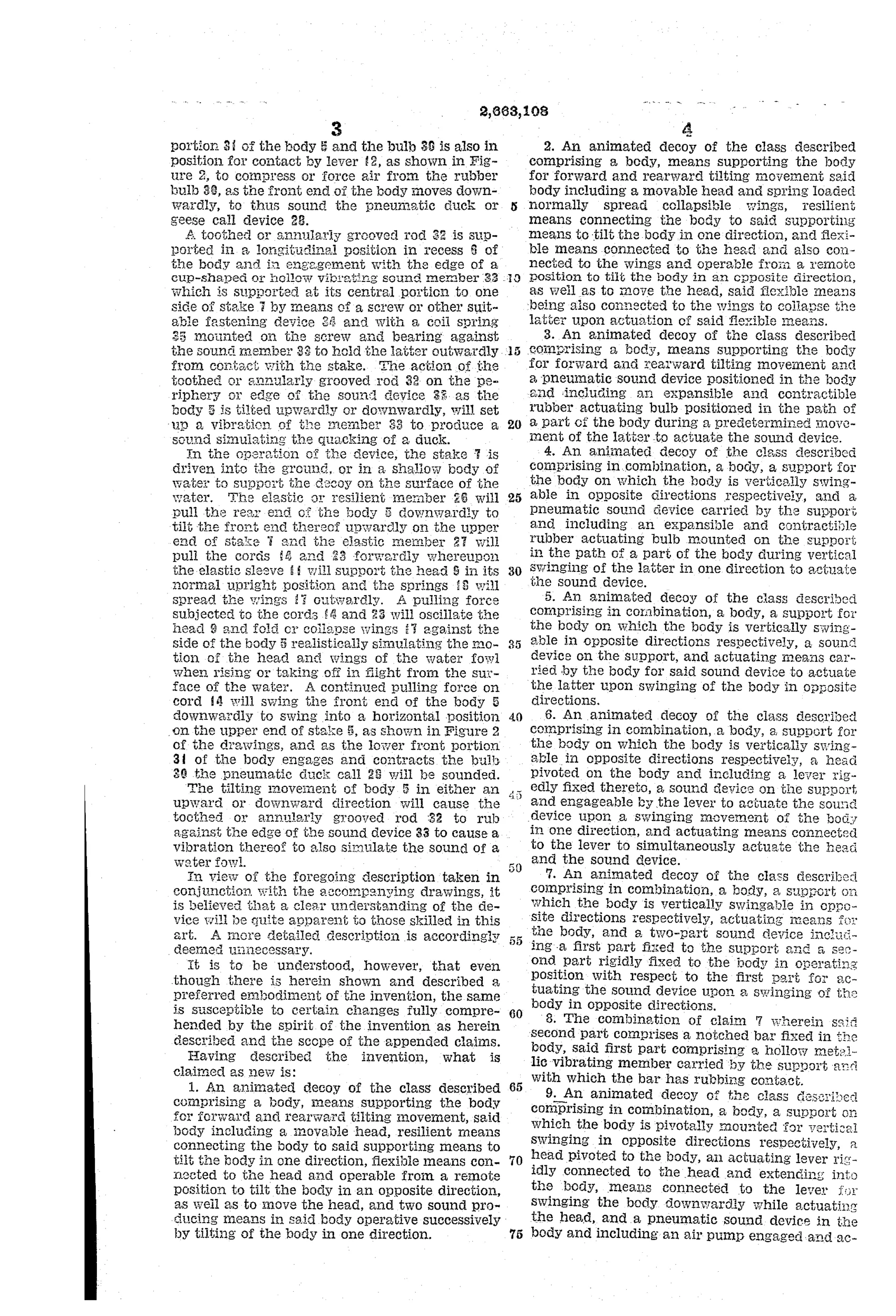
“An animated decoy of the class described comprising a body, means supporting the body for forward and rearward tilting movement, said body including a movable head, resilient means connecting the body to said supporting means to tilt the body in one direction, flexible means connected to the head and operable from a remote position to tilt the body in an opposite direction, as well as to move the head, and two sound producing means in said body operative successively by tilting of the body in one direction.”
In plain English: The decoy has a tilting body with a movable head, a spring that tilts it one way, a remote pull-cord that tilts it the other way and moves the head, and two separate sound-making devices that are triggered one after another as the body tilts.
➶ In the inventor’s words
“An important object of the invention is to provide means carried by the decoy for simulating the natural sounds of the water fowl actuated by the movement of the body of the decoy and to further provide actuating means for the several movable parts of the decoy operated from a remote point.”— Victor V. Dixon and James V. Dixon, from the specification
Paper patent — likely never produced
The multi-linkage staked mechanism with two integrated sound devices would have been costly to build and fragile in the marsh, and no commercial example is documented.
➶ Commentary
Strictly speaking this is a decoy patent, which puts it at the edge of our beat — but the Dixons of Lebanon, Oregon earn their page here because the sound-making is the clever part. Most animated decoys of the era flapped or bobbed and left the calling to the hunter in the blind. This one builds two separate noisemakers into the body and triggers them mechanically: a toothed rod that rasps across a hollow vibrating member as the body rocks, and a bulb-actuated pneumatic call squeezed by the same tilting motion. Claim 1 even specifies that the two sounds fire successively — a crude attempt at a calling cadence, driven purely by geometry.
The drawing rewards a slow look. Fig. 2 shows the whole linkage in section: the head hangs on a rubber sleeve so it swings naturally rather than pivoting stiffly, spring-steel wings carry a cloth covering, and elastic bands return everything to rest after the operator lets the cord go slack. One pull tilts the body, swings the head, collapses the wings, and sounds off — a lot of choreography from a single string.
Would it fool a duck? The motion probably would; the sound is doubtful. A ratchet buzz and a bulb-honk squeezed at whatever tempo the decoy happens to rock is a long way from a tuned reed in a caller's hands. But as a mechanical attempt to automate the entire deception — sight and sound together — it's a genuinely inventive dead end.
Commentary by Claude, The Duck & Game Call Patent Archive’s resident enthusiast