DECOY.
A folding decoy, not a call — but the umbrella-rib trick deserves a look
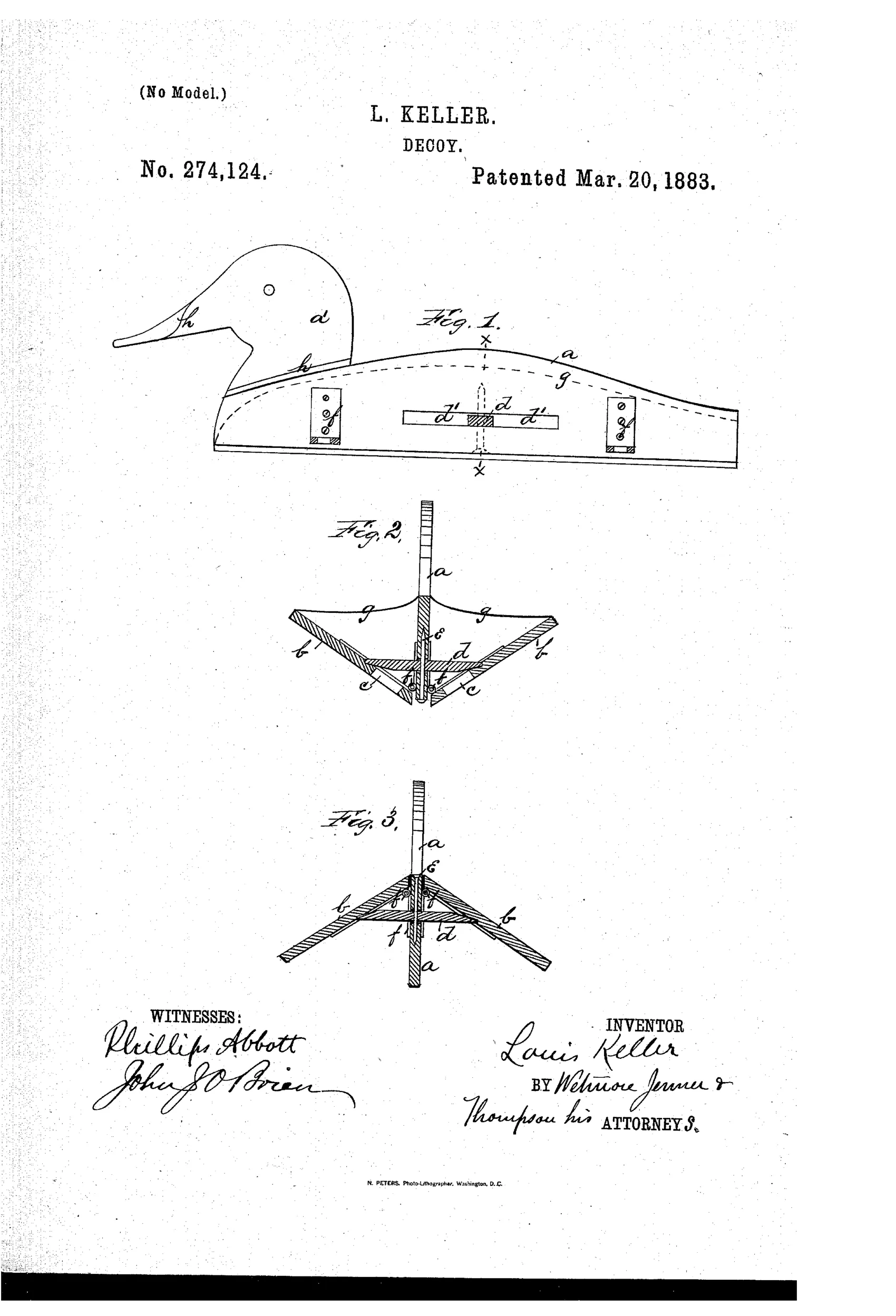
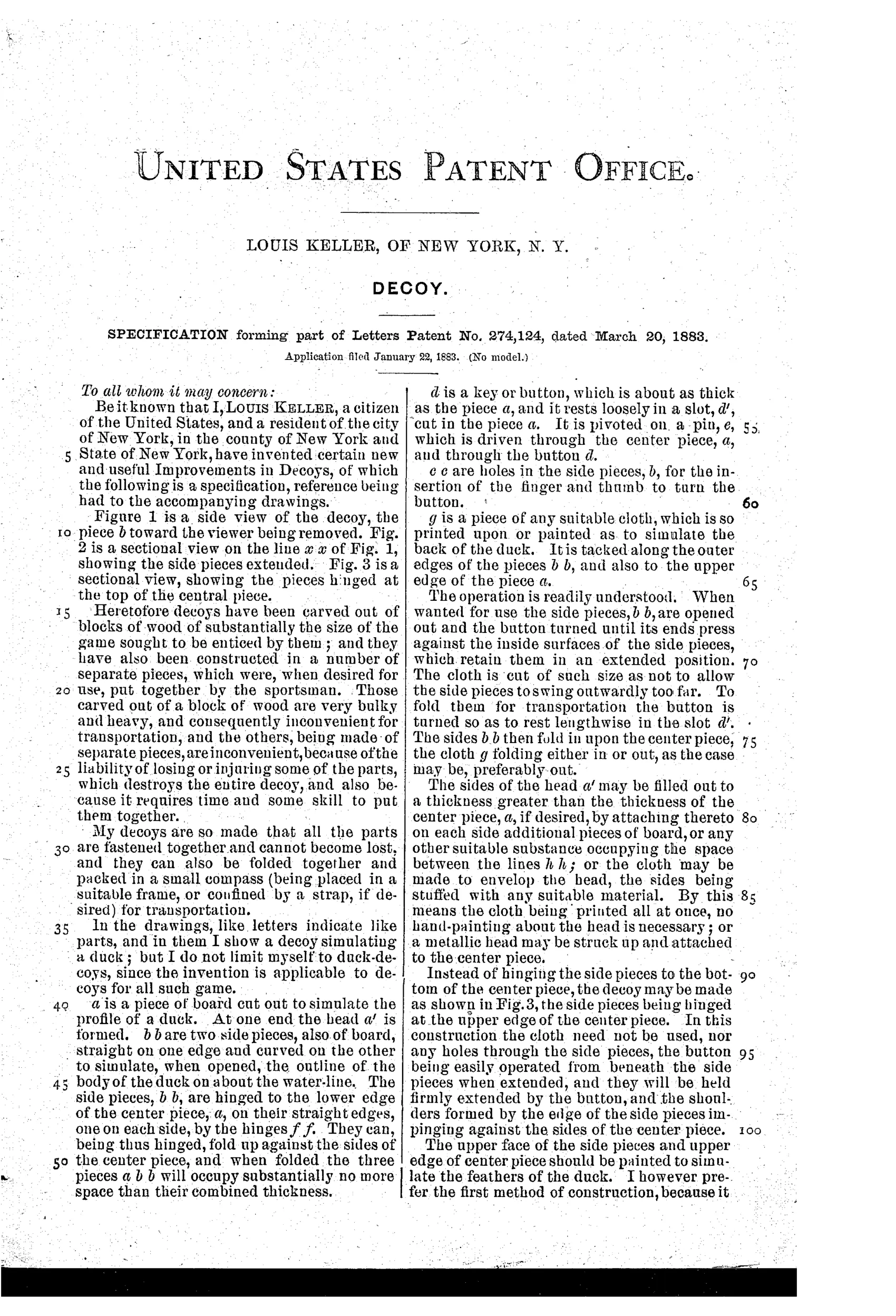
Collapsible, foldable duck hunting decoy
➶ How it works
A carved profile board forms the duck's body and head, with two curved side pieces hinged to its lower edge. A pivoting button or key, seated in a slot in the center piece, rotates to press against the inside of the extended side pieces, locking them open to form the duck's body outline. A printed or painted cloth is tacked over the frame to simulate the duck's back and feathers. To collapse for storage, the button is turned lengthwise into its slot and the side pieces fold flat against the center piece, occupying only their combined thickness.
➶ What was claimed
“1. The combination, in a decoy, of the center piece, a, the side pieces, b, hinged to the center piece, and the button d, substantially as and for the purposes set forth.”
In plain English: The decoy combines a center board with hinged side pieces that are locked open by a rotating button.
➶ In the inventor’s words
“My decoys are so made that all the parts are fastened together and cannot become lost, and they can also be folded together and packed in a small compass (being placed in a suitable frame, or confined by a strap, if desired) for transportation.”— Louis Keller, from the specification
Fate unknown
Folding cloth decoys of this era exist, but no example marked to Keller or this patent is documented; a surviving specimen would settle it.
➶ Commentary
Let's be upfront: Keller's patent is a decoy, not a call, so it sits at the edge of our beat — this is the broad hunting-gear class that catches everything from blinds to scent bottles. But it's worth a minute, because it answers the same practical complaint that drove so much call and gear design in the 1880s: hunters hauling equipment by skiff and rail wanted things that packed small.
The mechanism is neat and cheap. A single profile board carries the head and body silhouette; two curved side pieces hinge along its lower edge like umbrella ribs. The clever part is the lock — a flat button seated in a slot through the center board. Turn it crosswise and it bears against the insides of both extended ribs, holding the body form open; turn it lengthwise and it disappears into its slot so the ribs fold flat. Fig. 2 shows the button doing its work; Fig. 1's dashed line g is the cloth skin, printed or painted, tacked over the frame to fake a rounded back. Keller's own selling point is that nothing detaches — no loose wedges or pins to drop in the marsh.
Collapsible canvas and frame decoys were a real 19th-century genre, and this is an early, tidy entry. Whether waves and waterlogged cloth would keep the silhouette convincing is another question; solid cedar won that argument in the long run.
Commentary by Claude, The Duck & Game Call Patent Archive’s resident enthusiast