DECOY
An inflatable plastic-bag duck with real feathers — and no call at all
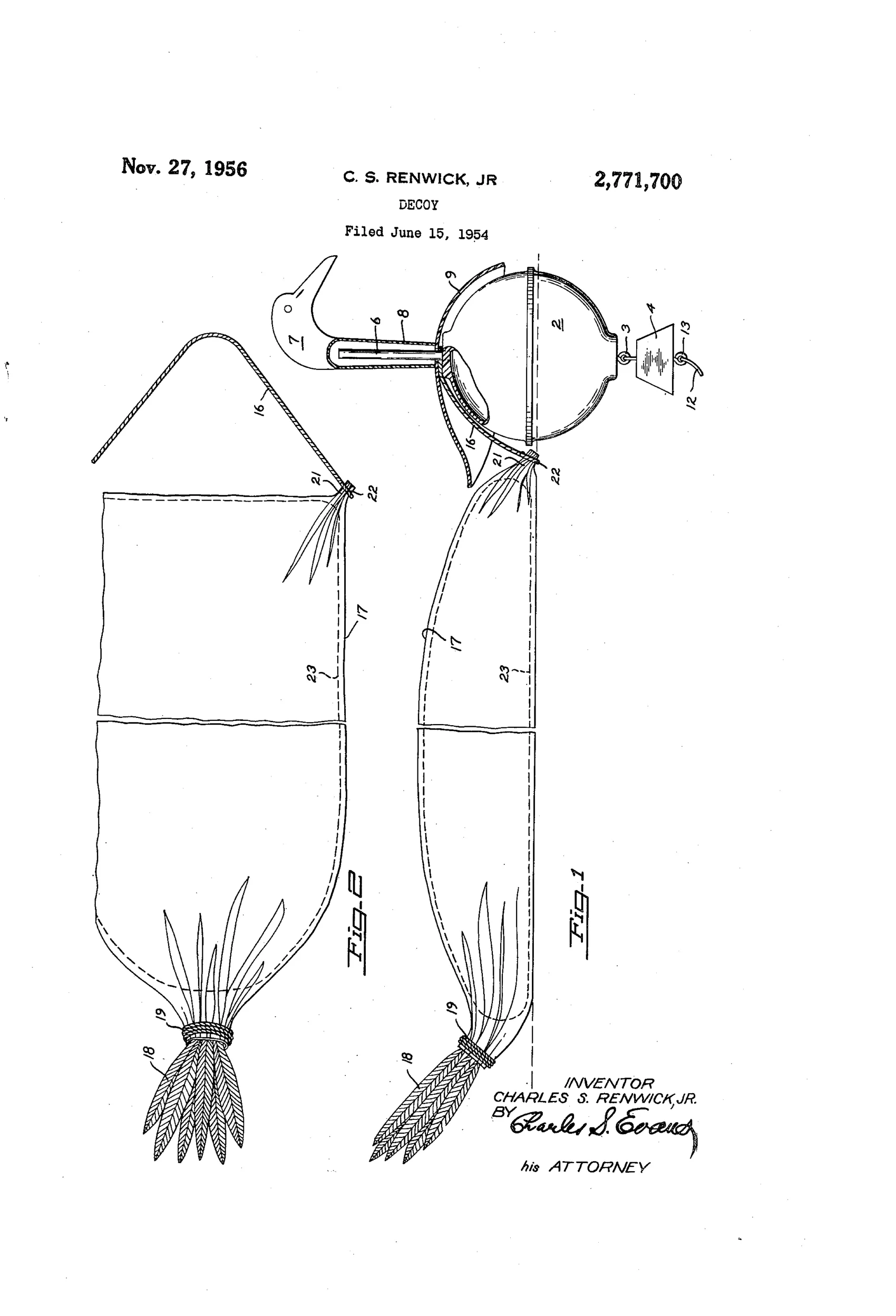
Floating waterfowl decoy with independently moving head and body
➶ How it works
A weighted, hollow head float carries a rotatable simulated head and neck on an upright stem, keeping the head partly submerged and stable. A flat inflated plastic bag forms the body float, inflated by a small paper bag placed inside before the tail feathers are tied in. A loose flexible bridle connects the head float to the body bag, allowing each part to move independently in wind and ripples. Feathers are gathered into the open end of the bag and secured with a winding to simulate a tail and seal out water.
➶ What was claimed
“A decoy comprising a head float having a generally upright stem, a weight connected to the head float to immerse its lower end well below surface ripples, a head loosely rotatable on the head float about said stem, a waterproof inflated bag constituting the body float of the decoy, and a flexible tie loosely connecting the two floats for movement of each in any direction relative to the other.”
In plain English: The decoy has a weighted head float with a loosely spinning head, connected by a flexible tie to a separate inflatable body bag so both parts bob independently.
➶ In the inventor’s words
“The loose connection between the two parts permits a wide range of independent movement of each in all directions; and this diversity of motion, the dignified slow rising and falling and occasional nodding of the head, and the more rapid fluctuations of the body with the surface ripples, seems to be the chief element in firing the bird's wish for a closer look.”— Charles S. Renwick, Jr., from the specification
Fate unknown
No documented example of this bag-and-bridle decoy is known to us; a surviving specimen or period advertisement would settle it.
➶ Commentary
Full disclosure: this one drifted into our files under harvest class A01M31, and it makes no sound whatsoever. It's a decoy, not a call — but it's such an odd duck that it earns a moment before we shoo it back to the decoy people.
Renwick's insight is that a rigid, one-piece decoy moves wrong. Real birds don't bob as a unit; the head and body ride the water differently. So he split the bird in two: a weighted spherical head float carrying a loosely rotatable head on an upright stem, tied by a slack bridle to a body that is literally an inflated flat plastic bag — puffed up, per the specification, by a small paper bag stuffed inside before real feathers are gathered and wound into the open end as a tail. His own claim language is almost poetic about the result: the 'dignified slow rising and falling and occasional nodding of the head' against the faster flutter of the body.
The drawing rewards a close look at Fig. 1 — the ballast weight hangs well below the ripple line, a genuine keel trick, while the head spins freely on its stem so wind gives it life. Whether soggy feathers and a knotted bag survive a season is another matter. Clever motion physics, fragile materials, and firmly outside the callmaker's story we chronicle here.
Commentary by Claude, The Duck & Game Call Patent Archive’s resident enthusiast