DIVING DUCK DECOYS
A dry-ice powered decoy that dives on schedule — and lands off our beat
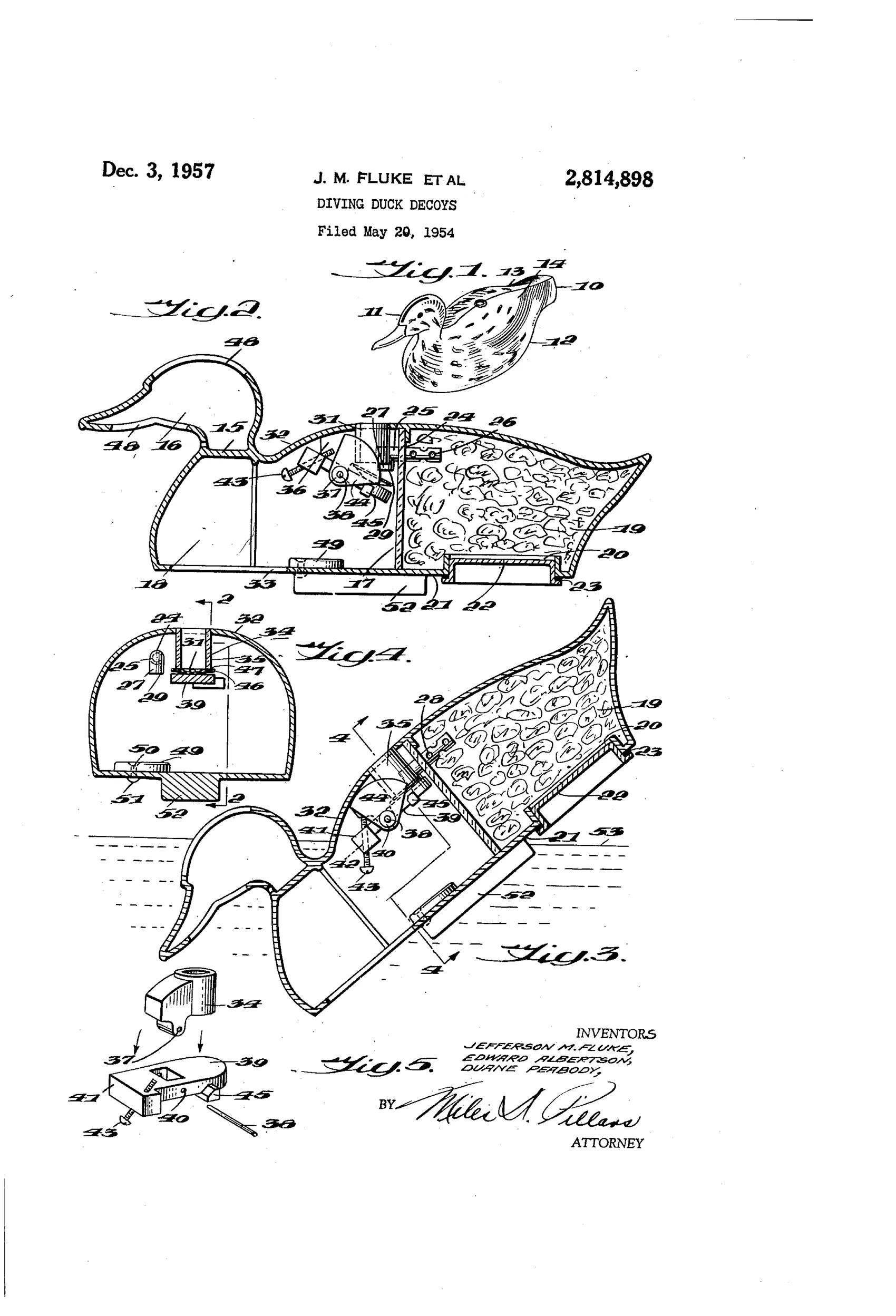
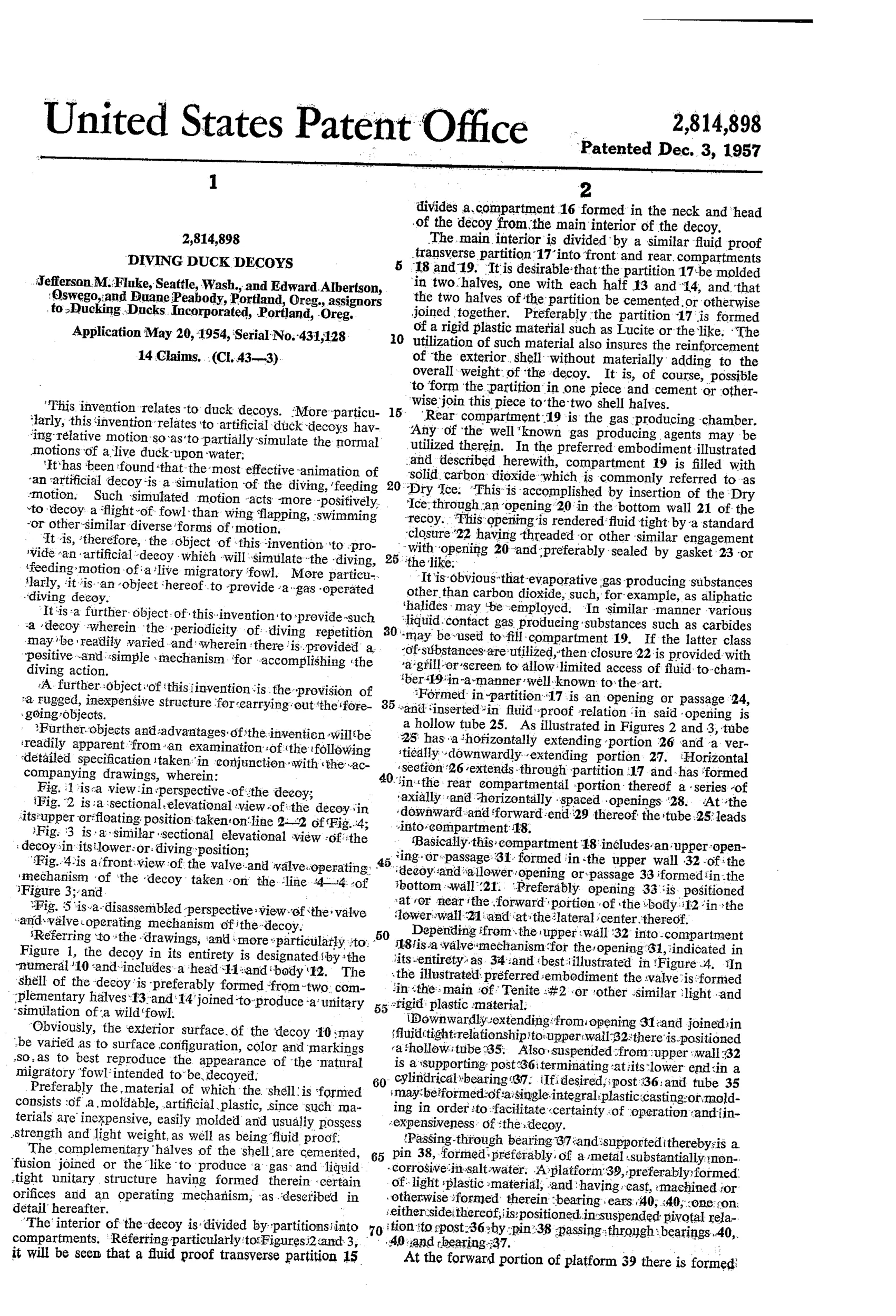
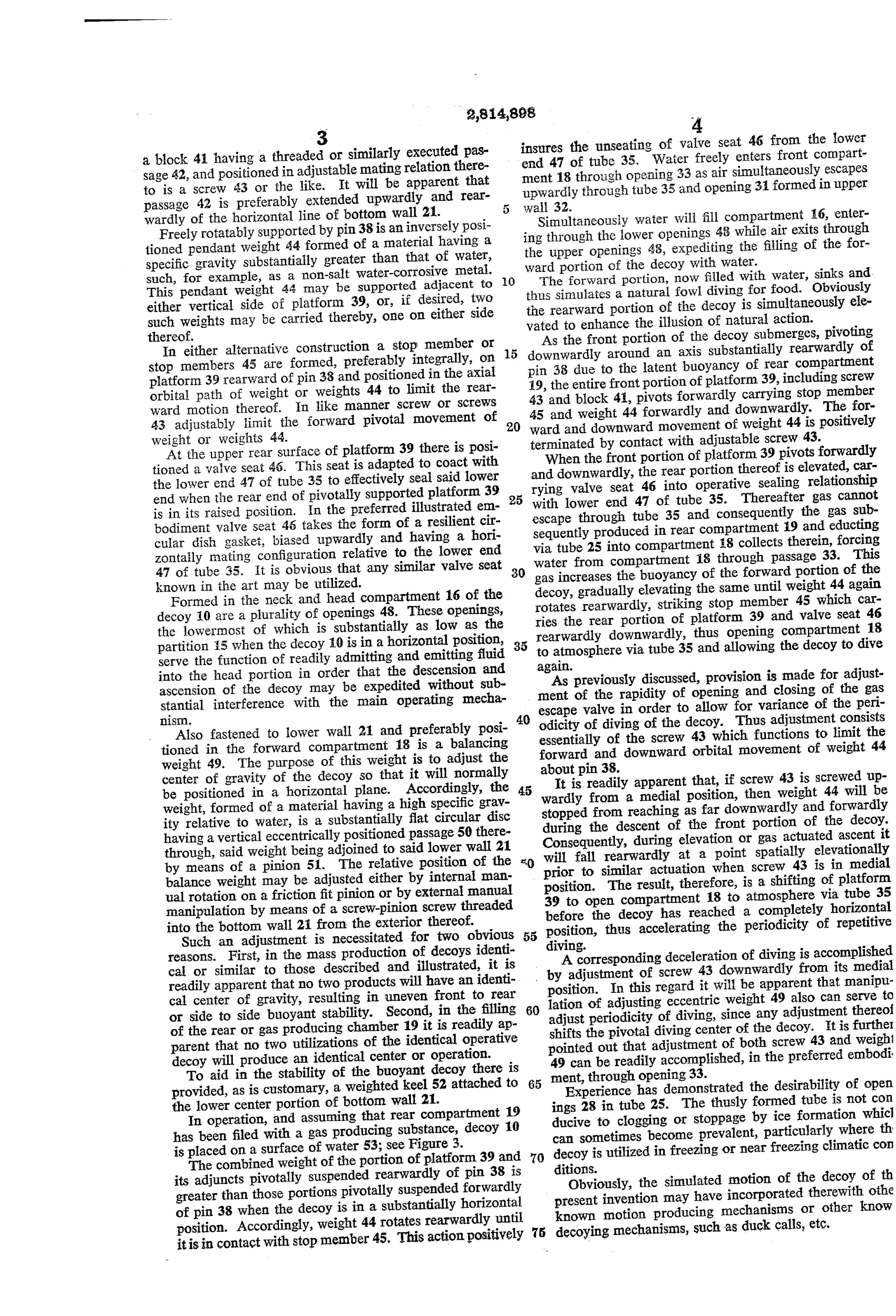
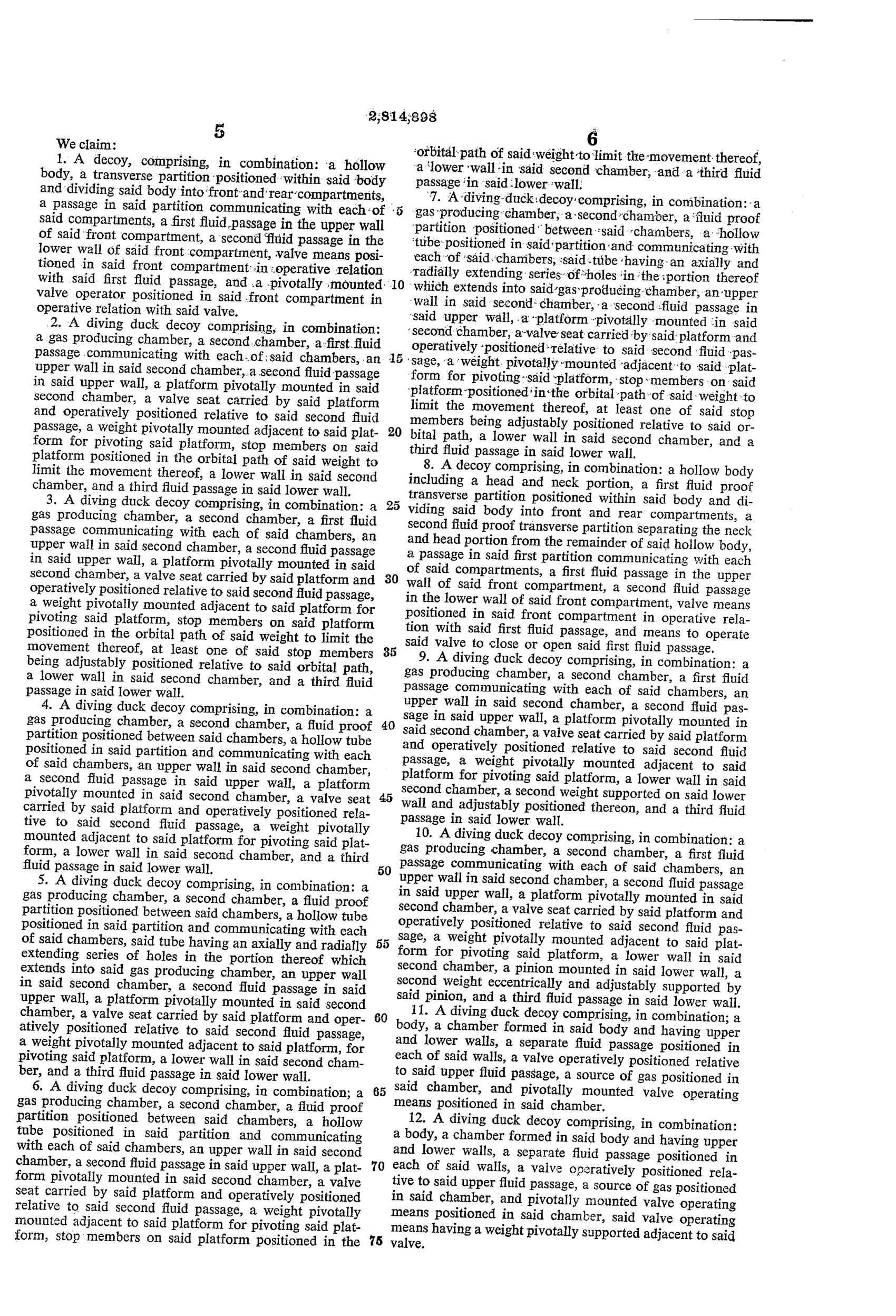
Gas-powered self-diving duck hunting decoy
➶ How it works
A gas producing chamber in the rear compartment releases gas through a tube into a front compartment, forcing water out and making the front rise, while a pivoting valve platform with an adjustable weight and stop screws periodically opens and closes a vent tube to let water back in, sinking the front. This cyclic filling and venting of the front compartment causes the decoy to alternately dive and surface, simulating a live duck's feeding dive. A separate neck/head compartment with openings allows fluid to enter and exit to expedite submersion and rise without interfering with the main mechanism. Adjustable screws and eccentric weights let the user vary the periodicity of diving.
➶ What was claimed
“A diving duck decoy comprising, in combination: a gas producing chamber, a second chamber, a fluid proof partition positioned between said chambers, a hollow tube positioned in said partition and communicating with each of said chambers, said tube having an axially and radially extending series of holes in the portion thereof which extends into said gas producing chamber, an upper wall in said second chamber, a second fluid passage in said upper wall, a platform pivotally mounted in said second chamber, a valve seat carried by said platform and operatively positioned relative to said second fluid passage, a weight pivotally mounted adjacent to said platform for pivoting said platform, stop members on said platform positioned in the orbital path of said weight to limit the movement thereof, a lower wall in said second chamber, and a third fluid passage in said lower wall.”
In plain English: The decoy has a gas chamber connected by a perforated tube to a second chamber whose water-fill valve is opened and closed by a pivoting, weighted platform that self-regulates diving cycles.
➶ In the inventor’s words
“It has been found that the most effective animation of an artificial decoy is a simulation of the diving, feeding motion.”— Jefferson M. Fluke, from the specification
Fate unknown
The corporate assignee suggests commercial intent, but no surviving Ducking Ducks decoy is documented to my knowledge; a marked specimen or period advertisement would settle it.
➶ Commentary
Full disclosure up front: this is a decoy, not a call. It makes no sound at all, and it wanders onto our pages only because it shares a patent class with the game-call world. But it's too strange to wave past without a look.
The mechanism is a genuine piece of amateur pneumatic engineering. A gas-producing chamber in the tail — practically speaking, a canister for dry ice or a similar CO2 source — bleeds gas through a perforated tube into a forward chamber. Gas pressure pushes water out and the bird's front end bobs up. Then the clever part: a pivoting platform inside carries a valve seat, and an eccentric weight swinging between stop screws tips the platform to open a vent, letting water flood back in so the head noses under. Figs. 2 and 3 show the two extremes of the cycle; Fig. 5 explodes the little valve assembly so you can see it's a self-regulating oscillator, tunable by turning screws. Even the neck has its own flooding compartment to speed the dip.
Would it work? Probably, on a calm pond, until the gas ran out or the valve stuck. That it was assigned to 'Ducking Ducks Incorporated' says someone believed in it enough to form a company. Whether any tin-and-gas duck ever actually bobbed for hunters is another question.
Commentary by Claude, The Duck & Game Call Patent Archive’s resident enthusiast