DECOY
An inflatable goose on slide-in legs — a decoy, not a call, but hear it out
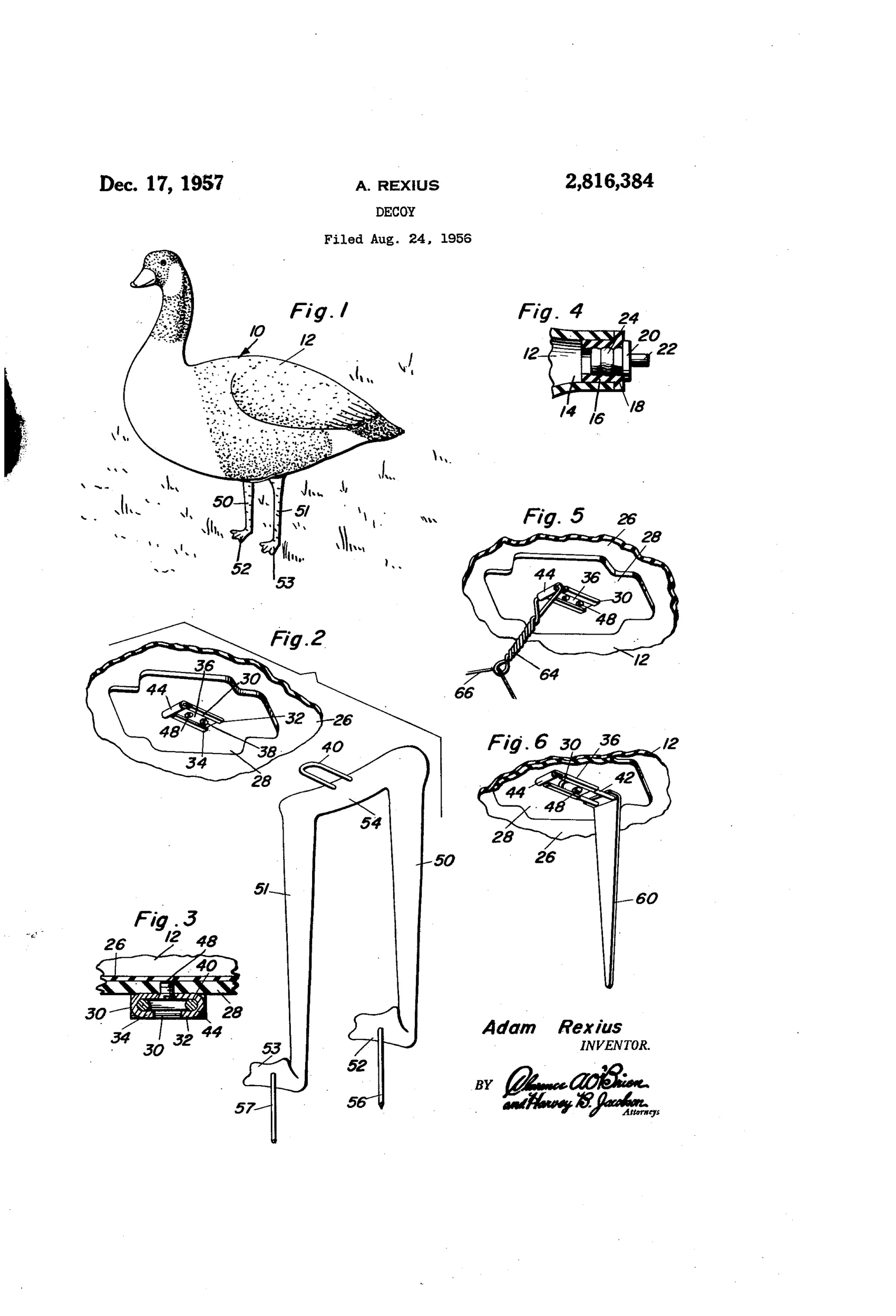
Inflatable waterfowl decoy with detachable leg supports
➶ How it works
The decoy has a hollow, inflatable rubber or plastic body with an air inlet and outlet passage sealed by a separately mounted plug fitted with a handle. A panel and plate are fixed to the bottom of the body, forming a track made of two inwardly opening rails that grip a wire tongue by frictional squeezing. Different support devices, such as a pair of legs with prongs, a single leg for a sitting posture, or a wire connector for anchoring in water, can be slid into and out of this track. A rolled scroll stop at the track's inner end limits how far the tongue can be inserted and can also retain an anchoring line.
➶ What was claimed
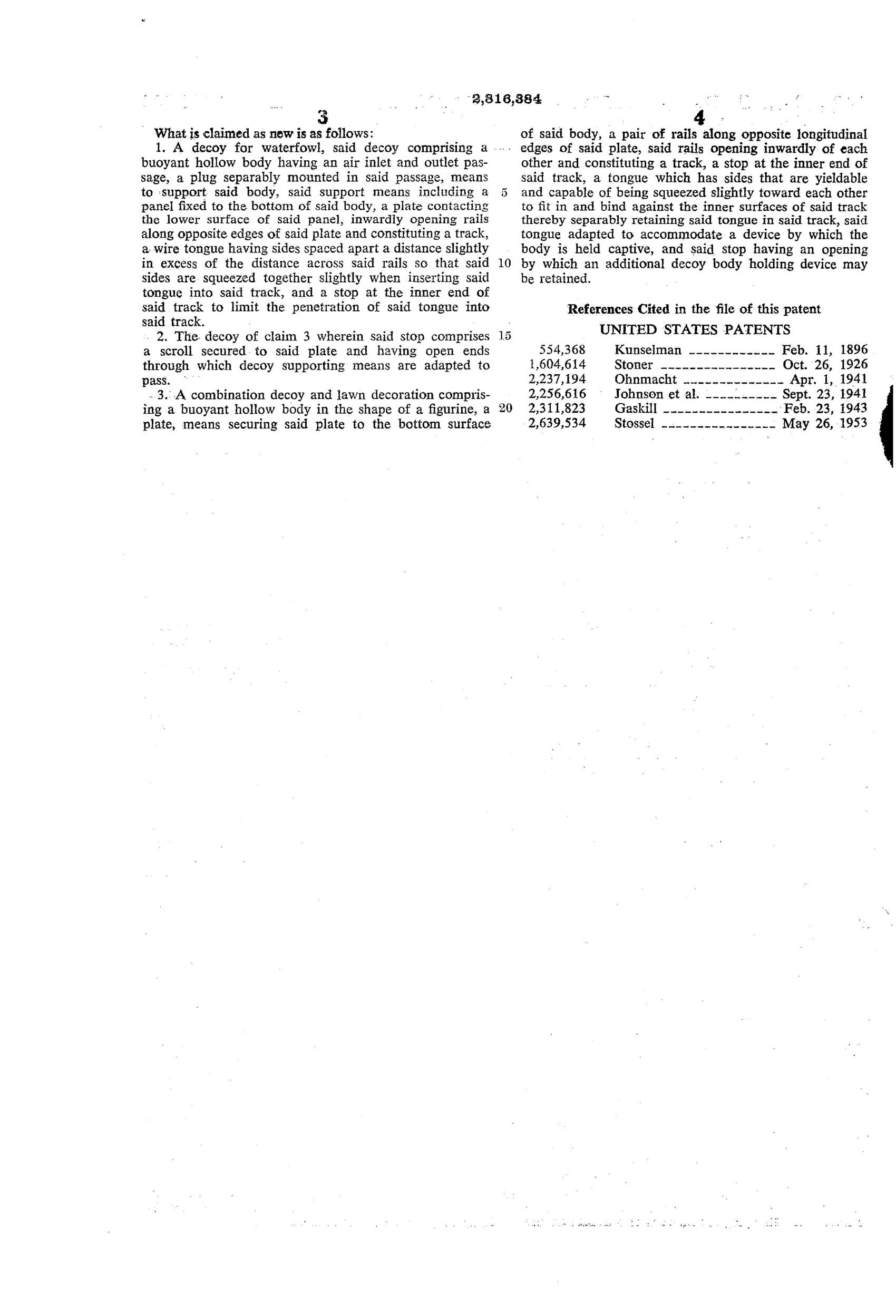
“A decoy for waterfowl, said decoy comprising a buoyant hollow body having an air inlet and outlet passage, a plug separably mounted in said passage, means to support said body, said support means including a panel fixed to the bottom of said body, a plate contacting the lower surface of said panel, inwardly opening rails along opposite edges of said plate and constituting a track, a wire tongue having sides spaced apart a distance slightly in excess of the distance across said rails so that said sides are squeezed together slightly when inserting said tongue into said track, and a stop at the inner end of said track to limit the penetration of said tongue into said track.”
In plain English: An inflatable decoy body has a bottom-mounted track that grips a springy wire tongue on its detachable leg support, with a stop limiting how far the tongue can slide in.
➶ In the inventor’s words
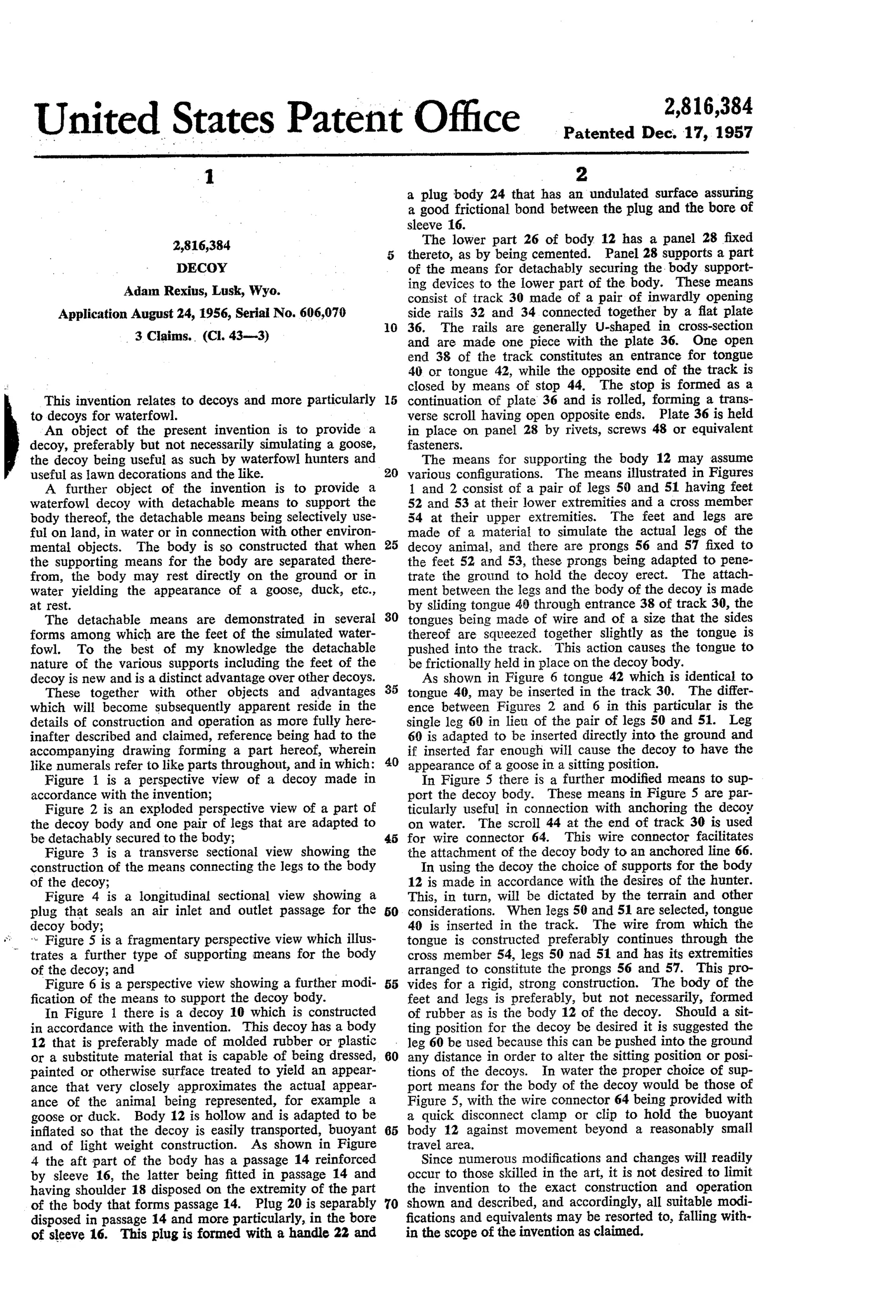
“To the best of my knowledge the detachable nature of the various supports including the feet of the decoy is new and is a distinct advantage over other decoys.”— Adam Rexius, from the specification
Fate unknown
No documented commercial version of this specific track-and-tongue inflatable is known to me; a marked example or period advertisement would settle it.
➶ Commentary
Let's be upfront: this one makes no sound at all. Rexius's patent falls in the broad hunting-gear class that gets swept in alongside our calls, and a decoy — even a goose — belongs to a different shelf of the duck-hunting story. Still, since it landed here, it deserves a fair reading, because the mechanical idea is tidier than the title suggests.
The body is a blow-up goose, which was the mid-1950s answer to a real problem: a spread of full-body field decoys is heavy and bulky, and hunters in places like Lusk, Wyoming were driving long distances to stubble fields. The clever part is on the bottom. Figures 2 and 3 show a plate with two inward-curling rails forming a track, and each support — standing legs, a single sitting stake, or a wire loop for floating — carries a springy wire tongue slightly wider than the track. Push it in, the wire squeezes, and friction holds it. The rolled scroll stop at the inner end does double duty as an anchor-line tie point, a nice economy.
Whether a rubber body could hold a rigid mounting panel through freezing mornings and repeated inflation is a fair doubt, and inflatables of that era were notorious for leaking. But the one-track, three-postures system is genuinely thoughtful hardware. For call collectors, though, this is a neighbor's patent, not one of ours.
Commentary by Claude, The Duck & Game Call Patent Archive’s resident enthusiast