DEVICE FOR SETTING UP DEAD GAME FOR DECOY PURPOSES.
Not a call at all: wire rig that props real dead ducks as decoys
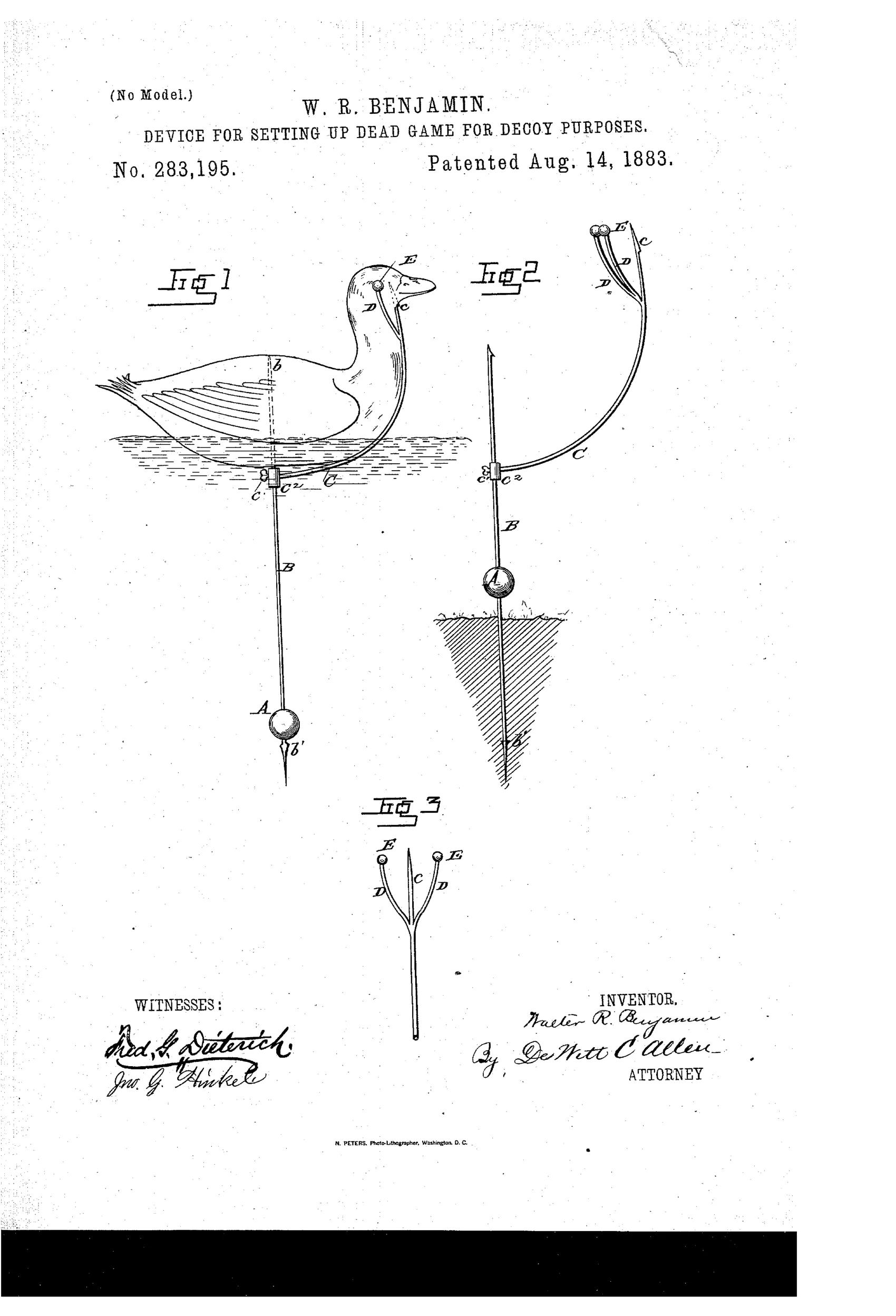

Device for mounting dead birds as decoys
➶ How it works
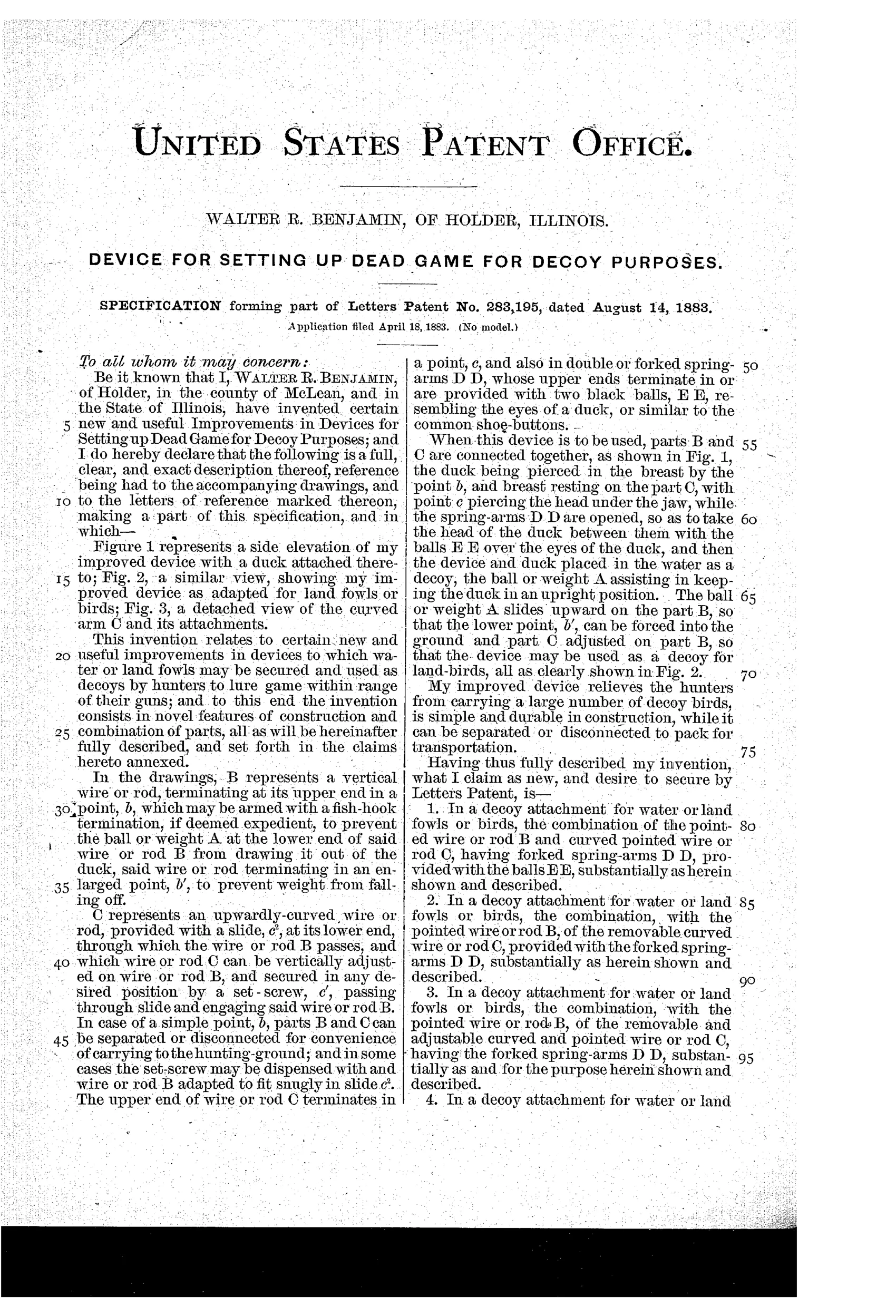
A pointed vertical wire or rod B carries a sliding weight A that can be forced into the ground or float on water to keep the mount upright. An upwardly-curved wire or rod C, adjustable and lockable on B via a slide and set-screw, pierces the dead bird's breast with a point and its head with a second point. Forked spring-arms D D branch from C and terminate in two black balls E E that resemble a duck's eyes, clamping over the bird's head to hold it in a lifelike pose. Parts B and C can be disconnected for compact transport and reassembled in the field.
➶ What was claimed
“1. In a decoy attachment for water or land fowls or birds, the combination of the pointed wire or rod B and curved pointed wire or rod C, having forked spring-arms D D, provided with the balls E E, substantially as herein shown and described.”
In plain English: The core invention is a pointed support rod combined with a curved piercing rod that has spring arms tipped with eye-like balls to hold a dead bird's head in place as a decoy.
➶ In the inventor’s words
“My improved device relieves the hunters from carrying a large number of decoy birds, is simple and durable in construction, while it can be separated or disconnected to pack for transportation.”— Walter R. Benjamin, from the specification
Fate unknown
No marked example or advertisement is documented; the design is cheap enough to have been made, but a surviving marked rig would settle it.
➶ Commentary
Full disclosure before anything else: this is decoy hardware, not a sound-making call, so it sits at the edge of our beat. But it earns a look for how bluntly it answers the market hunter's problem of hauling a boatload of wooden blocks — Benjamin's pitch is that you shoot your first bird, then put it to work luring the rest.
The mechanics are grimly practical. A pointed rod B carries a sliding ball weight, so the same rig either stakes into a mudflat (Fig. 2) or hangs ballast below a floating bird (Fig. 1). The clever bit is arm C: it pierces breast and head to fix the pose, and the forked spring arms D clamp the skull from outside, each tipped with a black ball E positioned where the eyes belong. Dead birds' eyes film over quickly, and old-timers swore ducks flare from that; Benjamin builds fake eyes into the very clamp that holds the head up. That's a real field observation baked into wirework.
Where does it sit historically? It's an ancestor of the 'confidence' and stuffed-bird rigs that market hunters actually used through the 1890s, though usually improvised rather than patented. Whether Benjamin's specific slide-and-set-screw version ever left Holder, Illinois is another matter — it's the kind of thing a blacksmith copies rather than orders.
Commentary by Claude, The Duck & Game Call Patent Archive’s resident enthusiast