TURKEY CALLER
A suction-powered turkey box: rubber diaphragm slapping a 47-degree anvil edge
Mouth-operated box-type turkey game caller
➶ How it works
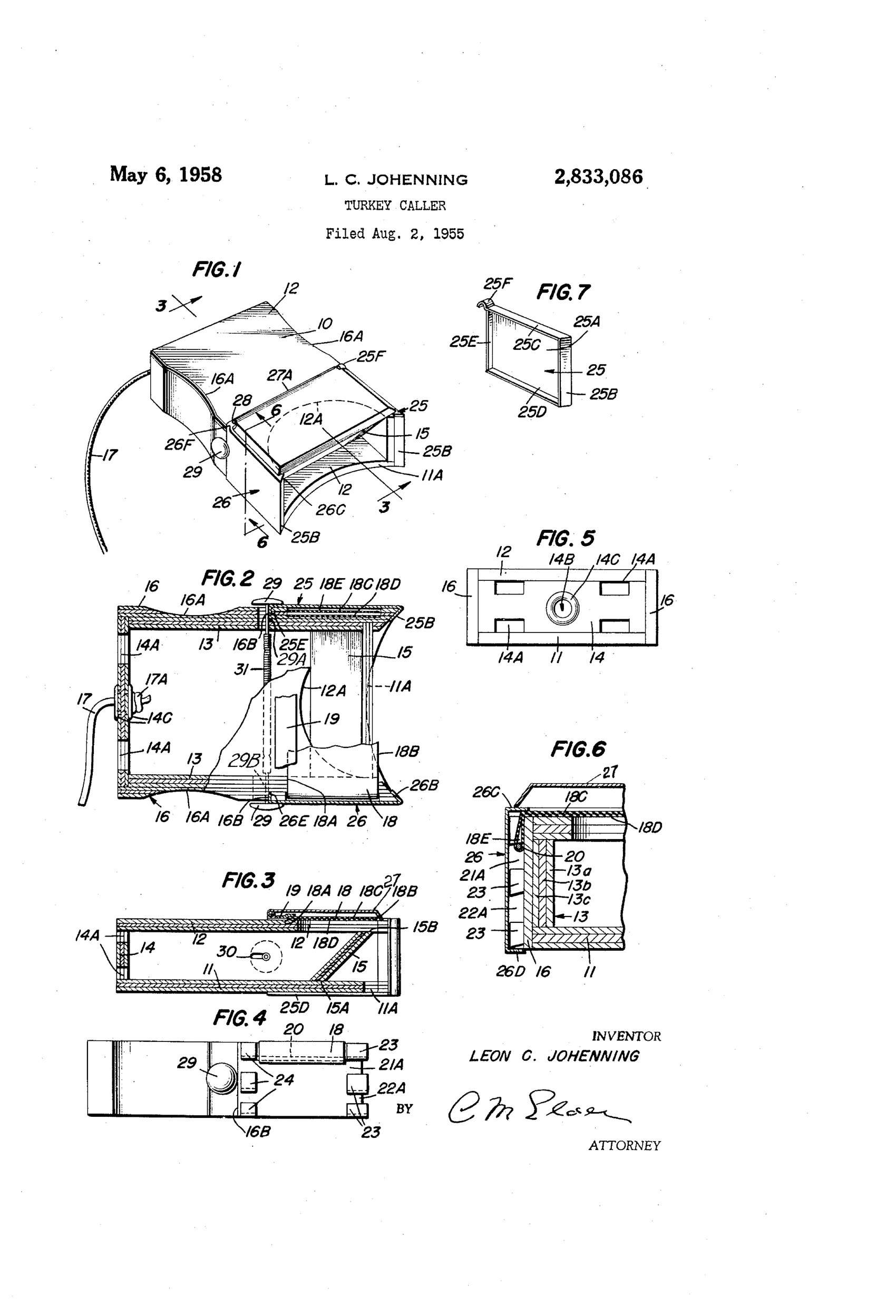
A rectangular plywood box forms a fixed sound chamber closed at one end by an acutely angled sound anvil or tongue set at about 47 degrees. A double-fold thin rubber diaphragm is stretched over a concave recess opposite the anvil's mitered edge, spaced roughly 1/16 inch away. Drawing air inward through four holes in the back plate vibrates the diaphragm against the anvil's edge to produce turkey calls, while pins in slotted grooves allow retensioning of the worn membrane. A hinged metal cover with crimped end plates and spring-loaded studs protects the diaphragm when not in use.
➶ What was claimed
“A hand-size, box-type turkey caller structure defining an oblong-shaped, fixed sound chamber and having an opening at one end thereof for the intake of energizing air upon the mouth-pull of the user; a sound anvil approximately 1 1/16 of an inch in width and extending, at a sharp angle to that face of the caller which is uppermost in use, completely across the box-like structure and downwardly towards the front or mouth end of the caller; and a flexible diaphragm extending across the mouth-adjacent end of the anvil in closely spaced relation thereto, for vibrating thereagainst and thereby producing mouth- and diaphragm-modulated calls when the user by mouth pulls air through the sound chamber, the said anvil, at the mouth end of the caller having a mitered longitudinal edge, approximately 1/8 of an inch in thickness or depth, facing said diaphragm, and along the transverse center of which exposed edge of the anvil, the related edge of the diaphragm is centered.”
In plain English: The caller is a hand-sized wooden box with a sealed air chamber, an angled hard anvil edge, and a thin rubber diaphragm positioned close to that edge so that pulling air through the box by mouth vibrates the diaphragm against the anvil to produce realistic turkey calls.
➶ In the inventor’s words
“He thoroughly scatters the flock. It is now when he uses his caller to re-assemble the flock.”— Leon C. Johenning, from the specification
Fate unknown
No documented commercial production or marked example is known to me; a surviving specimen or Virginia-area advertising would settle it.
➶ Commentary
Most box calls of the era make turkey noise by friction — a chalked paddle scraped across a lip. Johenning went a different way entirely: his box is a wind instrument played in reverse. You put your mouth to the holes in the back plate and pull air inward, drawing a thin rubber diaphragm against the mitered edge of an angled 'sound anvil' set at about 47 degrees inside the chamber. The 1/16-inch gap between membrane and edge is where the yelp lives. It is closer kin to a mouth diaphragm call than to a box call, wrapped in plywood.
The details show a man who had actually hunted with prototypes. Rubber diaphragms wear and go slack, so he ran pins in slotted grooves to let you retension the membrane in the field. He added a hinged metal cover with spring-loaded studs to keep the diaphragm from being crushed in a coat pocket, and a cord so the whole thing hangs from the neck. His specification even narrates the fall-turkey routine — scatter the flock, then call it back together — which tells you the design brief was reassembly yelps, not spring gobbler work.
Whether suction gives the operator enough dynamic control is the open question. A drawn breath is harder to modulate than a struck paddle, and rubber's pitch drifts with temperature. It's an inventive dead end more than a refinement, but an honest one.
Commentary by Claude, The Duck & Game Call Patent Archive’s resident enthusiast