SEAT FOR SPORTSMEN
Not a call at all: a canvas tree seat that moonlights as a deer drag
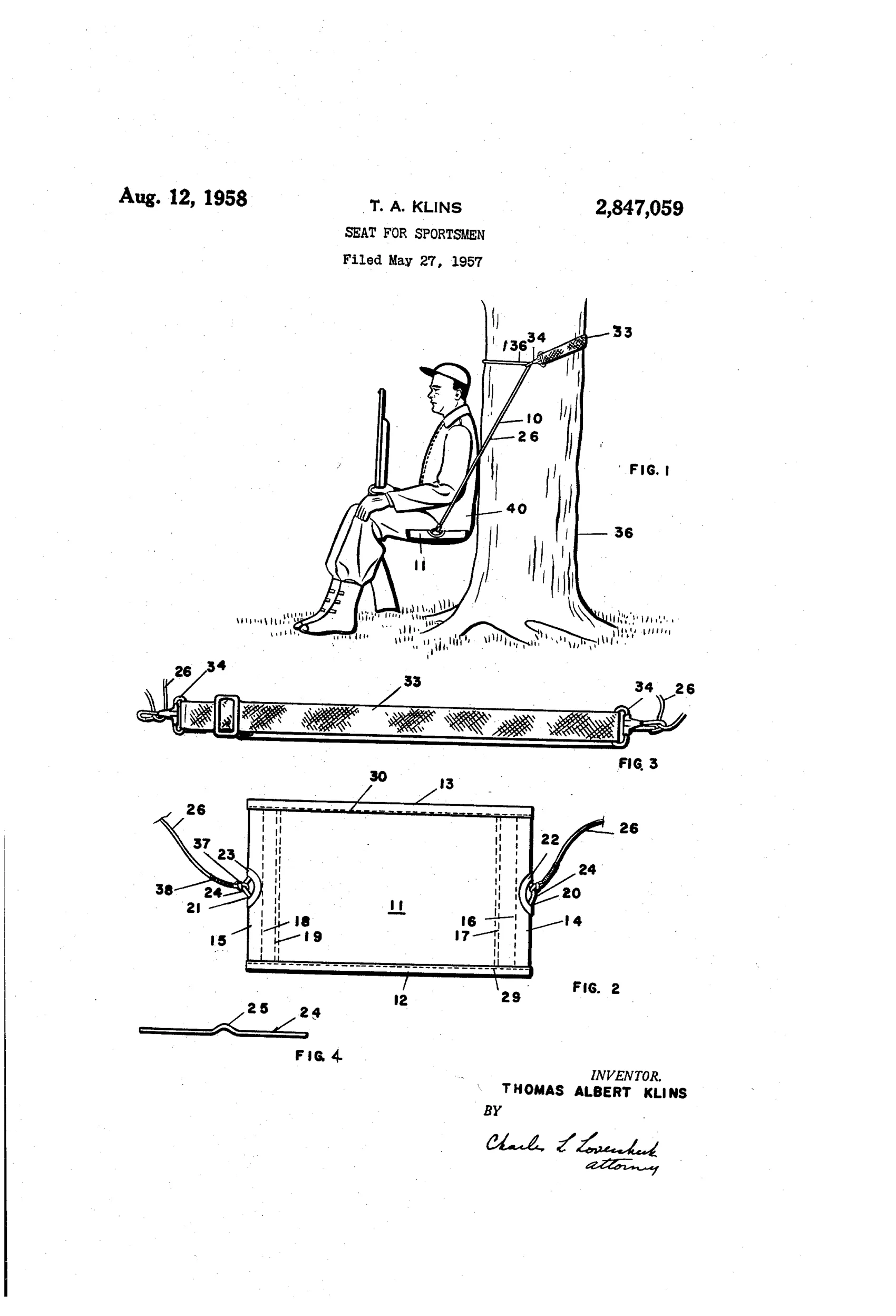
Portable tree-mounted canvas seat for hunters
➶ How it works
A rectangular sheet of flexible material has its front and back edges hemmed with a rigid rod sewn inside each hem. A cord is tied to the central portion of each rod, and the bight of the cord is placed against the front of a tree trunk. A separate sling with snap fasteners on each end loops around the far side of the tree and clips onto the cord's bight, so that a hunter sitting on the seat pulls the cord and sling taut against the trunk, using the tree as a backrest. The sling can double as a rifle sling or be looped around a deer's neck or antlers to help drag the animal through the woods.
➶ What was claimed
“A chair comprising a seat made of a rectangular sheet of flexible material having two opposite edges turned back on themselves and their turned back edges attached to said sheet to each form a hem, a rigid rod disposed in each said hem, a cord, one end of said cord being attached to the central portion of one said rod, the other end being attached to the central portion of the other said rod, the bight portion of said cord adapted to be disposed against the trunk of a tree on the side thereof adjacent said seat above said seat, and a sling, said sling adapted to be disposed around the other side of said tree trunk, the ends of said sling being attached to said cord, said seat tensioning said ends to draw said bight portion and said sling tight on said tree trunk...”
In plain English: The seat is a fabric sheet with rigid rods sewn into hems at front and back, cords from the rods loop against the front of a tree, and a sling around the back of the tree clips to those cords so the seated hunter's weight pulls everything tight against the trunk.
➶ In the inventor’s words
“It will be noted that the sling 33 is very much like a rifle sling or it could be used to loop around the neck or antlers of a deer or other heavy animal and the seat 11 could be put around the chest or midsection of the hunter so that he could conveniently drag his catch through the woods.”— Thomas Albert Klins, from the specification
Fate unknown
Simple enough to have been made cheaply, but no marked commercial example is documented; a catalog listing or surviving specimen would settle it.
➶ Commentary
Housekeeping first: this one lives in the broad hunting-gear class that gets swept in with game calls, but there's no reed, no barrel, no sound-maker anywhere in it. Klins patented a place to sit while you wait for the duck or deer to come to you. Off-topic for our shelf, but the mechanism deserves a look before we send it on its way.
The engineering is neat in the way good camp gear is neat. Two rods sewn into hems keep the fabric from bunching under you; cords from the rod centers loop against the front of the trunk, and a sling snaps around the back. The clever bit is that the whole rig is self-tensioning — your own weight is what cinches the sling tight against the bark. No screws into the tree, no straps to buckle blind. Fig. 4 shows the small refinement a casual reader misses: the rod is bent at its center to form a cleft that keeps the cord from sliding along the rod and dumping you sideways.
And Klins was thinking like a hunter, not a draftsman: the sling doubles as a rifle sling, and he suggests looping it around a deer's antlers with the seat panel as a chest harness for the drag out. It's a modest, honest piece of 1950s multipurpose gear — a distant cousin of today's lean-against tree seats — just not a call.
Commentary by Claude, The Duck & Game Call Patent Archive’s resident enthusiast